
Quick Answer
An Odoo integration consultant connects Odoo to external systems such as payment gateways, ecommerce platforms, shipping carriers, tax engines, and legacy software, using Odoo’s external API and middleware where needed.
Typical hourly rates run 40 to 150 USD depending on delivery model and complexity. Hire one when your scope involves more than one external system, custom data mapping, or two way sync rather than a single pre built connector.
Why does hiring the right Odoo integration consultant matter?
Most Odoo projects work fine until data has to move between systems. That is where connectors break, sync jobs silently fail, and finance stops trusting the numbers.
An Odoo integration consultant is the specialist who builds and maintains those connections correctly the first time. The right hire prevents duplicate orders, missed webhooks, and a support ticket queue that never empties.
This guide covers what the role does, when you need it, and what it costs. It also explains how to evaluate a candidate and what red flags to watch for.
For the full scope of connection work, see Odoo integration services. If your need is a single connection built through Odoo’s API, the Odoo API integration page covers that narrower case.
What does an Odoo integration consultant actually do?
An Odoo integration consultant designs, builds, and maintains data connections between Odoo and outside systems. The work spans requirements, architecture, development, testing, and ongoing monitoring.
This person is not the same as a general Odoo developer. Integration work demands fluency in APIs, authentication, data mapping, and failure handling that a features developer rarely needs day to day.
How is this role different from a general Odoo developer or a functional consultant?
A functional consultant designs how Odoo behaves internally and specifies what should connect to what. An integration consultant builds and hardens the actual connection between Odoo and the external system.
| Role | Main focus | Typical output |
| Functional consultant | Internal process and configuration | Requirements, gap analysis, workflow design |
| General Odoo developer | Custom modules inside Odoo | New fields, views, business logic |
| Integration consultant | Connections to outside systems | API clients, middleware, sync jobs, error handling |
Small projects often combine these into one person. Larger rollouts with several external systems usually need a dedicated integration consultant.
What systems does an Odoo integration consultant connect to?
Common connection targets include payment gateways, ecommerce platforms, shipping carriers, tax calculation services, CRM and marketing tools, and legacy ERP or accounting systems. Manufacturing environments also connect shop floor equipment and barcode scanners.
Each target has its own authentication method, rate limits, and data model. The consultant’s job is to reconcile those differences with Odoo’s own data structure.
How does the Odoo integration process work, step by step?
Odoo integrations follow a consistent sequence: requirements and mapping, architecture and method selection, build, testing, and monitoring after launch. The table below shows what each phase covers.
| Phase | What happens | Typical duration |
| Requirements and mapping | Define what data moves, in which direction, and how often | 1 to 2 weeks |
| Architecture and method selection | Choose direct API, webhook, middleware, or batch file exchange | 2 to 5 days |
| Build | Develop the connector, authentication, and error handling | 1 to 6 weeks depending on complexity |
| Testing | Validate data accuracy, edge cases, and failure recovery | 1 to 2 weeks |
| Monitoring and support | Watch logs, fix failures, adjust for API changes | Ongoing |
Simple single system integrations can be completed in two to three weeks. Multi system projects with two way sync often need two to three months.
What does requirements and data mapping involve?
Mapping defines every field that moves between systems and what happens when a value does not match. A product SKU, a customer email, or a tax code must resolve the same way in both systems or the integration produces bad data quietly.
The consultant also decides which system owns each piece of data. Ownership conflicts, such as both systems trying to update the same price, cause the most integration bugs.
How do consultants choose between API, webhook, and middleware approaches?
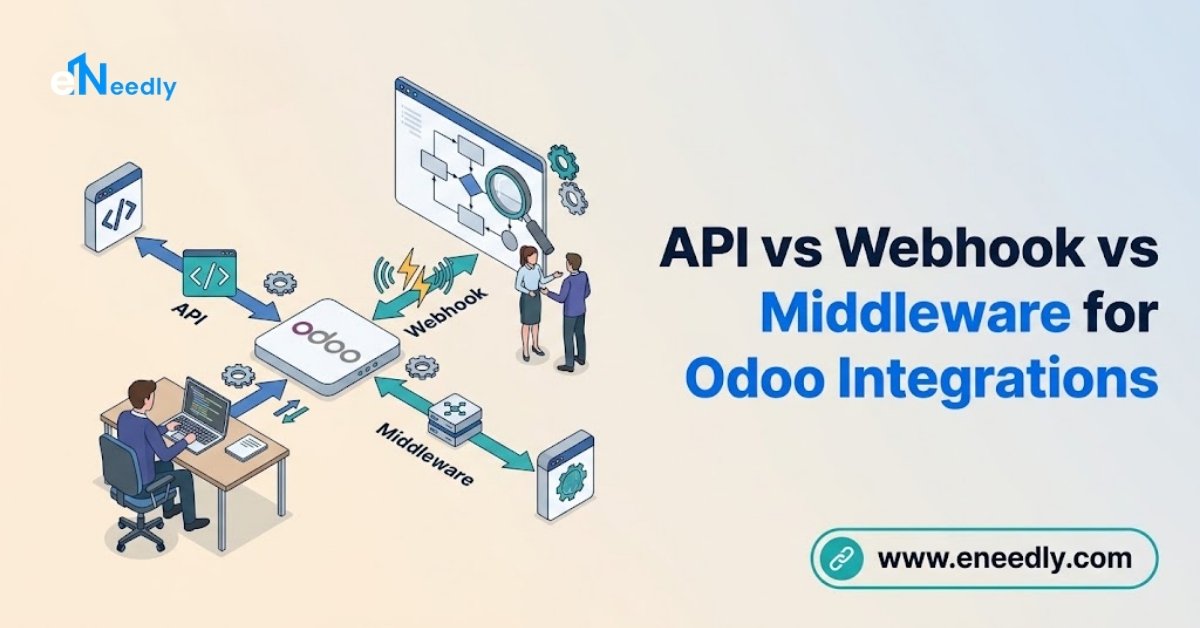
Direct API calls suit simple, low volume, one direction data flows. Webhooks suit real time events such as a new order or a payment confirmation, since the outside system pushes the update the moment it happens.
Middleware such as an integration platform or message queue suits high volume, multi system, or two way sync scenarios. It adds a layer that retries failed messages and decouples Odoo from a single point of failure.
What makes an integration build differ from other Odoo development?
Integration code has to handle failure as a normal condition, not an exception. Networks drop, external APIs change without notice, and rate limits get hit during a sale.
A well built integration retries safely, logs every transaction, and alerts someone before customers notice a problem. A poorly built one fails silently until someone reconciles the books and finds a gap.
What should testing and monitoring cover?
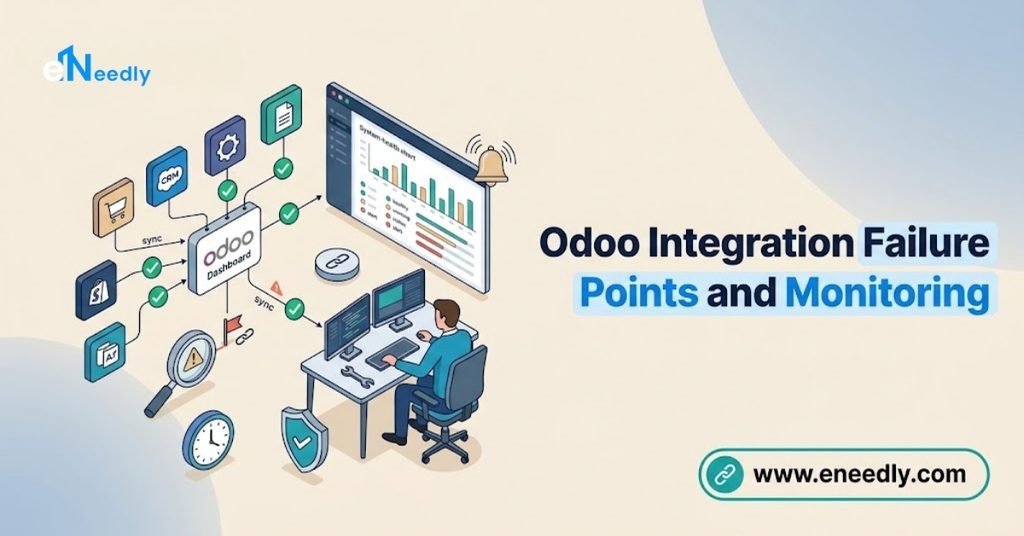
Testing should include normal transactions, duplicate submissions, missing fields, and a simulated outage of the external system. Monitoring after go live should track failed syncs, response times, and any change in the external system’s API version.
Assign a person to check the integration dashboard weekly for the first month. Most integration failures surface within that window.
When do you actually need an Odoo integration consultant?
You need a dedicated Odoo integration consultant when your project involves more than one external system, custom field mapping, two way sync, or high transaction volume. A single, well supported connector for one common platform often does not need this level of specialization.
| Situation | Complexity | Who typically handles it |
| One pre built connector, one direction, low volume | Low | General Odoo developer or the app vendor’s setup |
| Custom field mapping to one system | Medium | Odoo developer with API experience |
| Two way sync between Odoo and one system | Medium to high | Integration consultant |
| Multiple systems, shared data ownership rules | High | Integration consultant with middleware experience |
| High volume, real time requirements | High | Integration consultant, often with a middleware platform |
If your integration involves finance, inventory counts, or customer facing data, treat it as at least medium complexity regardless of volume. Errors in those areas cost more to fix than the integration itself.
What is Odoo’s API and how does it support open ERP integration?
Odoo exposes an external API, commonly accessed through XML RPC or JSON RPC, that lets outside systems read and write Odoo records. This API is the foundation for most open ERP integration work, whether the consultant writes custom code or configures a third party connector platform.
Odoo is open source at its core, which is why the term open ERP integration consultant is sometimes used interchangeably with Odoo integration consultant. The API supports standard models such as sales orders, invoices, products, and partners, and custom modules can expose additional models for integration.
What can and cannot be integrated through the standard API?
Most standard business objects, including sales orders, purchase orders, invoices, inventory moves, and contacts, are accessible through the API. Highly customized workflows or fields added through custom modules need those modules to expose the right endpoints, which the consultant plans during the build phase.
Real time performance and very high volume scenarios sometimes need direct database level work or a message queue instead of repeated API calls. An experienced consultant recommends the approach that fits your volume rather than defaulting to the simplest one.
How does authentication and security work for integrations?
Odoo API access typically uses an API key or OAuth style credentials scoped to a specific user and set of permissions. The consultant should scope that user’s access to only the models the integration needs, not full administrator rights.
Every credential should live in a secrets manager, not in code or a spreadsheet. Ask the consultant how they store and rotate credentials before the project starts.
What skills should an Odoo integration consultant have?
A strong Odoo integration consultant combines Odoo API fluency, general API and middleware experience, and disciplined error handling practice. The table below lists the core skills and a way to test each one.
| Skill | Why it matters | How to test it |
| Odoo API fluency | Odoo’s data model has specific quirks around records, relations, and states | Ask how they would sync a partial shipment back to Odoo |
| REST, SOAP, or webhook experience | Most external systems do not speak Odoo’s native protocol | Ask about a past integration with a payment gateway or carrier |
| Middleware or queue experience | High volume and multi system projects need decoupled architecture | Ask when they would introduce a queue instead of direct calls |
| Data mapping and validation | Wrong mapping causes silent data corruption | Ask how they handle a field that does not exist in both systems |
| Error handling and monitoring | Integrations fail in production regardless of build quality | Ask what alerts they set up on their last project |
| Security practice | Credentials and data in transit are common attack points | Ask how they store API keys and scope access |
Ask for a specific example of an integration that failed and how they recovered it. Consultants without a real failure story either lack experience or are not being candid.
What does it cost to hire an Odoo integration consultant?
Typical hourly rates run 40 to 150 USD depending on delivery model, and most single system projects cost 3,000 to 20,000 USD in total. The table breaks down typical ranges.
| Delivery model | Typical hourly rate (USD) | Typical fit |
| Offshore freelancer | 25 to 50 | Simple, well defined single connector |
| Offshore agency | 40 to 75 | Small to medium projects needing team coverage |
| Onshore freelancer | 75 to 130 | Projects needing close, real time collaboration |
| Onshore agency | 100 to 150 | Complex, multi system, or regulated data projects |
| Project scope | Type | Typical range (USD) |
| Single pre built connector setup | One time | 1,000 to 5,000 |
| Custom single system integration | One time | 3,000 to 20,000 |
| Multi system integration with middleware | One time | 15,000 to 60,000 or more |
| Ongoing monitoring and maintenance | Recurring | 300 to 2,000 per month |
These are typical ranges, not fixed quotes, and complexity moves them significantly. Where do buyers overspend? They overspend on custom code for a system that already has a maintained standard connector, and they underspend on monitoring, which is the line most likely to be cut and most likely to cause a costly failure later.
How do you evaluate and hire the right Odoo integration consultant?
Evaluate candidates on demonstrated integration work, not general Odoo experience. Ask for a specific past project involving the type of system you need connected, and request a short written approach for your actual scope before signing.
Which interview questions reveal real experience?
Ask which authentication method they used on their last three integrations and why. Ask how they handled a webhook that arrived twice for the same event.
Ask what monitoring they set up after going live and what it caught. A candidate who cannot describe a real failure and fix has likely not run one in production.
What should a proposal include before you sign?
A sound proposal names the exact systems, the data direction for each field, the chosen method such as API, webhook, or middleware, and the failure handling plan. It should also state who owns the integration code and documentation after delivery.
Reject proposals that say the integration will be handled as needed without naming these elements. That phrasing usually means the estimate was written before real analysis.
What red flags should end the conversation?
A fixed price offered before any requirements discussion is a red flag for integration work specifically, because scope depends heavily on data quality and edge cases discovered during mapping. So is a refusal to discuss monitoring, and a consultant who claims every integration is simple regardless of the systems involved.
eNeedly scopes integration work after a short discovery pass on your specific systems, rather than quoting blind. That discovery step is worth asking any consultant or agency about.
What are the most common mistakes when hiring for Odoo integration work?
Five mistakes account for most integration failures and cost overruns. Each is preventable with a decision made before the build starts.
Mistake 1: Choosing price over demonstrated integration experience
Buyers hire the cheapest bid without checking whether the person has built this type of connection before. General Odoo skill does not transfer automatically to integration work.
Require a specific reference project involving a similar system before comparing prices.
Mistake 2: Skipping field level data mapping
Teams agree on which systems should talk without mapping individual fields. Mismatched formats and units surface only after going live, in production data.
Require a written field mapping document as a deliverable before development starts.
Mistake 3: Ignoring failure handling until something breaks
Projects get built for the happy path only, with no plan for a dropped connection or a duplicate webhook. The first real failure then causes data corruption or lost orders.
Require a documented retry and alerting plan as part of the build, not as an afterthought.
Mistake 4: Treating go live as the finish line
Budgets stop at launch, and nobody watches the integration afterward. External APIs change without notice, and a silent failure can run for weeks before anyone notices.
Budget for ongoing monitoring or a support agreement from day one.
Mistake 5: Leaving credentials and access poorly scoped
Some builds use a full administrator account for the integration user because it is faster to set up. A compromised credential then exposes far more than the integration needed.
Scope integration users to only the models and actions the connection requires.
Who should hire a dedicated Odoo integration consultant?
This hire fits companies connecting Odoo to two or more external systems, running real time sync with a payment gateway or ecommerce platform, or replacing manual data entry between Odoo and a legacy system. It also fits businesses whose existing integration has already failed once in production.
Distributors, ecommerce sellers, and manufacturers with shop floor systems gain the most, since their data flows are the most complex and the most costly to get wrong.
Companies planning several integrations over time benefit from bringing in one consultant who understands the whole architecture rather than hiring separately for each connection.
Who should not hire a dedicated specialist? A business needing one simple, low volume, one direction connection to a well supported platform can usually rely on a general Odoo developer or the platform’s own setup guide.
Companies without a clear list of which systems need to connect should complete that scoping first, since an integration consultant cannot price undefined work.
Frequently Asked Questions
What does an Odoo integration consultant do?
An Odoo integration consultant designs, builds, and maintains connections between Odoo and external systems such as payment gateways, shipping carriers, and legacy software.
work covers requirements, data mapping, development, testing, and monitoring after launch. This differs from general Odoo development, which focuses on features inside Odoo itself.
How much does an Odoo integration consultant cost?
Typical hourly rates run 40 to 150 USD depending on delivery model and complexity. Single system projects usually cost 3,000 to 20,000 USD in total. Multi system integrations with middleware can run 15,000 to 60,000 USD or more.
What is an open ERP integration consultant?
An open ERP integration consultant refers to the same role as an Odoo integration consultant, since Odoo’s core is open source. The term is used interchangeably in job postings and search queries. The skill set and typical work are identical.
Do I need middleware for my Odoo integration?
You need middleware when you have multiple systems, high transaction volume, or two way sync with strict data ownership rules. Simple, low volume, one direction connections usually work fine with a direct API call or webhook. A consultant should recommend the simplest architecture that meets your actual volume and reliability needs.
How long does an Odoo integration project take?
A simple single system integration typically takes 2 to 3 weeks. Multi system integrations with two way sync and middleware often take 2 to 3 months. Data quality and how quickly your team can validate mapping decisions affect the timeline as much as the technical build.
Can Odoo integrate with legacy ERP or accounting systems?
Yes, through Odoo’s external API, custom scripts, or a middleware platform depending on what the legacy system supports. Older systems with limited API access sometimes require batch file exchange instead of real time sync. The consultant should confirm what the legacy system actually exposes before committing to an architecture.
What is the difference between an Odoo developer and an integration consultant?
A general Odoo developer builds custom features and modules inside Odoo. An integration consultant specializes in connecting Odoo to outside systems, with skills in APIs, authentication, and failure handling that general development does not require as often. Many projects need both roles.
How do I know if my integration project needs a specialist?
You likely need a specialist if the project involves more than one external system, two way data sync, or business critical data such as payments or inventory.
A single well supported connector for a common platform often does not require dedicated integration expertise. When in doubt, ask a candidate to assess complexity during a short scoping call.
Key Takeaways
- An Odoo integration consultant builds and maintains connections to outside systems, which is a distinct skill from general Odoo development.
- Complexity, not the number of systems alone, determines whether you need a dedicated specialist or a general developer.
- Typical rates run 40 to 150 USD per hour, and most single system projects cost 3,000 to 20,000 USD.
- Field level data mapping and documented failure handling prevent the majority of integration problems.