
Quick Answer
Odoo custom development services build custom modules, workflows, reports, and integrations using Python, XML views, and QWeb templates when standard configuration cannot meet a business requirement.
Typical custom module projects cost 5,000 to 100,000 USD depending on complexity, and most run 3 to 12 weeks. Custom development should follow a documented gap analysis, not replace configuration for requirements Odoo already supports.
Why do businesses need Odoo custom development services?
Standard Odoo covers most sales, inventory, purchasing, and accounting needs out of the box. It does not cover the specific pricing rule, industry workflow, or legacy system connection that makes your business different from a generic template.
Odoo custom development services close that gap through Python code, custom views, and integrations built specifically for your requirements. Done well, this work extends Odoo without breaking its upgrade path or its standard behavior.
This guide explains what custom development actually involves, when it is worth the cost, and what a project costs and takes to build. You will also see how to choose an Odoo erp software development company and avoid the mistakes that turn custom code into a liability.
For the full service catalog, see Odoo services. If your need is narrower, such as a targeted feature addition, the Odoo app development page covers that scope.
What is Odoo custom development and how does it differ from configuration?
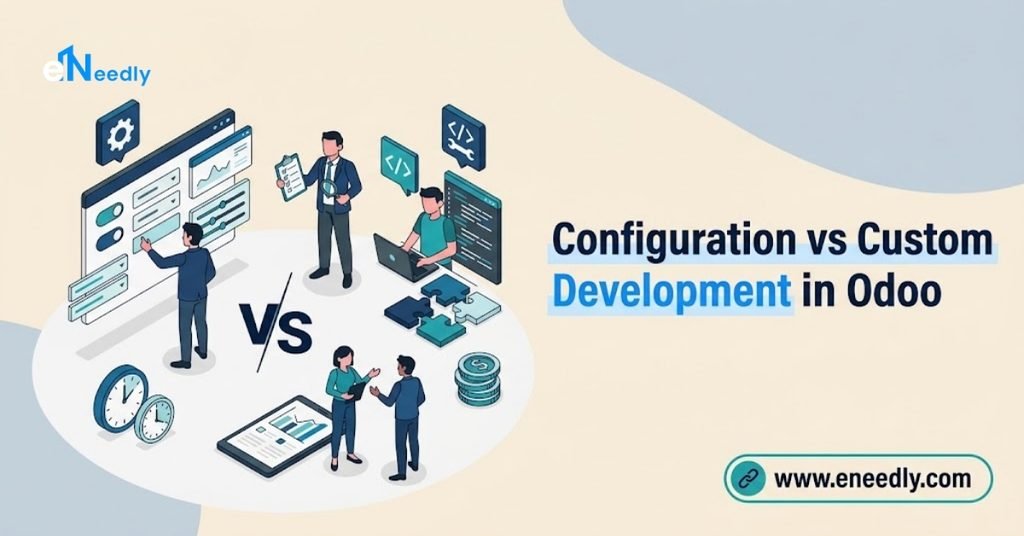
Odoo custom development is the practice of writing new code, typically in Python, XML views, and QWeb templates, to add functionality that standard configuration cannot provide. Configuration means setting up existing apps through menus, fields, and rules, with no new code written.
The distinction matters because it drives cost, risk, and upgrade complexity. Configuration survives version upgrades with minor adjustment, while custom code needs review and sometimes rework every major release.
Configuration vs custom development: what is the real line?
The table below shows how the two approaches differ across common project decisions.
| Factor | Configuration | Custom development |
| Tools used | Settings, Studio, standard fields | Python, XML views, QWeb, new modules |
| Cost | Low, included in setup or consulting | Higher, scoped per feature |
| Upgrade risk | Low | Moderate to high, needs review each version |
| Skill required | Functional consultant | Odoo developer |
| Example | New tax rule, custom report field via Studio | New pricing engine, custom approval workflow, third party integration |
Odoo Studio, available in Enterprise, sits between the two. It lets a functional consultant add fields, views, and simple automations without a developer, but it cannot handle complex business logic.
When does a requirement actually need custom development?
A requirement needs custom development when it involves logic Odoo does not support natively, a workflow with several conditional branches, or a connection to a system with no existing connector. Treat every other requirement as a configuration or Studio task first.
The decision should come from a documented gap analysis, not from habit. A requirement labeled custom without that analysis is often a configuration task in disguise.
What can Odoo custom development actually build?
Odoo custom development covers new modules, workflow automation, custom reports, and third party integrations, each requiring a different mix of skills. The table below maps common project types to the technology involved.
| Development type | What it produces | Core technology |
| Custom module | New business object, new app, or extension of an existing one | Python, XML views, ORM |
| Workflow automation | Approval chains, conditional actions, scheduled jobs | Python, Odoo automation rules |
| Custom reports | PDF invoices, dashboards, printed documents | QWeb, XML |
| Portal and website features | Customer self service pages, custom forms | Python, QWeb, JavaScript |
| Third party integration | Connections to payment, shipping, tax, or legacy systems | Python, REST or XML RPC APIs |
| Mobile or barcode extensions | Custom scanning flows, field operations | Python, Odoo mobile framework |
Custom module development is the most common request and the widest in scope, ranging from a single new field’s business logic to an entirely new app built on Odoo’s framework. Integrations are covered in more depth on the Odoo integration services page.
What does a custom module actually contain?
A custom module is a self contained package with Python models that define data structure and logic, XML files that define views and menus, and security rules that control access. Odoo’s module system loads these alongside standard apps without modifying Odoo’s core code.
This structure is why well built custom modules survive upgrades better than direct changes to Odoo’s source. A developer who edits core files instead of building a proper module creates a maintenance problem that compounds with every release.
What role does QWeb play?
QWeb is Odoo’s templating engine, used for PDF reports, invoices, portal pages, and website content. Custom development often includes QWeb templates when a business needs a document layout or customer facing page that standard templates do not provide.
QWeb templates are also where many businesses request their first custom work, since a branded invoice or a specific report layout is a common early need. This work is lower risk than business logic changes, since it primarily affects presentation, not data.
How does an Odoo custom development project run, phase by phase?
A custom development project moves through five phases: requirements and specification, technical design, build, testing, and deployment with support. The table shows what each phase includes and typical duration for a mid complexity module.
| Phase | What is included | Typical duration |
| Requirements and specification | Detailed functional spec, acceptance criteria, edge cases | 1 to 2 weeks |
| Technical design | Data model design, module architecture, integration points | 3 to 5 days |
| Build | Python and XML development, QWeb templates if needed | 2 to 8 weeks |
| Testing | Unit tests, functional testing, user acceptance testing | 1 to 2 weeks |
| Deployment and support | Staging deployment, production release, post launch fixes | 1 to 2 weeks |
Small modules can complete in three to four weeks total. Complex modules with several integrations or a new app structure often run two to four months.
What should a functional specification include?
A functional specification describes exactly what the feature does, who uses it, and what happens in every edge case, written so a developer needs no further interpretation. It should include field definitions, workflow states, permission rules, and acceptance criteria that testing will check against.
Skipping this step is the single biggest cause of scope disputes in custom development. A specification the client approves in writing protects both sides when a feature is judged incomplete later.
What happens during technical design?
Technical design decides the data model, how the new module relates to existing Odoo objects, and where the logic will live. The developer also identifies any performance risk, such as a calculation that runs across a large dataset.
This phase produces a design document the client can review before code is written. Catching a structural problem here costs hours, catching it after the build costs weeks.
How should testing work for custom modules?
Testing should include automated unit tests for the core logic, functional testing against the specification, and user acceptance testing with real business scenarios. Odoo’s testing framework supports automated tests, and a developer who skips them is trading short term speed for long term fragility.
Require a test report showing what was tested and what passed before accepting delivery. A module with no test coverage is a liability the moment the next version upgrade runs.
What belongs in deployment and post launch support?
Deployment should move through a staging environment before production, with a rollback plan if something breaks. Post launch support covers the first weeks of real use, when edge cases the specification missed usually surface.
Budget for at least two to four weeks of support after going live. A developer who disappears at deployment leaves you to debug production issues alone.
When is Odoo custom development worth the investment?
Odoo custom development is worth it when a requirement is core to how your business makes money, cannot be met through configuration or Studio, and will be used often enough to justify the build and maintenance cost. It is not worth it when it only recreates how your old system looked or handles a rare edge case better served by a manual workaround.
What makes a good custom development candidate?
A good candidate directly supports revenue, compliance, or a process your competitors cannot easily copy. Industry specific workflows, unique pricing logic, and proprietary calculations are common examples that justify the investment.
What makes a poor custom development candidate?
A poor candidate exists mainly because a user is used to seeing something a certain way. Cosmetic requests, rarely used edge cases, and features that duplicate a standard Odoo capability with minor variation rarely earn back their cost.
How do you keep custom development affordable over time?
Start every project with the standard workflow and change your process where standard Odoo is good enough. Reserve custom code for the two or three areas that genuinely differentiate your business, and review any Studio or configuration alternative before approving a custom build.
Require documentation, automated tests, and full code ownership transfer with every module. A developer who resists those terms is protecting their own position, not yours.
How much do Odoo custom development services cost?
Typical custom module projects cost 5,000 to 100,000 USD depending on complexity, and hourly rates for Odoo developers run 25 to 150 USD depending on delivery model. The table breaks down typical costs by project type.
| Project type | Typical range (USD) | Typical duration |
| Small module, single feature | 5,000 to 15,000 | 3 to 4 weeks |
| Medium module, multiple related features | 15,000 to 40,000 | 6 to 10 weeks |
| Large module or new app, complex logic | 40,000 to 100,000 or more | 3 to 6 months |
| Custom QWeb report or document | 1,000 to 5,000 | 1 to 2 weeks |
| Custom integration, single system | 5,000 to 20,000 | 3 to 6 weeks |
| Delivery model | Typical hourly rate (USD) |
| Offshore freelancer | 25 to 50 |
| Offshore agency | 40 to 75 |
| Onshore freelancer | 75 to 130 |
| Onshore agency | 100 to 150 |
These are typical ranges, not fixed quotes, and actual pricing depends on data complexity, integration count, and how well the specification is defined before the build starts. Where do buyers overspend? They overspend on custom code that reproduces old habits, and they underspend on testing and documentation, which raises maintenance cost for years after launch.
Odoo Community vs Enterprise: what changes for custom development?
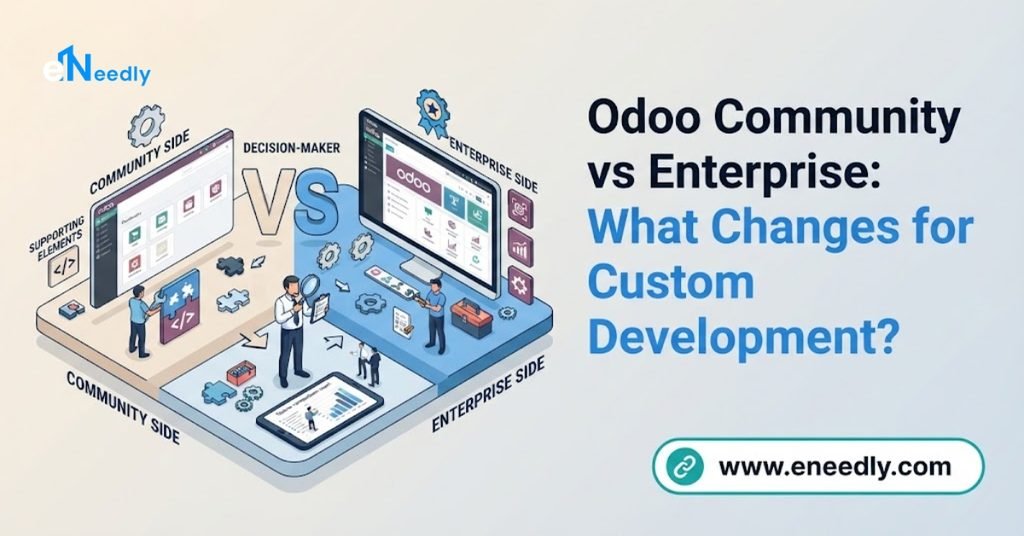
Odoo Community and Odoo Enterprise both support custom Python development, but Enterprise includes Studio, more advanced base apps, and official support that changes what custom developers need to build from scratch. The table shows the practical differences.
| Factor | Odoo Community | Odoo Enterprise |
| Custom Python modules | Fully supported | Fully supported |
| Studio for no code additions | Not available | Available |
| Advanced accounting, quality, and other Enterprise apps | Must be custom built if needed | Included as standard apps |
| Official Odoo support | Not included | Included with subscription |
| License cost | Free | Per user per month |
Teams on Community often build custom modules to replace Enterprise features they need but do not want to license. Whether that trade off makes sense depends on user count and how close the custom build can get to Enterprise’s native behavior.
Where should custom development happen: Odoo.sh, on premises, or Odoo Online?
Custom Python modules cannot be deployed on Odoo Online, which limits that hosting option to configuration and Studio changes only. Odoo.sh and on premises or private cloud hosting both support full custom development.
| Hosting option | Custom code support | Best fit |
| Odoo Online | No custom Python modules | Standard apps and Studio only |
| Odoo.sh | Yes, deployed through Git | Mid market companies with ongoing custom development |
| On premises or private cloud | Yes, full control | Regulated environments or heavy infrastructure requirements |
Decide the hosting model before development starts, since moving from Odoo Online to a code capable host later becomes its own migration project. Odoo.sh also provides staging branches, which support the testing and deployment phases described earlier.
How do you choose an Odoo development company?
Choose an Odoo development company by checking code samples, references in your industry, development practices, and how the team handles version upgrades. Run the same evaluation on every candidate so the comparison is fair.
What should you check before hiring an Odoo erp software development company?
Ask for a code sample or a description of a past module’s architecture. Ask whether they write automated tests, how they document modules, and who owns the code after delivery.
Ask for two references from projects similar in complexity to yours. A confident Odoo development company answers with specifics rather than general assurances.
What separates the best Odoo development company from an average one?
The best firms treat custom code as a long term asset, with documentation, tests, and a clear upgrade strategy built in from day one. Average firms optimize for delivery speed and leave maintenance cost for the client to discover later.
Ask directly how they approach the next major Odoo version upgrade for code they write today. The answer reveals whether they think past the current release.
Does location matter: Odoo development company USA vs offshore options?
An Odoo development company USA offers closer time zone overlap and often deeper familiarity with US specific requirements such as sales tax and payroll integrations. Offshore development companies typically offer lower rates and can deliver equally strong code when documentation and communication discipline are strong.
| Factor | US based development company | Offshore development company |
| Typical hourly rate | 100 to 150 USD | 25 to 75 USD |
| Time zone overlap | Full US business hours | Limited, needs a defined overlap window |
| US specific integration familiarity | Higher | Varies by firm |
| Best fit | Regulated, high touch, or urgent projects | Well specified projects with cost sensitivity |
Neither option guarantees quality by itself. The specification quality and the development discipline of the specific team matter more than geography.
What are the most common mistakes in Odoo custom development projects?
The six mistakes below account for most cost overruns and post launch problems. Each is preventable with a decision made before the build starts.
Mistake 1: Building custom code for requirements configuration could solve
Teams request custom development because it feels more thorough than checking configuration options first. The result is unnecessary cost and unnecessary upgrade risk.
Run every requirement through a gap analysis and confirm it cannot be met with configuration or Studio before approving custom work.
Mistake 2: Writing a specification too vague to build against
Vague requests such as make it work like our old system produce modules that satisfy the letter of the request but not the actual need. Rework then costs more than a proper specification would have.
Require a written functional specification with acceptance criteria before development starts.
Mistake 3: Skipping automated tests to save time
Untested modules pass a quick demo and then fail on an edge case in production. Every version upgrade afterward becomes a manual re-test of code nobody fully understands.
Require automated test coverage for core logic as a condition of delivery, not an optional extra.
Mistake 4: Editing Odoo’s core files instead of building proper modules
Some developers edit Odoo’s own source files directly because it is faster than building a clean module. This breaks the upgrade path and can cause silent failures on the next update.
Require all custom work to live in properly structured, separate modules that Odoo loads alongside its core.
Mistake 5: Losing code ownership and documentation
Contracts without clear ownership terms leave the client dependent on the original developer indefinitely. Losing access to that developer then means losing the ability to maintain your own system.
Require code ownership transfer and documentation as standard delivery terms in every contract.
Mistake 6: Ignoring the upgrade path when scoping new modules
Teams build for today’s version without planning for next year’s. Complex custom logic can require substantial rework when Odoo releases its next major version.
Ask the developer to document dependencies and known upgrade risks as part of the delivery package.
Who is Odoo custom development right for?
Odoo custom development suits companies whose core processes include a genuine differentiator, such as a unique pricing model, an industry specific workflow, or proprietary business logic that standard Odoo does not support. It also suits businesses that have outgrown Studio’s capabilities for a specific requirement and need real application logic.
Manufacturers, distributors, and service firms with complex billing or production rules gain the most from custom development, since their processes rarely map cleanly to generic templates. Companies planning to scale a differentiated process into a competitive advantage should also invest here, since the code becomes part of their operational moat.
Who should not invest in custom development? Businesses whose requirements are standard across their industry should configure Odoo rather than build custom code, since maintenance cost accrues whether or not the feature earns its keep. Companies without an internal budget for ongoing maintenance and future upgrades should think carefully before adding custom logic, since unmaintained modules become liabilities within a few version cycles.
Frequently Asked Questions
What are Odoo custom development services?
Odoo custom development services build new modules, workflows, reports, and integrations using Python, XML views, and QWeb templates when standard configuration cannot meet a requirement. The work includes specification, technical design, coding, testing, and deployment. It differs from configuration, which uses existing settings with no new code.
How much does Odoo custom development cost?
Typical projects cost 5,000 to 100,000 USD depending on complexity. Small single feature modules run 5,000 to 15,000 USD, while large modules or new apps can exceed 100,000 USD. Hourly rates range from 25 to 150 USD depending on delivery model.
When should I choose custom development over configuration?
Choose custom development when a requirement involves logic Odoo does not support natively and cannot be handled through Studio. A documented gap analysis should confirm this before any code is written. Most requirements are better and more cheaply solved through configuration.
Can Odoo Community handle custom development?
Yes, Community fully supports custom Python modules, but it lacks Studio and several Enterprise apps such as full Accounting. Teams often build custom modules on Community to replace Enterprise features they need without the license cost. The trade off depends on user count and how closely the custom build can match Enterprise behavior.
What is QWeb used for in Odoo development?
QWeb is Odoo’s templating engine, used to build PDF reports, invoices, and portal or website pages. Custom development commonly includes QWeb work when a business needs a branded document layout or a customer facing page beyond the standard templates. It is generally lower risk than custom business logic since it mainly affects presentation.
Does custom code survive Odoo version upgrades?
Well structured custom modules built as separate packages, not edits to Odoo’s core files, generally survive upgrades with review and adjustment. Complex business logic sometimes needs rework when Odoo changes underlying models between major versions. Ask any developer to document upgrade risk as part of delivery.
Odoo.sh or on premises for custom development?
Both support full custom Python development, unlike Odoo Online, which does not allow custom modules. Odoo.sh offers Git based deployment and staging branches, which suit teams doing ongoing development. On premises or private cloud suits regulated environments needing full infrastructure control.
How do I choose the best Odoo development company?
Check code samples, references in your industry, testing and documentation practices, and how the firm plans for future version upgrades. Ask who owns the code after delivery and require that ownership in the contract. The best odoo development company treats custom code as a long term asset, not a one time deliverable.
Key Takeaways
- Custom development should follow a documented gap analysis, reserved for requirements configuration and Studio genuinely cannot meet.
- Well built custom modules live in separate packages with tests and documentation, which protects the upgrade path.
- Typical projects cost 5,000 to 100,000 USD and take 3 weeks to several months depending on complexity.
- Hosting choice matters early, since Odoo Online cannot run custom Python modules.
- Code ownership, documentation, and a support period after launch belong in every development contract.
Pingback: Odoo App Development Company: Custom Apps & Modules
Pingback: Odoo Development Company India: Dedicated & Affordable
Pingback: Odoo Development Company USA: Custom ERP Solutions
Pingback: Best Odoo Development Company: How to Pick the Right One
Pingback: Odoo Services Provider: ERP for Growing Businesses