
Quick Answer
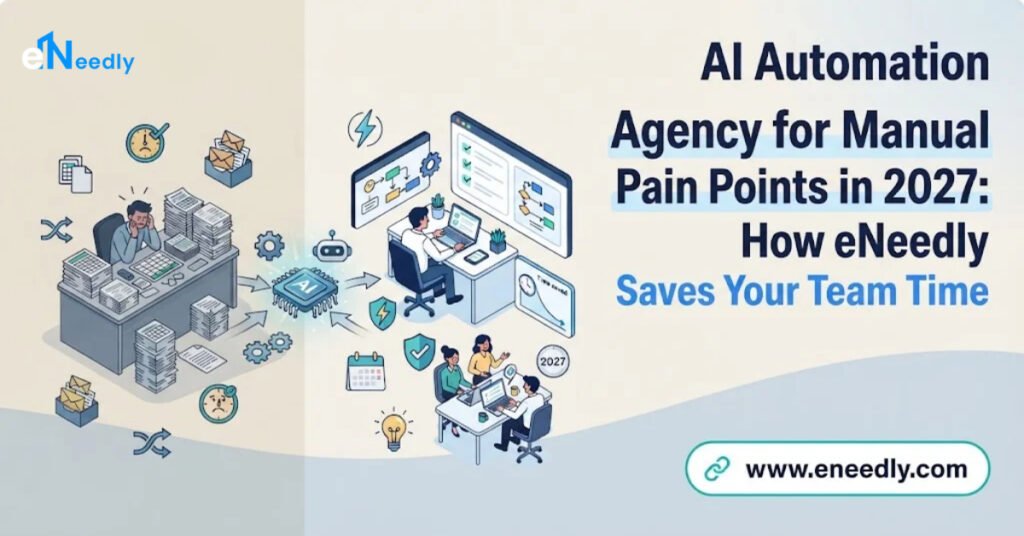
An AI automation agency finds the repetitive, time-consuming tasks that slow your business down, such as data entry, follow-ups, reporting and customer replies, and replaces them with automated workflows powered by artificial intelligence.
In 2027, businesses that still depend on manual work lose time, make more mistakes and struggle to grow. eNeedly, a digital solutions agency with over 8 years of experience, helps businesses identify their manual task pain points and build practical AI automation that gives their teams time back for work that really matters.
What Is an AI Automation Agency?
An AI automation agency is a team that helps businesses use artificial intelligence and automated workflows to handle routine work.
Instead of selling you a single piece of software, a good agency studies how your business actually runs, finds where time is being wasted and designs a solution that fits your processes.
The work usually includes three parts:
- Finding the problem: reviewing your daily tasks to see which ones are repetitive, slow or error-prone.
- Designing the automation: deciding which tasks can be handled by a system and how the steps should connect.
- Building and supporting it: creating the workflows, connecting them to your existing tools and improving them over time.
AI makes this more powerful than older automation. Traditional automation follows fixed rules, such as “when a form is submitted, send an email.”
AI automation can also read text, understand requests, sort information, write drafts and make simple decisions, which allows it to handle work that used to need a person.
An agency matters because the biggest challenge is rarely the technology. It is knowing what to automate, in what order and how to do it without disrupting your team.
What Are Manual Task Pain Points?
A manual task pain point is any repetitive job that your team does by hand and that costs more time, effort or accuracy than it should. These tasks are often so familiar that people stop noticing how much they cost.
They tend to share a few features:
- They happen again and again, daily or weekly.
- They follow clear steps that do not change much.
- They involve copying, checking or moving information from one place to another.
- They are boring, which makes mistakes more likely.
- They take time away from higher-value work, such as serving customers or planning growth.
When you add up the hours across a whole team, even small tasks become a significant cost. Spotting them is the first step toward fixing them.
What Are the Most Common Manual Task Pain Points in 2027?
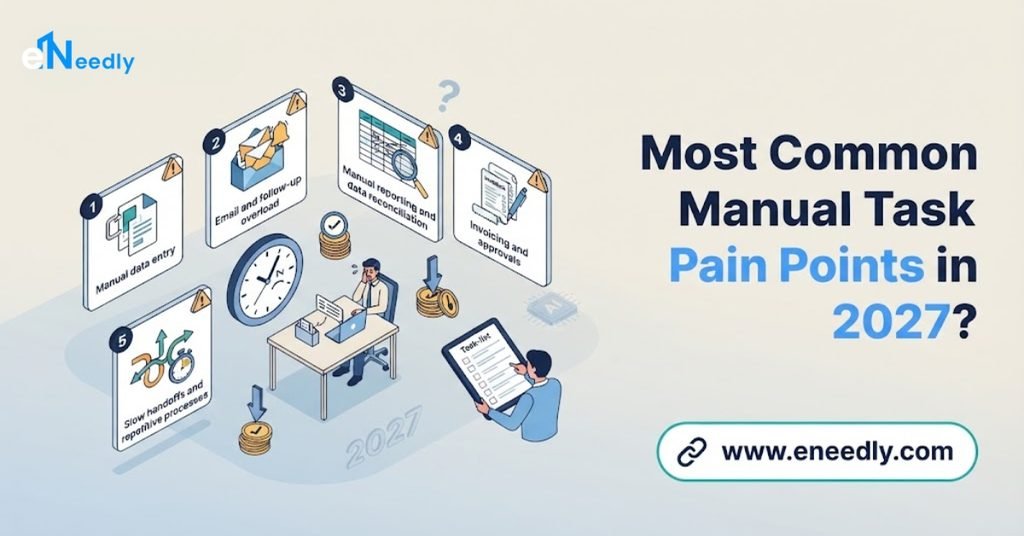
Every business is different, but the same problems appear again and again. Here are the ones we see most often.
Repeated data entry
Teams type the same information into several systems, such as a customer’s details into a spreadsheet, then a billing tool, then a project list. This wastes time and creates mismatched records.
Slow lead follow-up
When a new inquiry arrives and nobody replies for hours or days, the lead often goes elsewhere. Manual sorting and responding cannot always keep up with the volume.
Customer support overload
Many customer questions are the same: opening hours, order status, pricing, how to book. Answering each one by hand keeps staff busy with questions that could be handled instantly.
Manual reporting
Collecting numbers from different places and building weekly or monthly reports by hand can take hours. By the time the report is ready, the information may already be out of date.
Invoicing and payment follow-ups
Creating invoices, sending reminders and checking who has paid are tasks that depend on someone remembering to do them. Delays here affect your cash flow directly.
Scheduling and booking
Going back and forth to find a meeting time, confirm an appointment or send reminders uses up more time than most people expect.
Document handling
Reading, sorting, renaming and filing documents, forms and emails is repetitive work that is easy to get wrong.
Employee onboarding and internal requests
Setting up accounts, sending welcome information and answering the same internal questions repeatedly takes time from managers and support staff.
Social media and content posting
Planning, formatting and publishing the same type of content across several channels is a regular drain on small marketing teams.
If you recognize several of these in your own business, you are not alone, and most of them can be improved with automation.
Why Do Manual Tasks Hurt Your Business?
Manual work does not only slow people down. It creates problems that spread through the whole business.
- Lost time. Hours spent on routine work are hours not spent on customers, sales or improvement.
- More mistakes. People get tired and distracted. A typing error or a missed step can lead to wrong invoices, lost leads or unhappy customers.
- Slower response. Customers and leads expect quick answers. Manual processes cannot always deliver them.
- Higher costs. You pay for the time spent on repetitive tasks, and you may need extra staff just to keep up as you grow.
- Team frustration. Skilled people do not enjoy repetitive work. It can reduce motivation and increase staff turnover.
- Limited growth. If every new customer adds more manual work, your business cannot grow without growing your costs at the same speed.
Automation changes this pattern by letting the system handle repetitive work, so your team can focus on the parts of the business that need a human touch.
How Does AI Automation Solve These Pain Points?
AI automation addresses manual work in several clear ways.
- It handles repetitive steps automatically. Information entered once can flow to every system that needs it.
- It works at any hour. Lead replies, booking confirmations and customer answers can happen outside working hours.
- It reduces mistakes. A system follows the same steps every time and does not get tired.
- It sorts and prioritizes. AI can read incoming messages, requests or documents and send them to the right place.
- It speeds up responses. Customers get answers in seconds instead of hours.
- It produces reports automatically. Numbers are gathered and presented without anyone building the report by hand.
- It scales with you. When volume grows, the automation handles more without needing proportionally more staff.
The goal is not to remove people from the business. It is to remove the boring parts of their work.
What AI Automation Services Can eNeedly Provide?
eNeedly combines digital marketing, web development, business development and lead generation, which means we understand the processes that most businesses depend on. Here is how we can help you reduce manual work.
Lead capture and follow-up automation
Using our lead generation experience, we set up systems that capture new inquiries, sort them by quality and send quick, relevant replies, so no lead is left waiting.
Customer support automation
We help you build automated responses for common questions on your website and other channels, so your team only handles the questions that need personal attention.
Workflow automation between your tools
We connect the systems you already use, so information moves automatically from one place to another instead of being typed again and again.
Automated reporting
We create reports that collect your key numbers automatically and present them clearly, whether you need them daily, weekly or monthly.
Booking and scheduling automation
We set up simple systems for appointments, confirmations and reminders, which reduces back-and-forth messages and missed meetings.
Marketing task automation
We help you plan and automate routine marketing work, such as content scheduling, email sequences and campaign tracking, so your marketing runs consistently.
Website and business process automation
We build website forms, customer portals and internal workflows that handle routine requests automatically and feed the right information to your team.
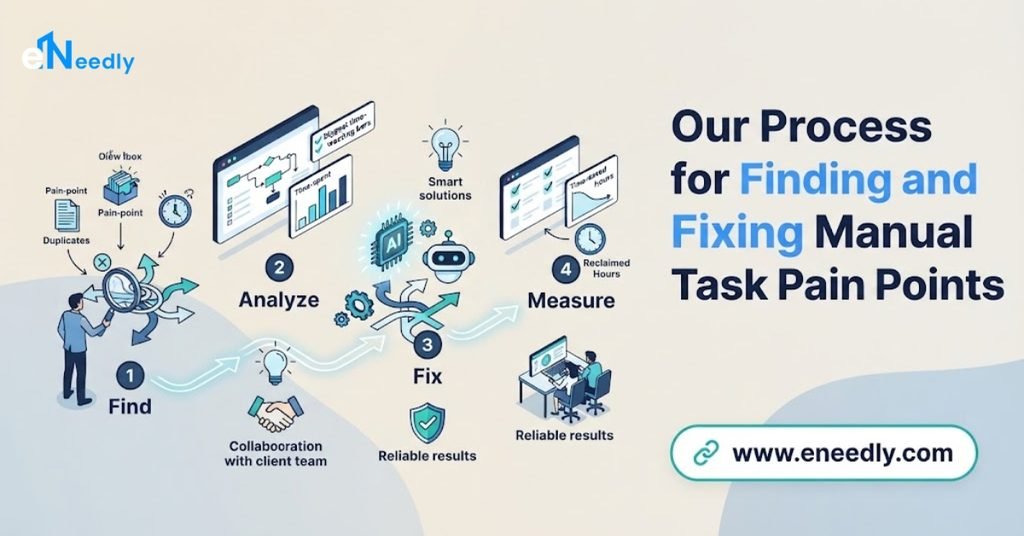
Our Process for Finding and Fixing Manual Task Pain Points
We follow a clear path, so the automation we build solves real problems and fits the way your team works.
Step 1: Listen and learn
We begin by talking with you about your business, your team and the tasks that take up the most time.
Step 2: Map your current processes
We look at how work moves through your business from start to finish, and where it slows down, repeats or breaks.
Step 3: Identify the best opportunities
Not every task is worth automating. We choose the ones that save the most time or reduce the most errors, so you see value early.
Step 4: Design the solution
We plan the workflow, decide which tasks the system handles on its own and which ones need a person’s approval.
Step 5: Build and connect
We create the automation and connect it to the tools and channels you already use.
Step 6: Test with real situations
We check that the workflow works correctly, handles unusual cases and does not cause problems for your customers or team.
Step 7: Train your team
We explain how the system works and what to do when something needs attention, so your team feels comfortable using it.
Step 8: Review and improve
After launch, we measure the results, listen to feedback and refine the automation over time.
Which Businesses Benefit Most from AI Automation?
Any business with repetitive tasks can benefit, but the results are especially noticeable for:
- Small and growing businesses where a few people handle many different tasks.
- Service businesses that deal with many inquiries, bookings and follow-ups.
- Online stores that manage orders, customer questions and updates.
- Agencies and consultants who handle reporting, client communication and project tracking.
- Sales-driven businesses that need fast lead response and organized follow-up.
- Businesses are planning to grow, because automation makes it possible to take on more customers without a matching rise in manual work.
If your team often says they are too busy to do the important work, that is a strong sign that automation could help.
What Should You Not Automate?
Good automation also means knowing when to keep a human involved. We usually recommend keeping people in charge of:
- Sensitive conversations, such as complaints or complicated customer problems.
- Important decisions, especially those involving money, contracts or legal matters.
- Creative and strategic work, where judgment and experience matter.
- Relationship building, which depends on real human connection.
The best results come when automation handles the routine work and people handle the work that needs care.
How to Start Reducing Manual Work in 2027
You do not need to automate everything at once. These practical steps help you begin:
Ask your team which tasks they find repetitive and time-consuming.
Track time for a week to see where hours are really going.
List the repeated tasks that follow the same steps every time.
Rank them by how much time they take and how often mistakes happen.
Start with one or two tasks that are simple but costly.
Measure the result after automating, then move on to the next one.
Starting small gives you quick wins, builds confidence and shows where automation can help next.
What Affects the Cost of AI Automation?
The cost depends on your needs, so there is no single price for every business. The main factors are:
- The number of tasks and workflows you want to automate.
- The complexity of each workflow and how many steps it includes.
- The tools you use and how many need to be connected.
- The level of AI involved, from simple sorting to more advanced understanding of messages and documents.
- Ongoing support and improvement after the system is live.
The easiest way to get a clear answer is to speak with us. After a short discussion about your tasks and goals, we can suggest a plan that fits your business and explain what is included.
Get Started with a Free Consultation
Manual work will not disappear on its own, and every month it continues, it costs your business time and money. With the right automation, your team can stop repeating the same steps and start spending time on the work that grows your business.
Here is how to begin:
Book a free consultation using the booking form on our website.
Tell us about your business and the tasks that take up the most time.
Receive a clear plan for AI automation that fits your needs.
You can also contact us directly at info@eneedly.com or on +92 345 114 4664.
Frequently Asked Questions
What does an AI automation agency do?
An AI automation agency studies how your business works, finds repetitive tasks that waste time, and builds automated workflows powered by AI to handle them. It also connects those workflows to your existing tools and keeps improving them after launch.
What are the most common manual task pain points for businesses?
The most common ones are repeated data entry, slow lead follow-up, customer support overload, manual reporting, invoicing and payment reminders, scheduling and booking, document handling and routine internal requests.
Most of these follow clear steps, which makes them good candidates for automation.
Will AI automation replace my employees?
The aim is not to replace people. Automation takes over repetitive, routine tasks, so employees can focus on customer relationships, creative work, decision-making and growth. Tasks that need judgment and personal care stay with your team.
Is AI automation only for large companies?
No. Small and growing businesses often see the biggest benefit, because a small team usually carries a heavy load of routine work. Automating even one or two tasks can free up a meaningful amount of time.
Which tasks should I automate first?
Start with tasks that are repetitive, follow clear steps and take a lot of time or often contain mistakes. Examples are lead follow-up, data entry between systems and regular reporting. Simple but costly tasks give you the fastest results.
How long does it take to set up business automation?
The timeline depends on how many tasks you want to automate, how complex they are and how many tools need to be connected. After we review your processes, we can give you a realistic timeline for your project.
Can automation work with the tools I already use?
In most cases, yes. A good automation project connects the tools your business already uses, so your team does not have to learn a completely new way of working. We check this during the planning stage.
Why choose eNeedly as my AI automation agency?
eNeedly brings together digital marketing, web development, business development and lead generation, with over 8 years of experience.