
Quick Answer
Odoo app development services build new applications and custom modules on Odoo’s framework using Python, XML views, and the Odoo ORM, extending what standard apps can do.
Typical module projects cost 5,000 to 40,000 USD and take 3 to 10 weeks, while mobile focused work adds scoping for offline sync and device features.
Choose an Odoo app development company based on demonstrated modules, testing practice, and a clear plan for future version upgrades.
Why do businesses need Odoo app development services?
Odoo ships with a wide set of standard apps, but no template covers every business exactly. A distributor with a unique commission structure or a clinic with a specific intake flow needs something the standard install does not provide.
Odoo app development services fill that gap by building new apps or modules on top of Odoo’s existing framework. Done properly, this work adds capability without breaking Odoo’s own upgrade path.
This guide covers what app and module development actually involves, how it differs from customization, and what it costs. It also looks at mobile specific work and how to choose the right development partner.
For the wider service context, see Odoo custom development services. This guide focuses specifically on building new apps and modules rather than the full development scope.
What is Odoo app development and how does it differ from module customization?
Odoo app development means building a new application on Odoo’s framework, typically with its own data models, views, and business logic, packaged as an installable module.
Module customization means extending or modifying an existing standard app, such as adding fields or workflow rules to Sales or Inventory.
The distinction matters for scoping and cost. A new app usually needs a complete data model and permission structure built from scratch, while customization builds on the structure Odoo already provides.
App development vs customization: what changes in scope?
| Factor | New app development | Module customization |
| Starting point | No existing data model | Existing app’s data model |
| Typical scope | Full new business object, views, security | Added fields, extra logic, new automation |
| Development time | Longer, several weeks to months | Shorter, days to a few weeks |
| Risk on upgrade | Moderate, self contained | Lower if changes stay additive |
| Example | A custom equipment rental tracking app | Adding a commission field to Sales orders |
Both approaches use the same underlying skills. The difference is the size and independence of what gets built.
What is an Odoo module, technically?
An Odoo module is a self contained folder of Python files, XML views, and a manifest file that Odoo’s framework loads as an installable unit. Every standard Odoo app, including Sales and Inventory, is itself a module built the same way custom ones are.
This structure is why well built custom apps behave like native Odoo features to end users. They appear in the same menu system, use the same security model, and follow the same list and form view conventions.
What can Odoo app and module development actually build?
Odoo app development covers new business applications, extensions to standard apps, custom reports, and portal features, each built from the same core toolkit. The table below shows common project types.
| Development type | What it produces | Core technology |
| New standalone app | A complete new business object with its own menu and workflow | Python, ORM, XML views |
| Extension of a standard app | Added fields, custom logic, new automation on existing objects | Python, XML inheritance |
| Custom reports and documents | Branded PDFs, dashboards, printed forms | QWeb, XML |
| Portal or customer facing features | Self service pages, custom forms | Python, QWeb, JavaScript |
| Mobile and offline features | Field data capture, barcode workflows | Python, Odoo mobile framework |
A new standalone app is the largest undertaking on this list, since it requires designing a complete data model rather than extending one that already exists. Extensions to standard apps are far more common in practice, since most businesses need Odoo’s existing apps to behave slightly differently rather than a wholly new application.
What does a typical custom module contain?
A custom module contains Python model files that define data structure and business logic, XML files that define menus, views, and access rules, and a manifest file that tells Odoo how to load it.
Well structured modules keep this logic separate from Odoo’s own core files, so upgrades can proceed without conflict.
Odoo’s module system also supports dependencies, so a custom app can be built on top of Sales, Inventory, or any other standard app rather than duplicating their functionality.
A developer who understands this dependency system builds smaller, more maintainable modules than one who does not.
How does an Odoo app development project run, phase by phase?
An app or module development project moves through five phases: requirements and data model design, technical build, testing, deployment, and post launch support. The table shows typical timing for a medium complexity module.
| Phase | What is included | Typical duration |
| Requirements and data model design | Functional specification, object relationships, permission rules | 1 to 2 weeks |
| Technical build | Python models, XML views, business logic, QWeb if needed | 2 to 6 weeks |
| Testing | Unit tests, functional testing, user acceptance testing | 1 to 2 weeks |
| Deployment | Staging release, production deployment, rollback plan | 3 to 5 days |
| Post launch support | Bug fixes, adjustments from real usage | 2 to 4 weeks |
Small extensions to existing apps can complete in two to three weeks total. A new standalone app with several related objects often needs two to four months.

What should the requirements phase produce?
The requirements phase should produce a written specification naming every field, workflow state, permission rule, and edge case the app must handle.
It should also define how the new app relates to existing Odoo objects, such as whether a custom record links to a partner, a product, or a sales order.
Approving this document before development starts prevents the most common source of dispute in app development: a feature that technically matches the request but misses the actual need.
What matters most during the technical build?
The build phase should follow Odoo’s own module conventions, using its ORM rather than direct database queries, and its standard view inheritance rather than copying and modifying core files. This discipline is what keeps a custom app compatible with future Odoo versions.
Ask any developer whether they extend standard apps through inheritance or by editing the original files directly. The second approach creates upgrade risk that often surfaces months later.
How should testing be structured?
Testing should include automated unit tests for core logic, functional tests against the written specification, and user acceptance testing with real business scenarios. Odoo’s own testing framework supports automated tests, and skipping them trades short term speed for long term fragility.
Request a test report before accepting delivery. A module with no test coverage becomes a liability the moment the next version upgrade runs.
What does Odoo mobile app development add to the process?
Odoo mobile app development extends the standard process with additional scoping for offline behavior, device features, and app store distribution when the work goes beyond Odoo’s built in mobile app.
Odoo’s Enterprise mobile app already provides access to standard apps on phones and tablets, so most mobile requests are actually about extending that experience, not building a separate app from scratch.
When do businesses need genuine custom mobile development?
Businesses need custom mobile development when field staff need offline data capture, barcode scanning tied to custom logic, or a workflow the standard mobile app does not support. Warehouse operations, field service, and delivery tracking are the most common drivers.
What technical considerations apply to Odoo mobile app development services?
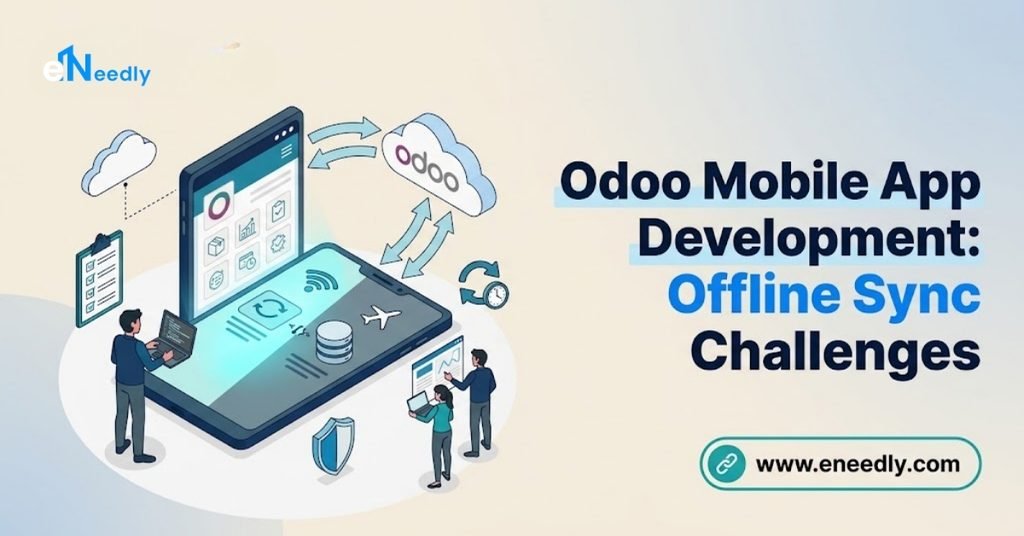
Offline sync is the hardest part of most mobile projects, since the app must record data without a connection and reconcile it correctly once connectivity returns.
Conflicts between two offline changes to the same record need a defined resolution rule, not an assumption that sync will simply work.
Device features such as camera based barcode scanning, GPS location capture, and push notifications each add scope beyond the core Odoo logic.
Scope these explicitly rather than treating mobile as a smaller version of the desktop feature.
Does a custom mobile app need app store distribution?
Only when the business wants a branded, independently installable app rather than an extension of Odoo’s own mobile app. App store distribution adds review time, ongoing update obligations, and platform specific testing that should be scoped and budgeted separately from the core development work.
What skills should an Odoo app development company have?
A strong Odoo app development company combines Python and Odoo ORM fluency, a disciplined approach to module structure, and real experience with the type of app you need. The table lists core skills and a way to test each one.
| Skill | Why it matters | How to test it |
| Python and Odoo ORM fluency | Poor ORM use causes performance problems at scale | Ask how they would model a many to many relationship in your use case |
| Module structure discipline | Determines whether the app survives version upgrades | Ask whether they inherit views or edit core files directly |
| QWeb and reporting | Needed for custom documents and dashboards | Ask for a sample custom report they built |
| Testing practice | Protects quality after delivery | Ask what percentage of their code typically has test coverage |
| Mobile and offline experience, if relevant | Offline sync is a common failure point | Ask how they handled a sync conflict on a past project |
| Communication and documentation | Determines how maintainable the result is | Ask for a sample of their module documentation |
Ask for a specific past app similar in scope to yours, not a general list of Odoo experience. A company that has built the type of app you need will scope it faster and with fewer surprises.
How much does Odoo app and module development cost?
Typical module projects cost 5,000 to 40,000 USD, while a new standalone app can run 40,000 to 150,000 USD or more depending on complexity. The table breaks down typical costs by project type.
| Project type | Typical range (USD) | Typical duration |
| Extension of a standard app | 3,000 to 15,000 | 2 to 4 weeks |
| Medium custom module | 15,000 to 40,000 | 6 to 10 weeks |
| New standalone app | 40,000 to 150,000 or more | 3 to 6 months |
| Custom report or document | 1,000 to 5,000 | 1 to 2 weeks |
| Mobile extension with offline sync | 15,000 to 60,000 | 2 to 4 months |
| Delivery model | Typical hourly rate (USD) |
| Offshore freelancer | 25 to 50 |
| Offshore agency | 40 to 75 |
| Onshore freelancer | 75 to 130 |
| Onshore agency | 100 to 150 |
These are typical ranges, not fixed quotes, and actual pricing depends on data complexity, number of related objects, and whether mobile or offline features are involved. Where do buyers overspend? They overspend on rebuilding standard app behavior with minor variation, and they underspend on testing and documentation, which raises long term maintenance cost.
How do you choose an Odoo application development company?
Choose an Odoo application development company by checking demonstrated apps similar to your need, testing and documentation practice, and how the team plans for future version upgrades. Run the same evaluation on every candidate so the comparison is fair.
What should you check before hiring?
Ask for a description of a past app’s architecture and why it was structured that way. Ask whether they write automated tests, how they document modules, and who owns the code after delivery.
Ask for two references from projects similar in complexity to yours. A confident Odoo application development company answers with specifics rather than general reassurance.
Does location affect the choice, such as an Odoo application development company in Orlando?
Local firms, including an Odoo application development company in Orlando, offer easier scheduling for in person meetings and often carry familiarity with regional business needs. That advantage matters most when a project needs frequent live workshops or on site work, such as warehouse mobile deployments.
For most module and app development work, the code quality and communication discipline of the specific team matter more than physical location. Compare a local firm and a remote one on the same evaluation criteria rather than defaulting to proximity.
Odoo development company USA vs offshore: what changes for app development?
An Odoo development company USA typically offers closer time zone overlap and stronger familiarity with US specific integrations. Offshore development, sometimes delivered through an Odoo development company India, typically offers lower rates and can deliver equally strong results when specifications and communication discipline are solid.
| Factor | US based company | Offshore company |
| Typical hourly rate | 100 to 150 USD | 25 to 75 USD |
| Time zone overlap | Full US business hours | Limited, needs a defined overlap window |
| Best fit | Urgent, high touch, or on site mobile projects | Well specified projects with cost sensitivity |
Neither option guarantees quality on its own. A clear specification and disciplined development practice matter more than where the team sits.
What are the most common mistakes in Odoo app development projects?
The five mistakes below cause most delays and cost overruns in app and module development. Each is preventable with a decision made before the build starts.
Mistake 1: Building a new app when an extension would do
Teams request a standalone app because it feels like a cleaner solution, when extending an existing app would meet the need with less cost and risk. A new app duplicates the structure Odoo already provides.
Ask the developer to justify a new app over an extension before approving the larger scope.
Mistake 2: Skipping the data model design review
Developers sometimes start coding before the object relationships are agreed. Structural mistakes discovered late cost far more to fix than they would have at the design stage.
Require a data model review and sign off before the build phase starts.
Mistake 3: Treating mobile as a smaller desktop feature
Mobile requests get scoped the same way as desktop features, without accounting for offline behavior or device specific constraints. Sync conflicts and connectivity gaps then surface in the field, not in testing.
Scope offline behavior, sync conflict rules, and device features explicitly and separately from the core logic.
Mistake 4: Accepting delivery without test coverage
Modules that pass a demo but carry no automated tests tend to fail quietly on edge cases in production. Every future version upgrade becomes a manual re-test of code nobody fully understands.
Require a test report showing coverage of core logic before accepting delivery.
Mistake 5: Losing code ownership and documentation
Contracts without clear ownership terms leave a business dependent on the original developer indefinitely. Losing access to that person then means losing the ability to maintain the app.
Require code ownership transfer and documentation as standard delivery terms in every contract.
Who are Odoo app and module development services right for?
These services suit businesses with a workflow, data structure, or field operation that standard Odoo apps cannot represent, and whose volume or importance justifies a dedicated build. Distributors, manufacturers, and field service companies with unique tracking or offline requirements gain the most.
Companies planning to differentiate their operations through a proprietary process should also invest here, since the app becomes part of that operational advantage. Businesses expanding into mobile field operations benefit from the mobile specific scoping this guide describes, provided the underlying process is stable enough to build against.
Who should not invest in a new app or module? Businesses whose needs can be met by extending a standard app, or by Studio for simpler additions, should choose that lighter path instead. Companies without a clear, written process for the workflow they want to build should define that process first, since no developer can build reliably against an undefined requirement.
Frequently Asked Questions
What does an Odoo app development company do?
An Odoo app development company builds new applications and custom modules on Odoo’s framework, using Python, XML views, and the ORM. The work includes requirements analysis, data model design, coding, testing, and deployment. It differs from configuration, which uses existing settings with no new code.
How much does Odoo app development cost?
Typical module projects cost 5,000 to 40,000 USD, while a new standalone app can run 40,000 to 150,000 USD or more. Hourly rates range from 25 to 150 USD depending on delivery model. Mobile projects with offline sync usually add cost beyond a comparable desktop feature.
What is the difference between an app and a module in Odoo?
A module is the technical package, containing Python models, XML views, and a manifest file, that Odoo installs and loads. An app is typically a module or set of modules that together deliver a complete business function, such as Sales or Inventory. Custom development can produce either a small module extension or a full new app.
Do I need a separate Odoo mobile app development company?
Not usually, since most Odoo development companies handle mobile extensions as part of their standard service. You need specific mobile app development experience when your project involves offline sync, device features like barcode scanning, or app store distribution. Ask any candidate directly about past offline sync work before assuming general Odoo skill transfers.
Can custom Odoo apps survive version upgrades?
Yes, when built as properly structured, separate modules that use Odoo’s inheritance system rather than edits to core files. Complex data models sometimes need review and adjustment when Odoo changes underlying structures between major versions. Ask any developer to document upgrade risk as part of delivery.
Should I hire a local Odoo application development company?
A local firm helps most when your project needs frequent in person workshops or on site mobile deployment. For most standard module and app work, code quality and communication discipline matter more than physical location. Compare local and remote firms on the same evaluation criteria rather than defaulting to proximity.
What is the difference between Odoo app development and customization?
App development typically means building a new application with its own data model from scratch. Customization means extending or modifying an existing standard app, such as adding fields or logic to Sales or Inventory. Customization is usually faster and lower risk since it builds on the structure Odoo already provides.
How do I evaluate an Odoo development company’s technical quality?
Ask for a description of a past module’s architecture, whether they write automated tests, and how they document their work. Request references from projects similar in complexity to yours. A company that answers with specific examples rather than general reassurance is more likely to deliver maintainable work.
Key Takeaways
- App development builds new structure from scratch, while module customization extends what Odoo already provides, and most needs are met by the lighter option.
- Well built modules use Odoo’s inheritance system and ORM rather than editing core files, which protects the upgrade path.
- Typical module projects cost 5,000 to 40,000 USD, and new standalone apps can run 40,000 to 150,000 USD or more.
- Mobile projects need explicit scoping for offline sync and device features, since these are the most common source of field failures.
- Code ownership, documentation, and test coverage belong in every development contract regardless of project size.