
Quick Answer
An Odoo development company in the USA builds custom modules, apps, and integrations at typical hourly rates of 100 to 250 USD, with full US business hour overlap and stronger familiarity with US tax, payroll, and compliance requirements.
The trade off is cost, since onshore rates run two to five times higher than offshore alternatives for comparable work.
Choose onshore when live workshops, regulated data, or urgent turnaround matter more than the lowest possible rate.
Why do businesses choose an Odoo development company in the USA?
Cost is not the reason most buyers choose an onshore firm, since US rates run well above offshore alternatives. The reasons that do matter are full time zone overlap, faster response during a live issue, and deeper familiarity with US specific requirements such as sales tax and payroll.
Regulated industries and complex multi-entity projects also favor onshore delivery, since data residency and compliance expectations are easier to satisfy with a US based team. This guide explains what these firms typically deliver, how their pricing compares to offshore options, and how to evaluate one properly.
For the broader development scope this fits into, see Odoo custom development services. If your project centers on adding a new app or module specifically, the Odoo app development guide covers that scope in depth.
What does an Odoo development company in the USA typically offer?
Most onshore Odoo firms offer the same core services as any development company: custom module development, app development, integrations, migration support, and ongoing maintenance. What differs is delivery structure, response time, and depth of US specific expertise.
What delivery models are common?
Onshore firms typically offer dedicated developer arrangements, project based fixed price delivery, and time and materials billing, the same three models available anywhere. The practical difference is that live workshops and status calls happen entirely within your own business hours, with no overlap window to schedule around.
Fixed price delivery suits a single, well specified build such as a custom module. Dedicated developer arrangements suit ongoing work where requirements evolve and priorities shift week to week.
What team structures do these companies use?
A typical onshore team pairs a functional consultant with one or more developers, and larger firms add a dedicated project manager for governance.
Smaller boutique firms sometimes combine consulting and development in one senior person, which works well for smaller projects but creates a single point of failure on larger ones.
Ask which structure applies to your project size. A team with a named backup developer protects your timeline if the primary developer is unavailable.
How do USA Odoo development rates compare to offshore options?
Odoo development companies in the USA typically charge 100 to 250 USD per hour, well above offshore rates for comparable seniority. The table compares typical hourly rates across delivery models.
| Delivery model | Typical hourly rate (USD) | Typical fit |
| US based agency | 125 to 250 | Complex, regulated, or urgent projects |
| US based freelancer | 100 to 175 | Smaller projects needing close collaboration |
| Offshore agency (India and similar regions) | 25 to 75 | Cost sensitive, well specified projects |
| Hybrid, US lead with offshore build team | 60 to 150 | Mid market projects balancing cost and contact |
Rates are typical ranges and vary by firm size and project complexity. A module quoted at 5,000 to 8,000 USD offshore might run 15,000 to 25,000 USD onshore for the same defined scope, and the Odoo development company India guide covers that comparison from the other direction.
What justifies the higher onshore rate?
Full business hour overlap removes the delay of waiting a day for a clarifying answer, which matters most during discovery and testing. Onshore teams also tend to carry deeper first hand experience with US sales tax, payroll integrations, and compliance frameworks that offshore teams encounter less often.
Where do buyers overspend or underspend onshore?
Buyers overspend when they pay premium onshore rates for pure configuration or data entry work that does not need real time collaboration. They underspend when they choose the cheapest onshore freelancer for a complex, multi month build that actually needs team coverage and continuity.
What does an Odoo custom development company in the USA actually build?
A custom Odoo development company in the USA builds new modules, workflow automation, custom reports, and integrations, using the same core Odoo framework as any development firm worldwide. The table shows common project types.
| Development type | What it produces | Core technology |
| Custom module | New business object or extension of an existing app | Python, XML views, ORM |
| Workflow automation | Approval chains, conditional actions, scheduled jobs | Python, Odoo automation rules |
| Custom reports | Branded invoices, dashboards, printed documents | QWeb, XML |
| Third party integration | Connections to payment, shipping, tax, or legacy systems | Python, REST or XML RPC APIs |
| Odoo store development | eCommerce catalog, checkout, and storefront customization | Python, QWeb, JavaScript |
Odoo store development is a common request among US retailers and distributors, since it touches customer facing pages directly and often needs iteration based on live feedback. That live feedback loop is where onshore teams have a natural advantage, since design and content changes benefit from same day turnaround.
Why does US specific knowledge matter for custom development?
Custom logic often needs to account for US sales tax rules, state specific compliance, or a connection to a US payroll provider. A developer without that background can still write correct code, but discovering the requirement late costs more than having it understood from the first workshop.
What US specific expertise should an Odoo development company in the USA bring?
An Odoo development company in the USA should understand US sales tax handling, US accounting localization, hosting region requirements, and common US integrations such as payroll and EDI. The table lists these areas and what to verify.
| Area | Why it matters | What to verify |
| US sales tax | Rates vary by state, county, and city, with economic nexus rules | Ask how they configured tax rules on a past project |
| US chart of accounts and reporting | GAAP alignment and 1099 reporting differ from other regions | Ask about their US Accounting localization experience |
| Hosting region and compliance | Regulated buyers need US data residency | Ask where their hosting recommendations place data |
| Payroll integration | US payroll runs through dedicated providers, not native Odoo payroll for most companies | Ask which payroll providers they have connected |
| EDI with retailers | Large US retailers often require EDI for orders and invoices | Ask about past EDI onboarding experience |
A firm with no history in these areas is not automatically wrong for your project. It becomes a real risk when the project depends heavily on one of these areas and the firm has never handled it before.
How do you evaluate an Odoo development company in the USA?
Evaluate any USA Odoo development company on demonstrated code quality, references, testing discipline, and specific US project history. Onshore location does not lower the bar for evidence of skill.
What should you check before hiring?
Ask for a code sample or a description of a past module’s architecture. Ask whether they write automated tests, how they document modules, and who owns the code after delivery.
Ask for two references from projects similar in complexity to yours, ideally in your industry. A confident custom Odoo development company in the USA answers with specifics rather than general reassurance.
Which questions expose a weak firm?
Ask about the last US sales tax or payroll integration they built and what went wrong on it. Ask how they handle scope changes and how they price them.
Ask whether the same developers stay on the project from start to finish. Even onshore firms sometimes rotate staff between projects without notice.
What red flags should end the conversation?
A fixed price offered before any requirements discussion is a red flag regardless of location. So is a claim of expertise in every US industry and integration without a single verifiable reference, and reluctance to share a written specification or test report from a past engagement.
Avoid firms that will not commit to code ownership transfer in the contract. Your business logic should belong to you regardless of who built it.
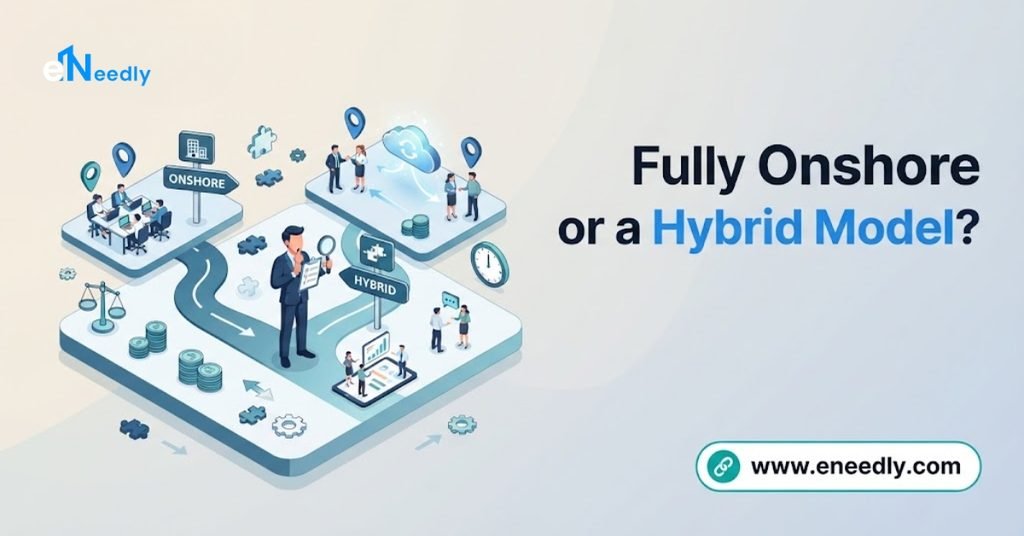
Should you choose fully onshore or a hybrid model?
Choose fully onshore when your project needs constant live collaboration, regulated data, or urgent same day turnaround. Choose a hybrid model, with a US based lead and an offshore build team, when you want US facing communication with a lower overall cost.
| Factor | Fully onshore | Hybrid model |
| Typical hourly blended rate | 125 to 250 USD | 60 to 150 USD |
| Live workshop availability | Full US business hours | Full, through the US based lead |
| Cost efficiency | Lower | Higher |
| Coordination complexity | Lowest | Moderate, needs a strong lead |
A hybrid model works well when the US based lead has real authority to make scope decisions rather than acting purely as a messenger. Ask directly what technical decisions that lead can make without escalating offshore.
What are the most common mistakes when hiring an Odoo development company in the USA?
The five mistakes below account for most of the cost overruns and frustration buyers report with onshore engagements. Each is preventable with a decision made before the contract is signed.
Mistake 1: Paying onshore rates for work that does not need it
Buyers default to onshore for every task, including configuration and data entry that do not benefit from live collaboration. This inflates the budget without improving the outcome.
Reserve onshore engagement for work that genuinely needs real time discussion, and consider a hybrid model for the rest.
Mistake 2: Assuming US location guarantees US specific expertise
A firm based in the US is not automatically experienced with sales tax, payroll integration, or EDI. Location and domain expertise are separate things.
Verify specific US project history for the exact requirement your project needs, not just the company’s address.
Mistake 3: Skipping the written specification because meetings are easy to schedule
Easy access to live meetings can tempt teams to skip documenting requirements, assuming any gap can be clarified quickly. Verbal agreements still drift, and disputes still arise over what was actually promised.
Write a functional specification with acceptance criteria regardless of how easy communication is.
Mistake 4: Overpaying for a small project through a large agency
Large onshore agencies carry overhead that shows up in the rate, which can be a poor fit for a small, simple module. A smaller firm or an experienced freelancer sometimes delivers the same result at a lower cost.
Match firm size to project complexity rather than defaulting to the largest name.
Mistake 5: Losing code ownership and documentation
Contracts without clear ownership terms leave a business dependent on the original developer indefinitely, regardless of location. Losing access to that developer then means losing the ability to maintain the system.
Require code ownership transfer and documentation as standard delivery terms in every contract.
Who should hire an Odoo development company in the USA?
Onshore development suits businesses with regulated data, complex US tax or payroll requirements, or a need for frequent live collaboration during discovery and testing. Enterprise and multi-entity companies, along with businesses in healthcare, finance, or defense supply chains, typically gain the most from onshore delivery.
Retailers and distributors needing EDI onboarding with a US partner also benefit from a team with direct experience in that process. Companies planning a store development project that will need frequent live design iteration often find same time zone collaboration worth the premium.
Who should not default to onshore? Businesses with well defined, standard scope and a strict budget often get equal quality from an offshore or hybrid model at a fraction of the cost. Companies whose main constraint is price rather than urgency or compliance should evaluate the Odoo development company India comparison before committing to a premium onshore rate.
Frequently Asked Questions
How much does an Odoo development company in the USA charge?
Typical hourly rates run 100 to 250 USD, depending on firm size and project complexity. This compares to 25 to 75 USD per hour for many offshore alternatives. A hybrid model with a US lead and an offshore build team typically falls between the two.
What does a custom Odoo development company in the USA build?
The same range as any Odoo development company: custom modules, workflow automation, custom reports, integrations, and eCommerce or storefront work through Odoo store development. The main advantage onshore firms bring is full business hour availability and often deeper US tax and compliance experience. The underlying Python, XML, and QWeb technology is the same everywhere.
Is onshore Odoo development worth the higher cost?
It is worth it when your project needs frequent live collaboration, involves regulated data, or depends on US specific integrations such as payroll or EDI. For well defined, standard scope with a strict budget, offshore or hybrid delivery often produces comparable results for less. The right choice depends on your specific requirements, not a general rule.
What is Odoo store development?
Odoo store development refers to building or customizing an Odoo based eCommerce storefront, covering catalog structure, checkout flow, and design. It draws on the Website and eCommerce apps along with QWeb templating and frontend skills. US retailers often prefer this work delivered locally due to frequent design iteration needs.
Do I need US specific expertise for my Odoo project?
You need it when your project involves US sales tax, payroll integration, EDI with US retailers, or regulated data requiring US hosting. Standard configuration and general custom development do not require US specific knowledge. Ask any onshore firm to demonstrate this experience with specifics rather than assuming their location guarantees it.
Should I choose a fully onshore team or a hybrid model?
Choose fully onshore when live collaboration, regulated data, or urgent turnaround matter most. Choose a hybrid model, with a US based lead and offshore build team, when you want US facing communication at a lower overall cost. The hybrid model works best when the US lead has real authority over scope decisions.
How do I evaluate an Odoo development company in the USA?
Check code samples, testing discipline, and references from projects similar in complexity to yours, the same criteria that apply to any Odoo development firm. Verify specific US project history, such as sales tax or payroll integration, rather than assuming location alone provides that expertise. Ask about code ownership and documentation terms before signing.
Is a US based Odoo agency better than a freelancer?
An agency offers team coverage, continuity, and governance that protects larger or higher risk projects. A freelancer can be an excellent, lower cost fit for a small, well scoped task with one clear owner on your side. The right choice depends on project size and risk, not a blanket rule favoring either.
Key Takeaways
- Onshore US rates run 100 to 250 USD per hour, justified mainly by full business hour overlap and US specific compliance experience, not by higher raw technical skill.
- US location does not guarantee sales tax, payroll, or EDI expertise, so verify that history specifically before assuming it.
- A hybrid model with a US based lead and an offshore build team can capture much of the cost advantage while keeping stakeholder communication local.
- Written specifications still matter onshore, even though live meetings are easy to schedule.
- Code ownership, documentation, and continuity commitments belong in every contract regardless of where the team sits.