
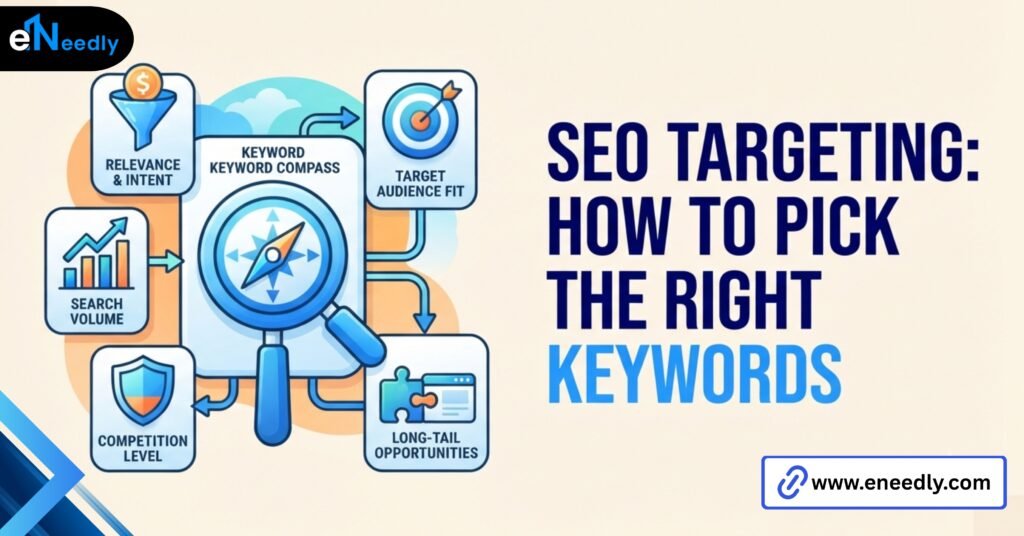
SEO Targeting: How Do You Actually Target the Right Keywords?
Quick answer: SEO targeting is the process of choosing which search terms your pages should rank for, based on what your ideal customers actually type into Google, not just what sounds good in a meeting.
It combines keyword research (finding demand) with keyword targeting (matching that demand to specific pages) so each piece of content has one clear job. Done right, it means less content, ranking faster, for terms that actually bring in business.
Most businesses we work with have this backwards. They publish a blog post, hope it ranks for something, and then wonder why traffic doesn’t turn into leads. That’s not a targeting strategy; that’s a guess.
This post walks through how we actually approach SEO targeting with clients, the tools we use to do it without wasting a month on research, and the mistakes that quietly tank rankings before a page ever gets a fair shot.
What Does “SEO Targeting” Actually Mean?
SEO targeting is deciding, before you write a single word, exactly which search query a page is meant to win. Not a topic. A query.
There’s a difference between “we should write about email marketing” and “this page targets ‘best email marketing tools for small businesses.'” “The first is a brainstorm. The second is a target. Google rewards the second one because it can tell what the page is trying to answer, and so can the person reading it.
We tell clients to think of every page on their site as a job application for one specific search result. If a page is trying to rank for five different things, it’s applying for five jobs and getting none of them.
Pick one primary target per page, support it with two or three related terms, and let the rest go to other pages. This is also where a lot of the “we post content but nothing ranks” frustration comes from. The content isn’t bad. It just was never aimed at anything specific in the first place.
Keyword Research vs. Keyword Targeting: Are They the Same Thing?
No, and mixing these up is one of the most common mistakes we see, even among people who’ve been “doing SEO” for years.
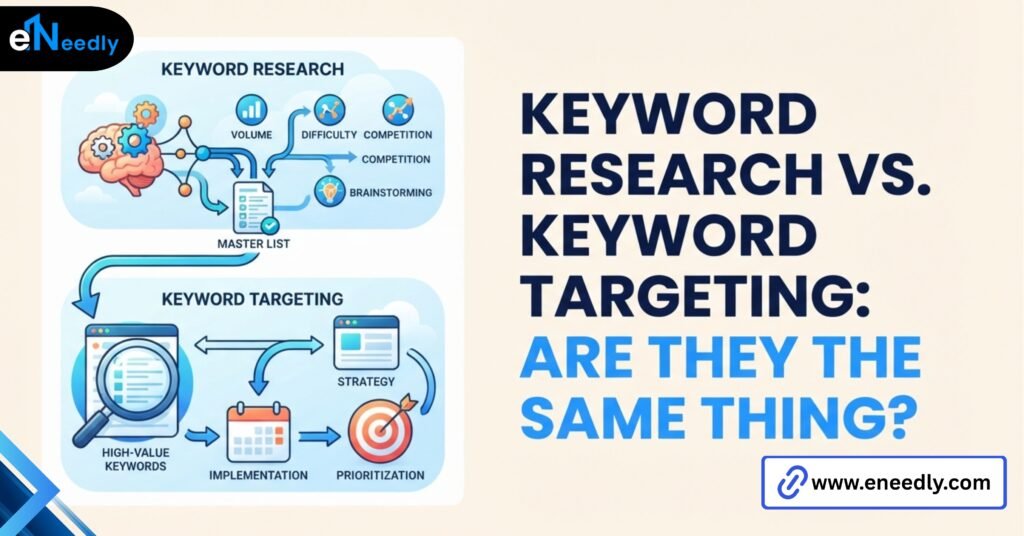
Keyword research is discovery. It’s the phase where you’re pulling data search volume, difficulty, related terms, and questions people ask to understand the landscape. You’re not committing to anything yet. You’re just mapping what’s out there.
Keyword targeting is the decision. It’s what happens after research, when you actually assign a specific term (or small cluster of terms) to a specific page and build that page around it. Research without targeting is just a spreadsheet nobody uses. Targeting without research is a guess dressed up as strategy.
Here’s a simple way to keep them straight:
| Keyword Research | Keyword Targeting | |
| Goal | Understand demand | Decide who wins which page |
| Output | List of terms, volume, intent | One assigned term per page |
| Timing | Before content plan | During content plan |
| Mistake if skipped | You target blindly | You never publish, or publish scattered |
We’ve had clients come to us with a folder of 400 keywords from a research tool and zero pages built around any of them. That folder is worth nothing until someone sits down and assigns terms to real URLs.
Short-Tail vs. Long-Tail Keywords: Which Should You Actually Target?
This one splits opinion, so here’s ours, based on what’s actually moved the needle for clients.Short-tail keywords (“web design,” “SEO agency,” “marketing services”) have big search volume and brutal competition.
Ranking for one usually means going up against companies with a decade of backlinks and a marketing budget bigger than most of our clients’ entire annual revenue. It’s not impossible. It’s just slow, expensive, and often not the best first move.
Long-tail keywords (“affordable web design for small law firms,” “SEO agency for HVAC companies near me”) get less traffic per term, but three things work in your favor:
- Lower competition, so you can actually rank in months, not years
- Higher intent, since someone typing a specific phrase usually knows what they want
- Easier to match with a page that speaks directly to that person’s situation
Our usual approach with new clients: build the foundation on long-tail terms first; they’re realistic wins that build trust and traffic while the domain gains authority and layer in short-tail targets later once there’s some ranking history and backlinks to lean on.
Trying to win the short-tail battle on day one, with a brand-new site, is the fastest way to burn a client’s patience before the strategy has time to work.
One caveat: this depends on your niche. If you’re in a low-competition local market, some short-tail terms are genuinely winnable early. Check the actual competition before assuming you need to start long-tail; don’t just take the “always start long-tail” rule as gospel.
How Do You Build an Actual SEO Targeting Strategy?
Here’s roughly how we structure it for clients, stripped down to the parts that matter:
1. Map intent before terms. Before picking keywords, figure out what stage of the buying journey you’re serving. Someone researching “what is SEO targeting” is not ready to buy, but someone searching “SEO agency pricing” is close. Target accordingly, and don’t put a hard sell in front of someone who’s still learning.
2. Cluster, don’t scatter. Group related terms into topic clusters with one pillar page and several supporting pages linking back to it. This tells Google (and readers) that you actually know the subject, instead of publishing disconnected posts that happen to share a keyword.
3. Assign one primary target per page. We said this above, but it’s worth repeating because it’s the single most skipped step. One page, one primary keyword, a couple of supporting variations.
4. Check the current top 10 before committing. If every result on page one is a massive publication or a government site, that’s a signal to adjust the term or the angle, not to fight it head-on.
5. Match the format to what’s already ranking. If the top results are all listicles, a 3,000-word narrative essay probably won’t outrank them, not because the writing’s bad, but because it’s answering the query in a format Google (and users) aren’t expecting for that term.
6. Revisit quarterly. Search behavior shifts. A strategy built in January can be stale by summer, especially in fast-moving industries.
None of this is exotic. It’s just disciplined, and most businesses skip the discipline because it’s less fun than writing.
What Tools Are Worth Using for SEO Targeting?
You don’t need an expensive stack to do this well. Here’s what we actually reach for, split by budget:
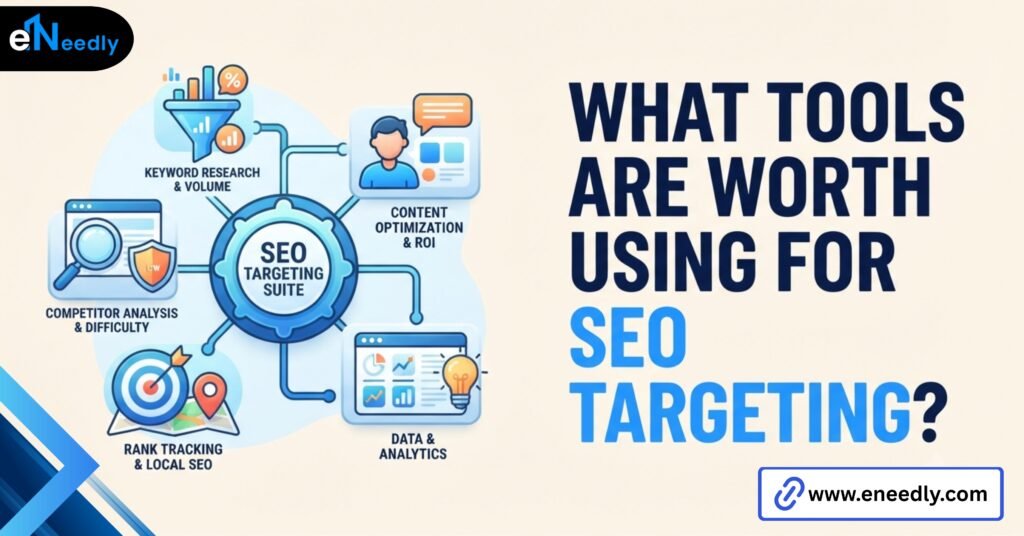
Free tools that genuinely help:
- Google Search Console shows you what you’re already ranking for (even accidentally), which is often the fastest way to find quick-win terms sitting just outside the top 10
- Google Keyword Planner’s clunky interface, but still useful for volume estimates, especially paired with other tools
- AnswerThePublic good for surfacing question-based long-tail terms real people are actually asking
- Google’s “People also ask” and autocomplete free and live and reflects actual current search behavior better than most paid tools
Paid tools worth the subscription if budget allows:
- Ahrefs or Semrush for competitive gap analysis and difficulty scoring; this is where you find what competitors rank for that you don’t
- Surfer SEO or Clearscope for on-page optimization once you’ve picked a target, making sure the content actually covers what top-ranking pages cover
Our honest take: Search Console alone, used properly, outperforms most paid tools for finding low-hanging fruit because it’s showing you real data from your own site, not modeled estimates. We tell clients to start there before spending a dime on anything else.
Where Does On-Page SEO Fit Into Targeting?
Picking the right keyword is half the job. On-page SEO is making sure the page actually earns the rank you’re aiming for.
This is the part that gets rushed. A client picks a great target keyword, writes solid content, and then the title tag says something generic like “Home” or “Blog Post 12.” That’s a missed opportunity sitting in plain sight.
At minimum, your target keyword (or a close natural variation) needs to show up in:
- The title tag
- The H1
- The first 100 words of the page
- At least one subheading
- The URL, ideally
Beyond that, internal linking matters more than most people give it credit for. If you’ve got a services page that’s central to your business, link to it from relevant blog content using natural anchor text it tells Google that page matters, and it moves warm readers toward the page that actually converts.
We handle this kind of structural work as part of our SEO and web design services, matching keyword targets to page structure so the technical side doesn’t undercut good content.
One thing we push back on with clients: don’t stuff the keyword into every heading just because a tool told you to. If it reads awkward out loud, it reads awkward to Google’s more recent algorithms too, and it definitely reads awkward to an actual human trying to make a decision.
How Do You Know Your SEO Targeting Is Actually Working?
Rankings are the easy metric to check and the least useful one on its own. A page can rank #3 for a keyword nobody’s searching for in a way that leads to revenue, and that’s a hollow win.
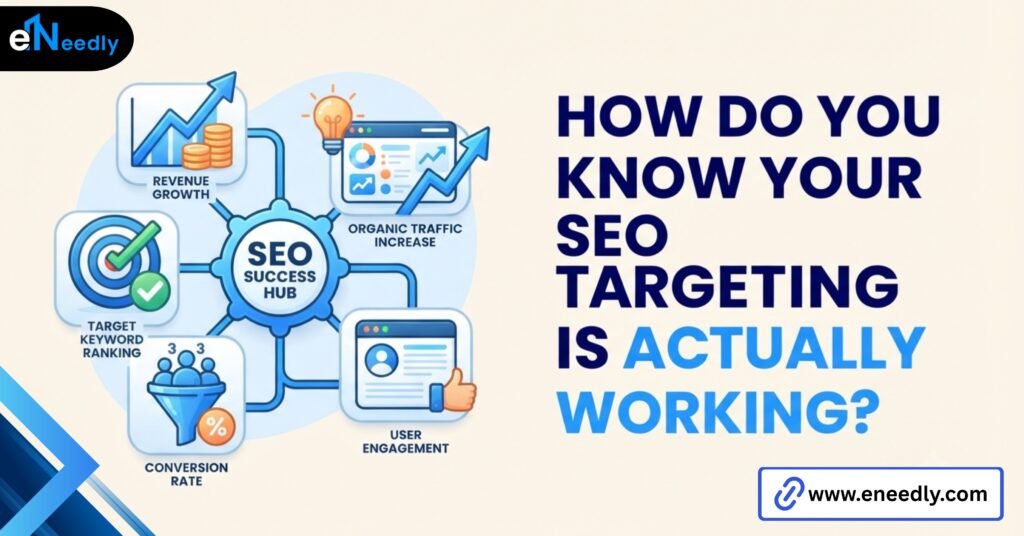
Better signals to track:
- Click-through rate from Search Console: If you’re ranking but nobody’s clicking, the title or meta description isn’t matching what searchers expect
- Time on page and bounce rate: high bounce on a page targeting a buyer-intent keyword usually means the content doesn’t match what the searcher actually wanted
- Conversions, not just traffic: a page bringing in 50 visits a month that converts at 4% often beats a page bringing in 500 visits that converts at 0%
We’ve had clients get excited about a traffic spike that turned out to be entirely informational searches with zero commercial intent nice for the ego, useless for the business.
Before celebrating a ranking win, ask what that specific searcher was actually trying to accomplish. If the answer isn’t “become a customer eventually,” recalibrate the target.
If you want a second set of eyes on whether your current pages are targeting the right terms, we offer a free consultation where we’ll walk through your site and flag the quick wins no obligation attached.
FAQs
What’s the difference between keyword research and keyword targeting?
Keyword research is the discovery phase, gathering data on search volume, competition, and related terms. Keyword targeting is the decision phase of assigning a specific keyword to a specific page and building that page to win that exact search. Research feeds targeting, but they’re not the same step.
Should small businesses target short-tail or long-tail keywords first?
Generally, long-tail first. They’re less competitive, easier to rank for on a newer site, and tend to convert better because they reflect specific intent. Short-tail terms are worth pursuing once you’ve built some domain authority and ranking history.
What are the best free tools for SEO keyword targeting?
Google Search Console tops the list, since it shows real ranking data from your own site. Answer The Public and Google’s autocomplete/”People also ask” features are also solid for finding long-tail, question-based terms without spending anything.
How many keywords should one page target?
One primary keyword per page, supported by two or three closely related variations. Targeting too many unrelated terms on a single page dilutes relevance and usually means the page ranks weakly for all of them instead of strongly for one.
Does on-page SEO matter more than keyword selection?
They work together picking the right keyword. Without solid on-page structure, it means you’re aiming at the right target but not equipped to hit it. Both need attention; neither compensates fully for the other.
How often should we revisit our SEO targeting strategy?
Quarterly is a reasonable baseline for most businesses, though fast-moving industries may need more frequent check-ins. Search behavior, competitor content, and even your own business focus shift over time, and a targeting strategy built a year ago may no longer match current demand.