
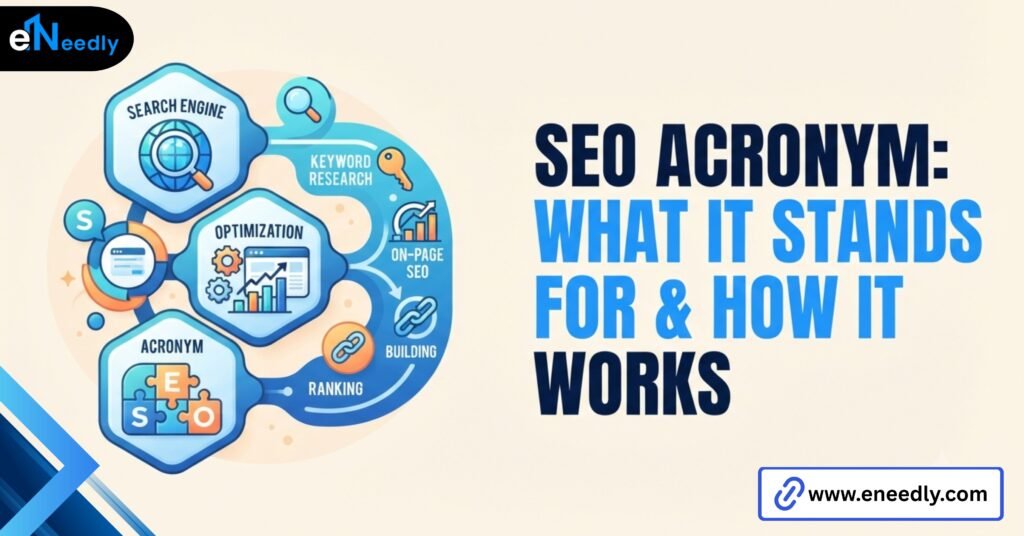
Quick Answer: SEO stands for Search Engine Optimization, the practice of improving a website so it ranks higher in Google’s organic (unpaid) search results.
It works by aligning your site’s technical setup, content, and reputation with what search engines look for when deciding which pages deserve the top spots.
Done right, it brings in traffic that keeps showing up long after you stop actively working on it. If you’ve ever nodded along in a meeting when someone mentioned “SEO” without actually knowing what the letters stood for, you’re not alone.
We get some version of this question from almost every new client, usually followed by the real one: does this actually work, and how long until I see something from it? Let’s clear up the acronym first, then get into what actually matters.
SEO Acronym: What It Actually Stands For
SEO is short for Search Engine Optimization. Three words, and each one matters more than people give it credit for.
“Search engine” is the obvious part; we’re talking about Google mostly since it handles the overwhelming majority of searches in the US, with Bing and increasingly AI search tools like ChatGPT and Perplexity picking up a growing slice.
“Optimization” is where the real work lives. It means adjusting things like your site’s code, your page content, and the links pointing at your domain so that a search engine’s algorithm reads your site as relevant and trustworthy for a given query.
Here’s the part people miss: optimization isn’t a one-time checklist. It’s ongoing. We’ve had clients treat SEO like a website launch task: set it up once, never touch it again, and then wonder six months later why a competitor with a worse-looking site is outranking them. The competitor just kept working on it.
One quick distinction worth making since it trips people up in sales calls: SEO is not the same as SEM (Search Engine Marketing). SEM is the broader umbrella that includes paid ads. SEO is specifically the unpaid, organic side of that equation.
What Is SEO and How It Works, in Plain English
This is the question underneath the acronym question, and it deserves a real answer instead of a jargon dump.
Search engines send out crawlers (Google’s is called “Googlebot”) that constantly scan the web, following links from page to page, reading content, and storing what they find in a massive index. Think of it as a library catalog of basically the entire internet. When someone types a search query, Google isn’t searching the live web in that instant. It’s searching its index and running an algorithm to rank the pages it thinks best answer that specific query.
That algorithm weighs a lot of factors, but they generally fall into three buckets:
- Relevance: Does this page actually address what the person is searching for?
- Does authority do other reputable sites link to or reference this page, suggesting it’s trustworthy?
- User experience: Does the site load fast, work on mobile, and keep people from immediately hitting the back button?
We’ve found that most small business sites fail on authority first, technical stuff second, and content relevance third, which is the opposite order most business owners assume.
They’ll spend weeks perfecting blog copy while their site takes six seconds to load on a phone. Google notices the six seconds before it notices the copy.
Why the SEO Acronym Matters More in Marketing Than People Assume
Ask ten marketers what SEO in marketing actually means day-to-day, and you’ll get ten slightly different answers, which is part of why the term gets thrown around so loosely.
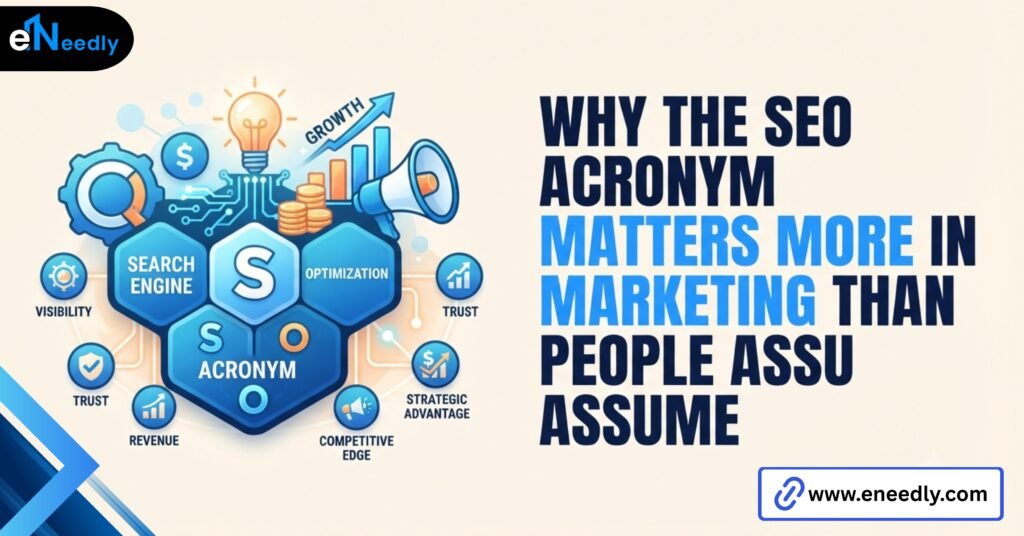
In practice, SEO acronym marketing conversations usually split into three functional areas:
- Technical SEO: site speed, mobile-friendliness, crawlability, security (HTTPS), and structured data. The plumbing.
- On-page SEO: content, keyword targeting, title tags, header structure, internal linking. What’s actually on the page.
- Off-page SEO: backlinks, citations, brand mentions, reviews. What other parts of the internet say about you.
A lot of agencies sell “SEO” as if it’s one service. It’s really three disciplines that need to work together.
We’ve walked into audits where a client’s previous agency wrote genuinely solid blog content; on-page was fine but never touched a single technical issue, and the site had a broken sitemap the whole time. Great content sitting behind a locked door Google couldn’t even get through.
This is also where the marketing side gets political inside a company. Whoever owns “SEO” often ends up owning content strategy, web dev priorities, and PR relationships all at once, because all three feed the same goal.
If nobody owns it, it tends to fall through the cracks — everyone assumes someone else is handling it.
SEO Acronym for Business: Why Small Businesses Can’t Skip It
For a solo consultant or a regional service business, SEO-acronym business questions usually come down to one thing: is this worth the money compared to just running ads?
Our honest answer, every time: it depends on your timeline and your margins.
Paid ads get you visibility immediately, but the second you stop paying, the traffic stops. SEO is slower to build realistically, three to six months before you see meaningful movement on competitive terms, but it compounds.
A blog post or service page ranking well on page one can keep bringing in leads for years with minimal upkeep. We’ve seen local service pages built two years ago still pulling in monthly inquiries without a single dollar of ongoing ad spend behind them.
That said, SEO isn’t free just because you’re not paying for clicks. It costs time, or it costs you paying someone (an agency, a freelancer, or an in-house hire) to do the work properly. The businesses that get burned are the ones expecting SEO to be both free and fast. Pick one.
A few signs a small business genuinely needs to prioritize SEO right now:
- You’re relying entirely on referrals or a single ad channel for new business
- Competitors show up above you for your own brand name or core service terms
- Your Google Business Profile has fewer reviews or worse ranking than a competitor with a clearly inferior product
If any of those sound familiar, it’s usually not a “someday” problem. It compounds the longer you wait, because competitors’ rankings today are building authority you’ll eventually have to out-earn.
Common SEO Mistakes We See Small Businesses Make
Most of these aren’t dramatic. They’re small, cumulative oversights that quietly cap how well a site can perform.
Keyword stuffing that reads like a robot wrote it. Cramming “best plumber in [city]” into every other sentence doesn’t fool anyone, least of all current Google algorithms, which have gotten very good at spotting unnatural repetition and will often suppress a page for it rather than reward it.
Ignoring Google Business Profile. This one’s worth its own callout, honestly. Most local businesses obsess over blog posts and forget their Google Business Profile. That’s a mistake. In our experience, an optimized GBP listing with real reviews often outranks a stack of blog content — especially for “near me” searches. Fix that first.
No internal linking strategy. Pages exist as islands. Nothing links to the service pages that actually make money, so Google and visitors struggle to find them through natural navigation. If you’re producing content but not connecting it back to your core offerings, you’re leaving easy wins on the table. Something as simple as linking from a blog post to a well-structured web design and SEO services page can meaningfully shift how both users and search engines move through a site.
Chasing rankings for the wrong keywords. Ranking #1 for a term nobody searches is worthless. We’d rather see a client rank #4 for a keyword with real monthly search volume and buyer intent than #1 for a vanity term that gets 12 searches a month.
Treating website copy like a brochure instead of an answer. Pages that talk about the business (“We’re passionate about quality!”) instead of answering what the searcher actually typed tend to underperform pages that just… answer the question directly.
How Long Does It Take to See SEO Results?
This is the question every business owner actually wants answered, even when they ask something else first. Realistically, technical fixes (broken links, site speed, missing meta tags) can show impact within a few weeks.
Content and authority-building, the stuff that moves competitive rankings, usually takes three to six months to show clear traction and up to a year for genuinely competitive terms in crowded markets.
There’s no legitimate shortcut around this timeline. Anyone promising page-one rankings in two weeks for a competitive term is either misunderstanding the algorithm or selling something that won’t last.
Google has run enough algorithm updates specifically targeting manipulative shortcuts (link farms, keyword stuffing, and thin content) that the “fast” tricks from five years ago now actively hurt sites that still use them.
Do You Need an Agency, or Can You DIY It?
Depends on your bandwidth and how competitive your market is. If you’re a solo operator in a low-competition niche, tools like Google Search Console, a solid WordPress SEO plugin, and consistent effort can genuinely get you there without outside help. We’ve seen it happen.
If you’re competing against ten other businesses in a metro area for the same handful of high-value keywords, DIY SEO becomes a part-time job on top of your actual job — and most business owners don’t have that time to spare.

That’s usually the point where bringing in outside help pays for itself faster than grinding it out solo.
Either way, it helps to actually understand what’s being done to your site, even if someone else is doing it. That’s part of why we walk clients through the reasoning behind changes instead of just handing over a report full of jargon.
If you want a second opinion on where your site currently stands, a free consultation is a low-pressure way to find out what’s actually fixable versus what’s just noise.
FAQs
What does SEO stand for exactly?
SEO stands for Search Engine Optimization. It’s the process of improving a website so search engines like Google rank it higher in organic (unpaid) search results, based on relevance, authority, and user experience.
Is SEO a one-time task or ongoing work?
Ongoing. Search algorithms update constantly, competitors keep publishing content, and rankings shift accordingly. Treating SEO as a “set it and forget it” task is one of the most common reasons businesses lose rankings they’d previously earned.
How much does SEO typically cost for a small business?
It varies widely based on competition and scope; freelancers might charge a few hundred dollars a month, agencies more, and DIY costs time instead of money. The right number depends on your market’s competitiveness and how fast you need results.
What’s the difference between SEO and SEM?
SEM (Search Engine Marketing) is the umbrella term covering both paid ads and organic search. SEO is specifically the organic, unpaid side — improving rankings without paying per click.
Can I do SEO myself without hiring anyone?
Yes, especially in low-competition niches, using tools like Google Search Console and a good SEO plugin. In competitive markets, though, DIY SEO often turns into a significant time sink that outside help can handle more efficiently.
Does having a blog actually help my SEO?
Yes, but only if it targets real search terms your customers use and links back to your service pages. A blog with no clear keyword strategy or internal linking rarely moves rankings on its own.