
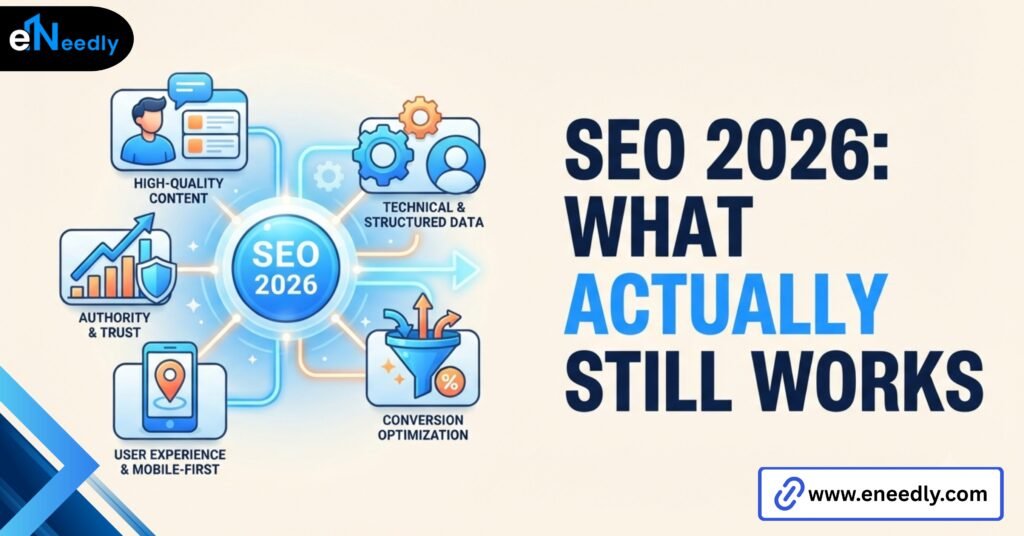
SEO 2026: What Actually Still Works?
Quick Answer: SEO in 2026 still runs on the fundamentals: solid technical health, content that genuinely answers the query better than what’s already ranking, and real-world authority signals, but Google’s frequent core updates (three broad ones between December 2025 and May 2026 alone) have made “information gain” and firsthand expertise the deciding factor between pages that rank and pages that don’t.
If you’re only rewriting existing top-ranking content instead of adding something to it, that’s the first thing to fix. Most of the SEO advice floating around right now is either recycled from 2023 or so vague it’s useless for an actual business trying to get found.
We’ve been in client accounts through every core update this year, and the pattern is consistent: sites that got hit weren’t doing anything wrong exactly; they were just doing what everyone else does. Here’s what we’re actually telling clients to prioritize.
Why does SEO in 2026 feel harder than it used to?
It’s not your imagination. Google ran three confirmed broad core updates in the first half of 2026: December 2025 (which read like an e-commerce reset), March 2026, and May 2026—plus a spam update and a Discover update layered in between.
That’s a lot of movement in six months, and each one has re-shuffled who shows up on page one. The March 2026 update is the one worth understanding, because it wasn’t a typical “quality recalibration” in the vague sense Google usually describes.
Analysts who tracked the winners and losers noticed Google tilting visibility toward original, brand-owned, and first-party sources and away from content that reads like a well-optimized summary of what already ranks.
If a page could disappear tomorrow and nobody would notice, because the same information exists on five other sites, that page is now more exposed than it was a year ago.
That doesn’t mean SEO “changed.” It means the gap between doing SEO properly and doing SEO as a checklist got wider. Keyword density, meta tag stuffing, and generic 800-word posts were already weak in 2023. In 2026 they’re closer to invisible.
What’s actually different about the Google SEO update in 2026?
A few things are genuinely new, not just relabeled old advice:
- AI Overviews and AI-mode search results now sit above the traditional blue links for a huge share of queries, which means some clicks that used to go to your site now get absorbed by Google’s own summary. If your content isn’t structured to be extractable (clear answers, defined terms, scannable structure), you’re invisible to that layer entirely.
- Information Gain is now something the algorithm appears to explicitly reward. Pages built from proprietary data, firsthand testing, or an agency’s own client experience are outperforming pages that synthesize what’s already on page one. This is the single biggest shift we’ve seen in how content gets evaluated.
- The line between a core update and a spam update is blurrier. Google ran a March 2026 spam update almost back-to-back with the March core update, and both hit scaled, low-value, AI-assisted content that lacked real editorial oversight.
Google has been careful to say AI content itself isn’t penalized; mass-produced content without a human actually shaping it is the target.
None of this means start from scratch. It means the businesses winning in search right now are the ones treating content as a place to say something they actually know, not a place to hit a word count.
How long does SEO take to update, and when will I see results?
This is the question we get asked in almost every first consultation, and the honest answer disappoints people: for a reasonably competitive keyword, expect 3 to 6 months before you see meaningful, stable movement and that’s assuming the technical foundation was already solid when you started.
Here’s why it’s not faster. Google has to first crawl your changes, then index them, then wait through however many ranking signal recalculations happen before your page settles into its “true” position relative to competitors.
On a well-established site with strong crawl frequency, Google might pick up a content change within days. On a newer or lower-authority site, it can take weeks just for Googlebot to notice the update happened.
Then there’s the core update timing problem. If you make changes right before a broad core update rolls out, like the ones in March or May 2026, both of which took around 12 days to complete, your results can get muddied by algorithm volatility that has nothing to do with your changes.
We generally tell clients: give any meaningful SEO change at least one full core update cycle before judging it.
Quick technical fixes (broken redirects, missing alt text, and a slow page finally getting optimized) can show smaller, faster wins sometimes within 2-4 weeks. Content and authority-building work is the slower lever. There’s no shortcut that changes that math, no matter what a course or a tool promises.
How often should you update SEO, realistically?
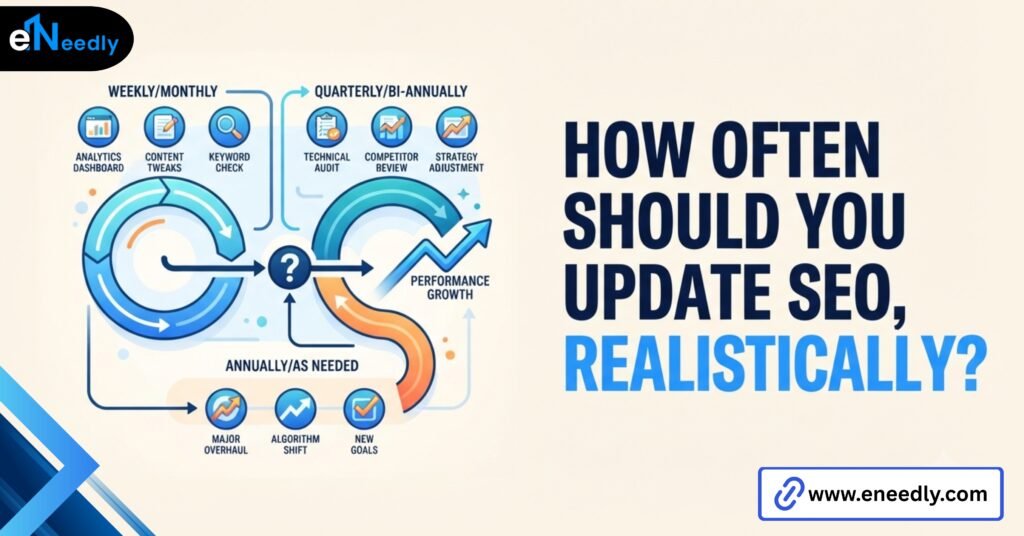
Not as often as the panic-driven advice suggests, but more often than “set it and forget it.” Here’s roughly how we schedule it for client accounts:
| What | How often | Why |
| Technical audit (crawl errors, Core Web Vitals, broken links) | Quarterly | Sites decay quietly plugins update, images get added unoptimized, redirects break |
| Content refresh on existing top pages | Every 6-9 months, or after a core update shakes rankings | Stale stats and outdated examples are an easy Information Gain penalty to avoid |
| New content publishing | Ongoing, consistency over volume | One well-researched piece a month beats four thin ones |
| Full strategy review | After each confirmed broad core update | Rankings shift, competitors move. Reacting blindly is worse than reviewing first |
The mistake we see constantly is the opposite of neglect: businesses that touch their SEO too often, out of anxiety, tweaking titles and meta descriptions weekly because a ranking dropped three spots.
That kind of thrashing makes it harder to tell what’s actually working. Slower, more deliberate changes and giving Google time to recrawl and reassess almost always outperform constant fiddling.
Should you take an SEO 2026 course or hire someone?
Depends entirely on what you’re trying to solve. If you want to understand SEO well enough to brief an agency intelligently, or you’re a solo operator with time but not budget, a good SEO 2026 course is genuinely worth it.
Look for ones updated within the last few months, since anything referencing pre-2025 ranking factors is already stale given how much has moved this year.
What a course won’t do is execute the work for you, and it won’t catch the site-specific technical issues that only show up when someone’s actually in your Google Search Console account looking at your crawl stats.
We’ve had clients come to us after finishing a course, genuinely more SEO-literate than before, still stuck because they didn’t have the bandwidth or tooling to act on what they’d learned.
Our honest take: courses are good for building judgment. They’re not a replacement for someone monitoring your account through algorithm volatility and making calls in real time. If you want both the education and the execution, that’s usually the point where hiring makes more sense than doing it yourself further on.
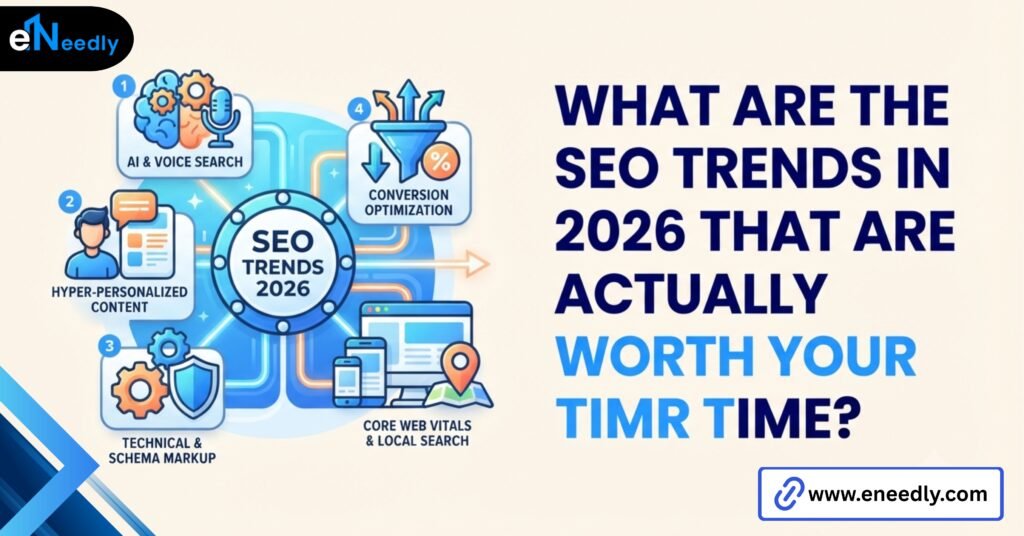
What are the SEO trends in 2026 that are actually worth your time?
A lot gets labeled a “trend” that’s really just a rebrand of an old tactic. Here’s what we think is genuinely worth attention right now and what’s just noise.
Worth your time:
- Structured, extractable content with clear headers, direct answers near the top, and scannable formatting. This helps both traditional rankings and your odds of getting pulled into an AI overview.
- First-party proof: your own data, your own case studies, your own before/after numbers. This is the clearest lever against the information gain problem.
- Google Business Profile optimization, if you’re a local business. This one’s not new, but it’s still underused. We’ve watched a well-maintained GBP listing with real, recent reviews outrank sites with far more content, purely on local intent queries.
Mostly noise, or overhyped:
- Chasing “AI SEO” tools that promise to auto-generate ranking content at scale. Given what the March 2026 spam update targeted, this is closer to a liability than a shortcut.
- Obsessing over a single ranking factor (E-E-A-T, Core Web Vitals, whatever’s trending on SEO Twitter this month) instead of treating your site as a whole system Google is evaluating.
FAQs
Is SEO still worth it in 2026 with AI overviews taking clicks?
Yes, but the math has shifted. Some informational queries now get answered directly on the results page, which does reduce clicks for pure info content.
Transactional and local searches, the ones that actually drive revenue for most small businesses, still send strong click-throughs to ranking pages. SEO isn’t dead; it’s just less forgiving of thin content.
What’s the single biggest SEO mistake small businesses make in 2026?
Publishing content that just restates what’s already on page one, worded slightly differently. It used to work when Google’s ranking signals were less sophisticated. After the March 2026 core update: Pages need to add something, a stat, a real example, or an angle nobody else covered or they’re competing with one hand tied.
Do I need to rewrite all my old content after a core update?
No. Rewriting everything reactively is one of the two most common overreactions we see (the other is doing nothing at all). Wait until the update fully rolls out, usually 10-14 days. Check which specific pages actually lost visibility, and start there. Blanket rewrites waste time on pages that weren’t affected.
How much does professional SEO cost, and is it worth it versus a course?
Pricing varies a lot by scope, but ongoing SEO retainers for small businesses typically run into the low-to-mid four figures monthly, versus a one-time course fee in the low hundreds.
A course builds knowledge; a retainer buys execution, monitoring, and someone accountable when rankings move. Which one’s “worth it” depends on whether you have the time to do the work yourself.
Does posting more content help rankings faster?
Not on its own, and it can backfire. Given how core updates in 2026 have rewarded depth and first-party insight over volume, four rushed posts a month tend to underperform one well-researched post. Consistency matters more than frequency once you’re past a baseline of regular publishing.