
Digital Marketing vs. SEO: What’s the Actual Difference?
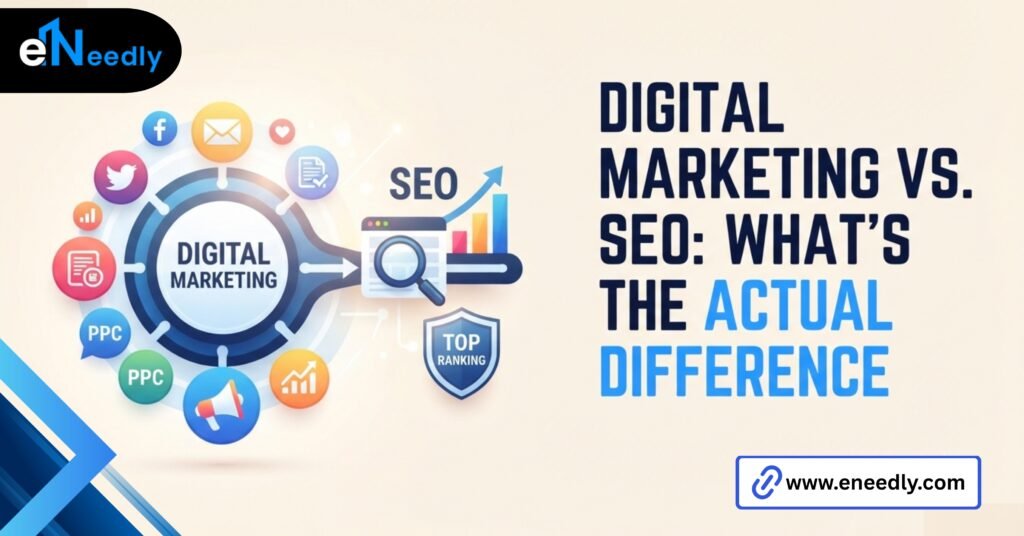
Quick answer: SEO is one channel inside digital marketing it’s the practice of getting your site to rank higher in search results. Digital marketing is the entire umbrella: SEO, paid ads, email, social media, content, and more. Think of SEO as one tool in a much bigger toolbox.
We get asked this constantly, usually by a business owner who just got off a call with an agency that quoted them $3,000/month for “SEO” and another one for “digital marketing” at a completely different price, and now they’re confused about what they’re actually buying.
Fair question. Let’s clear it up so you know exactly what you need and what you’re paying for.
So What Exactly Is SEO?
SEO stands for search engine optimization. It’s the work you do to get your website showing up higher on Google (and occasionally Bing, though let’s be honest, nobody’s optimizing for Bing on purpose) when someone searches for something related to your business.
That work breaks down into a few buckets:
- Technical SEO site speed, mobile-friendliness, crawlability, making sure Google can actually read your pages
- On-page SEO title tags, headers, content that matches what people are searching for
- Off-page SEO backlinks, mentions, the stuff that happens away from your site but still signals authority
- Local SEO Google Business Profile, citations, reviews, the stuff that matters if you have a physical location or service area
Here’s the thing people miss: SEO is slow by design. We’ve had clients ask why their new site isn’t ranking on page one after three weeks. It doesn’t work that way. Google needs to crawl, index, and build trust in your site over months, not days. Anyone promising overnight rankings is either lying or about to get you penalized.
And Digital Marketing Is… Everything Else?
Pretty much, yes. Digital marketing is the umbrella term for any marketing that happens online. SEO lives inside it, but so does the following:
- Pay-per-click advertising (Google Ads, Bing Ads)
- Social media marketing and management
- Email marketing
- Content marketing (blogs, videos, podcasts)
- Affiliate marketing
- Conversion rate optimization
- Paid social (Facebook/Instagram/LinkedIn ads)
When someone says “we need digital marketing help,” they could mean any combination of these. That’s actually the source of most of the confusion in this conversation; the term is so broad it barely means anything without more context. It’s like saying you need “transportation.” Sure, but do you need a car, a bike, or a plane ticket?
SEO vs. Digital Marketing: The Real Distinction
The cleanest way we explain this to clients: SEO is a strategy. Digital marketing is the whole game plan.
If digital marketing were a meal, SEO would be one ingredient an important one, but not the whole dish. You wouldn’t call a recipe “flour” just because flour is in it.
Here’s a table we actually use in client onboarding calls, because it tends to make the lightbulb go on faster than paragraphs do:
| SEO | Digital Marketing | |
| Scope | One channel | Umbrella term for all online channels |
| Timeline | Slow (3-12 months for real results) | Varies PPC can be instant; content is slow |
| Cost structure | Often monthly retainer or project fee | Ad spend + management fees + content costs |
| Goal | Organic visibility in search engines | Overall online growth across channels |
| Control | You don’t pay per click; you earn rankings | You often pay directly for visibility (ads) |
The distinction matters most when you’re budgeting. If your agency says “we do digital marketing,” ask them to break down exactly which channels are included and how much of your budget goes to each.
We’ve seen contracts where “digital marketing” turned out to be almost entirely paid ads with a token blog post thrown in once a month.
Do You Need SEO, Digital Marketing, or Both?
Depends on your timeline and your patience, honestly. If you need leads next week, SEO alone won’t get you there. Paid ads will. That’s just the reality of how long organic rankings take to build.
If you’re thinking two to three years out and want a sustainable source of traffic that doesn’t disappear the moment you stop paying for clicks, SEO deserves serious investment. It compounds. Ads don’t stop the day the budget runs out.
Most businesses we work with end up needing both, just weighted differently depending on the stage they’re in. A new business with zero online presence usually needs paid ads to get any traction while SEO builds in the background.
An established business with decent organic traffic might shift budget toward content and technical SEO refinements instead of ads because the foundation’s already there.
We’ve found the businesses that struggle most are the ones that pick one or the other and stick with it forever, regardless of what’s actually working.
SEO vs. Digital Marketing Salary: Which Career Path Pays More?
This comes up a lot from people considering a career change, so it’s worth addressing directly since the search volume tells us plenty of you are here for this exact question.
Broadly speaking, digital marketing roles, especially ones that oversee paid media budgets or manage multi-channel strategy, tend to sit slightly higher on the pay scale than pure SEO specialist roles, particularly at the entry level.
That’s partly because paid media roles often come with budget-management responsibility, which employers tend to compensate for.
But specialized SEO roles, particularly technical SEO and enterprise-level SEO strategy, can actually out-earn generalist digital marketing positions once you have a few years of experience.
A senior technical SEO who can audit a million-page e-commerce site and fix crawl budget issues is a rarer skill than someone who can run a competent Google Ads campaign. Rarer skills, generally, pay better.
If you’re weighing a digital marketing course against something SEO-specific, our honest take: start broad. Learn the fundamentals of digital marketing first, how channels work together, how attribution works, and basic analytics, then specialize once you know which part of the work you actually enjoy.
We’ve seen too many people jump straight into a niche SEO certification without understanding how it fits into a bigger campaign, and it makes them less useful on an actual team, not more.
Common Mistakes Businesses Make Mixing These Two Up

A few patterns we see over and over:
Hiring an “SEO expert” and expecting a full marketing strategy. SEO specialists optimize for search. That’s it. If you also need social media management and email campaigns, you need someone else or an agency that actually covers both, not just one dressed up as the other.
Assuming digital marketing agencies are automatically good at SEO. Some are. Plenty aren’t. SEO is technical and slow, and it’s the easiest thing for a generalist agency to phone in because results take months to show up — by which point you’ve already renewed the contract.
Cutting SEO the moment cash gets tight. This one costs businesses more than anything else on this list. SEO takes months to build momentum. Pausing it right when it starts working, because a paid ads campaign looks more exciting on a monthly report, means starting the slow climb over again later.
Confusing rankings with revenue. We’ve had clients thrilled about ranking #1 for a keyword that gets eleven searches a month. Ranking matters only if the keyword has real intent and volume behind it.
If you’re evaluating a provider for either service, our digital marketing services page breaks down exactly what’s included in each package worth a look before you sign anything so you know what you’re actually buying.
How to Tell If Your Current Provider Is Doing SEO or Just Calling It That
Ask for specifics. A real SEO provider should be able to tell you the following:
- What keywords they’re targeting and why those specific ones
- What technical issues they found on your site (there are always some)
- What your current organic traffic looks like month over month
- What link-building or content strategy they’re running
If the answer is vaguely “We’re optimizing your site for search engines” without any specifics, that’s a red flag. Good SEO work is measurable. You should be getting actual reports with actual numbers, not a paragraph of reassurance.
We’ll admit some bias here since this is literally our business, but if you want an outside opinion on whether your current setup is doing what it should, we offer a free consultation where we’ll look at what you’ve got and tell you straight no upsell pressure, just an honest read on where you stand.
FAQ
Is SEO part of digital marketing or separate from it?
SEO is one channel within digital marketing, not a separate discipline. Digital marketing includes SEO alongside paid ads, email, social media, and content marketing. Any agency treating them as entirely separate services is either being imprecise with language or trying to upsell you on things you may not need.
Which is better for a small business — SEO or digital marketing?
Neither is inherently “better”; it depends on your timeline. Need fast leads? Lean toward paid ads. Building long-term, sustainable traffic? Invest in SEO. Most small businesses eventually need a mix of both, just in different proportions depending on their growth stage.
How long does SEO take to show results compared to other digital marketing channels?
SEO typically takes 3-6 months for early movement and 6-12 months for solid results. Paid ads can generate traffic same-day. Email marketing results depend on list size and quality. This timeline difference is the single biggest factor in deciding where to put your first dollar.
Should I take a digital marketing course before specializing in SEO?
Generally, yes. A solid digital marketing course gives you the fundamentals of how channels interact and basic analytics and attribution before you specialize. Jumping straight into SEO-only training can leave gaps in how your work fits into a broader marketing strategy, which matters once you’re working with a team.
Do digital marketing agencies always include SEO in their packages?
Not always. Some agencies focus heavily on paid ads or social media and treat SEO as an add-on or skip it entirely. Always ask for a clear breakdown of exactly what channels are covered in your package before signing. “Digital marketing” can mean very different things between providers.
Is it worth paying separately for SEO and digital marketing, or bundling them?
Bundling often makes sense if your provider is genuinely skilled at both; it keeps your strategy consistent across channels. But if a bundled package is vague about what’s actually being done for SEO specifically, you’re better off separating the services so you can measure each one’s performance independently.