
Quick Answer
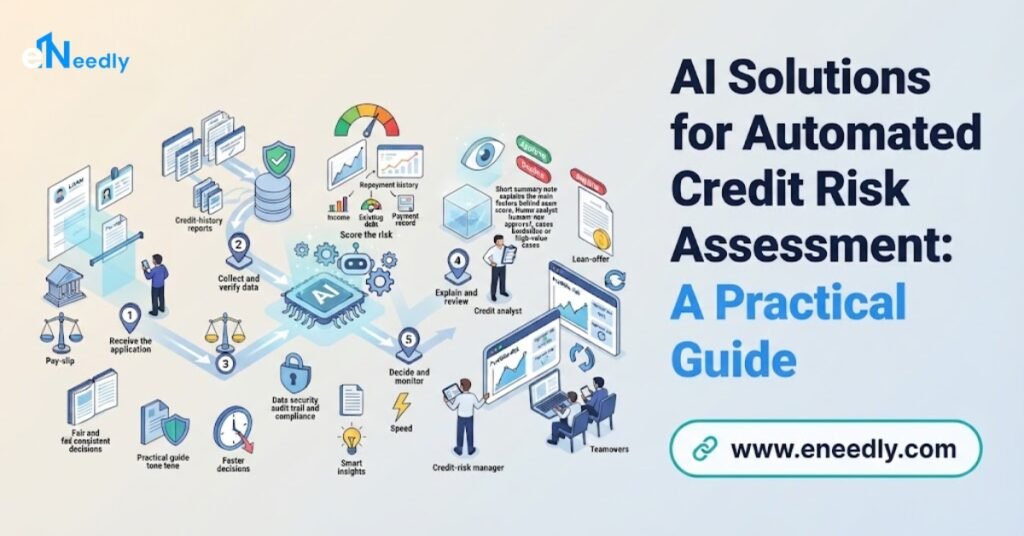
AI solutions for automated credit risk assessment read applications and financial documents, check the data, score the level of risk, and flag issues, so credit officers can make faster and more consistent lending decisions.
The final decision stays with your people, supported by clear reasons for every score. eNeedly designs and builds these solutions around your own lending process, data, and policies.
Every lender faces the same challenge. Applications keep arriving, each one comes with a stack of documents, and every decision carries real financial risk. Credit teams spend hours reading statements, typing numbers into spreadsheets, and checking details, long before they can think about the actual question: will this borrower repay?
That is where AI solutions for automated credit risk assessment can help. They take over the reading, sorting, and calculating, so your experts can focus on judgment. In this guide, we explain what these solutions do, how to judge them, and how eNeedly can help you build one that fits your business.
What Is Automated Credit Risk Assessment?
Credit risk assessment is the process of judging how likely a borrower is to repay a loan or credit line. It looks at a borrower’s finances, history, and circumstances, and ends with a decision on whether to lend, how much, and on what terms.
Automated credit risk assessment uses software and AI to handle the repeatable parts of this work. The system gathers the data, reads the documents, calculates the key numbers, and prepares a clear risk summary. A credit officer then reviews it and makes the decision.
A well-built solution can:
- Collect applicant data from forms, files, and connected systems.
- Read documents such as financial statements and bank records.
- Check the information for gaps, conflicts, and unusual values.
- Calculate key measures such as ratios and cash flow figures.
- Score the level of risk based on your own rules and past results.
- Explain the result in plain language, so reviewers know why.
The goal is not to remove people from lending. It is to give them better information, faster.
Why Is Manual Credit Risk Assessment Slow and Risky?
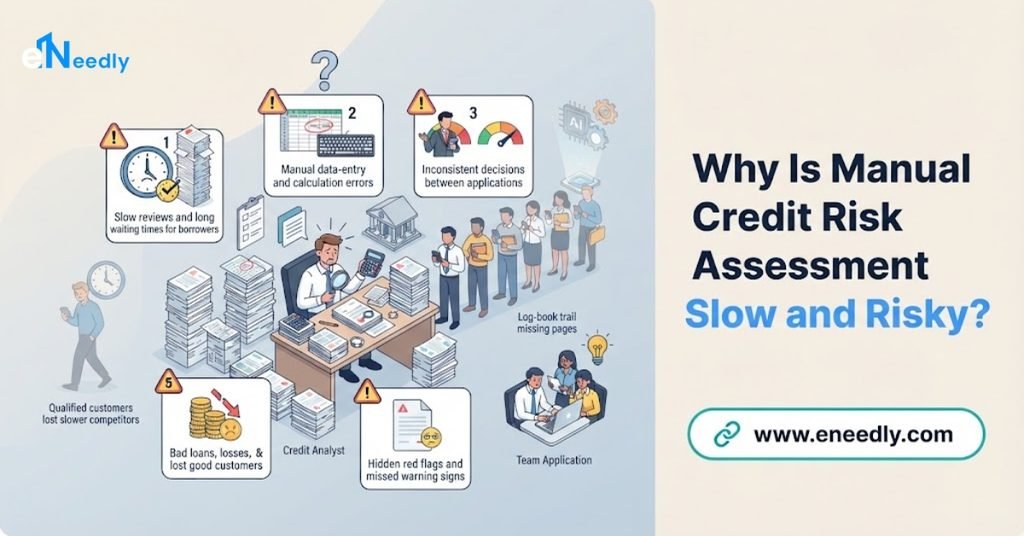
Many lenders still rely on a mix of paper files, PDFs, emails, and spreadsheets. This works at small volumes. As the business grows, problems appear.
Here are the most common ones:
- Slow turnaround: Reading and entering data by hand takes hours for each application, so borrowers wait.
- Repeated data entry: The same figures are typed into several places, which invites mistakes.
- Inconsistent decisions: Two officers may treat similar applications differently, depending on their time and experience.
- Missed warning signs: Important details hide in long documents and are easy to overlook under pressure.
- Limited capacity: Your team can only review so many applications at once, so good opportunities are delayed or lost.
- Weak records: It can be hard to show later exactly what was reviewed and why a decision was made.
- Late detection of problems: Without regular monitoring, signs of trouble in existing accounts appear too late.
These problems cost time, money, and trust. They also leave your best credit experts buried in routine work.
How Do AI Solutions for Credit Risk Assessment Work?
A strong solution follows a clear path from application to decision support.
Intake: Applications and documents arrive from forms, email, portals, or shared folders and are collected in one place.
Reading: AI reads each document, finds the important figures and details, and organizes them, even when layouts differ.
Checking: The system checks the data against your rules. It flags missing items, conflicts, and unusual values.
Calculating: Key ratios, trends, and measures are worked out automatically, the same way every time.
Scoring: A risk score or rating is prepared, based on your own criteria and your past experience.
Explaining: The system shows the main factors behind the score in plain language.
Review: A credit officer examines the summary, adds context, and makes the final decision.
Recording: Every step is saved, creating a clear trail for audits and later review.
People stay in charge at the point where judgment matters most, which is the decision itself.
What Data Can AI Use to Assess Credit Risk?
The data you use depends on your type of lending. Common sources include:
- Application forms: Personal or business details, requested amounts, and stated purpose.
- Financial statements: Income statements, balance sheets, and cash flow reports.
- Bank records: Account activity, balances, and regular payments.
- Payment history: Records of how the borrower has handled past credit.
- Business information: Industry, years in operation, ownership, and customer concentration.
- Supporting documents: Tax records, contracts, invoices, and similar proof.
- Account behavior: For existing customers, how they use and repay credit over time.
Data quality matters a great deal. Clean, complete, and well-organized data leads to better results. A part of every project is checking what data you have, what is missing, and how to improve it.
Which Credit Risk Tasks Can AI Automate?
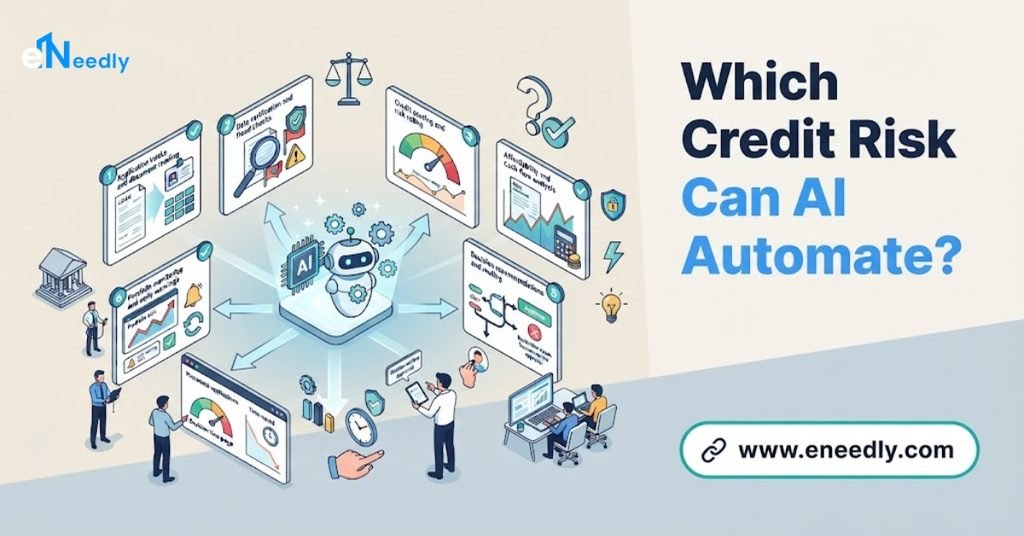
More than most lenders expect. If a task follows a pattern, AI can usually help with all or part of it.
- Document reading: Pull figures and details from statements, forms, and reports.
- Data checks: Compare numbers across documents and flag mismatches.
- Ratio calculation: Work out the standard measures your team uses, the same way every time.
- Risk scoring: Prepare a score or rating using your own rules and history.
- Early warning alerts: Watch existing accounts for signs of trouble and alert your team.
- Report writing: Draft credit summaries and memos from the gathered data.
- Policy checks: Confirm that an application meets your basic lending rules before it reaches a person.
- Follow-up requests: Ask borrowers for missing documents automatically and track replies.
At eNeedly, we start with the one or two tasks that cause the most delay, then expand from there.
How Does AI Improve Credit Decisions?
The benefits appear quickly, because the work being removed is so repetitive.
- Faster turnaround: Applications are read and prepared in minutes, so borrowers get answers sooner.
- More consistent reviews: Every application is checked against the same rules and measures.
- Fewer errors: Automated extraction and calculation remove much of the typing and arithmetic mistakes.
- Higher capacity: Your team can handle more applications without adding people.
- Better use of expertise: Credit officers spend their time on judgment, borrower conversations, and difficult cases.
- Earlier risk detection: Monitoring helps you act on warning signs before they become losses.
- Clear records: Every decision has a trail, which supports audits and internal reviews.
Speed matters in lending. A borrower who waits too long may simply go elsewhere.
Can AI Assess Credit Risk Fairly and Transparently?
This is one of the most important questions in lending, and it deserves a careful answer. Credit decisions affect people and businesses in a serious way. They must be fair, and they must be explainable.
Here is how a responsible solution handles this:
- Explainable results: The system shows the main reasons behind every score, using the principles of explainable AI. A reviewer, a borrower, or a regulator can understand why a result was reached.
- Careful choice of data: Inputs are chosen with care, and factors that could lead to unfair outcomes are avoided or tested closely.
- Regular testing: Results are checked over time for patterns that suggest bias or drift, and the rules are corrected when needed.
- Human decision-making: A person reviews and owns the final decision, especially for borderline or sensitive cases.
- Clear records: Every score and decision is stored, so it can be reviewed later.
Rules about fairness and explanation differ by region and by type of lending. Your solution should reflect the requirements that apply to you.
What Are the Risks and Limits of AI in Credit Risk?
AI is powerful, but it is not perfect. Knowing its limits helps you plan well.
- Wrong predictions: No model is right every time. Scores should support decisions, not replace them.
- Poor data: Missing or incorrect information leads to weaker results. Good data checks help.
- Changing conditions: A model built on past data may perform worse when the economy or your customer mix changes. It needs regular review.
- Over-reliance: Credit officers should keep their own judgment and not accept scores without thinking.
- Privacy: Credit data is highly sensitive and must be protected with strict access control.
- Hidden bias: Without testing, a model can reflect unfair patterns in old data.
A well-designed solution includes human review points, clear limits, ongoing testing, secure handling, and a full audit trail. eNeedly builds all of these in from the start.
What Should You Look for in an AI Credit Risk Solution?
Whether you work with eNeedly or anyone else, use this checklist to judge any solution.
- Proven accuracy checks: There should be a clear method to test and track performance over time.
- Explainable results: Every score should come with reasons that people can understand.
- Your rules, your control: You should be able to set your own criteria, limits, and approval steps.
- Audit trail: You should be able to see what the system did and why, for every application.
- Fit with your systems: It should connect to the lending, accounting, and document tools you already use.
- Handling of real documents: It must work with your actual files, including messy scans and unusual layouts.
- Security: Look for strong access controls and clear rules on how data is stored and used.
- Easy review screens: Credit officers should be able to check and correct results quickly.
- Ongoing support: Markets and policies change, so help should not disappear after launch.
If a solution cannot meet most of these points, keep looking.
Should You Buy Off-the-Shelf or Build a Custom Solution?
This is a key decision. Ready-made options can be a good starting point for simple needs. But as your lending grows more complex, they often show their limits.
A ready-made option works best when:
- Your lending products are common and standard.
- Your review process is simple.
- You do not need special rules, reports, or connections to other systems.
A custom solution works best when:
- You have your own credit policies and scoring approach.
- You handle varied documents from many types of borrowers.
- You need results to flow into your own lending, accounting, or case systems.
- You need reports and records that match the needs of your auditors and regulators.
- You want one connected process instead of several separate tools.
Many lenders find that a tailored setup saves more time in the long run, because it fits their process instead of forcing the process to fit the tool. eNeedly can help you decide which path makes sense, and we will tell you honestly if a simple option is enough.
Why Choose eNeedly for Credit Risk Automation
eNeedly is a digital solutions agency. We do not push a one-size-fits-all product. We study how your credit team works today and build a solution around your documents, your policies, and your goals.
Here is what you can expect when you work with us:
- Plain language: We explain everything clearly, even if you are not technical.
- Business-first thinking: We start with your goals, such as faster decisions and more capacity, and work backward.
- Tailored solutions: Your system is built around your process, not a generic template.
- Honest advice: If a task is not worth automating, we will tell you.
- Security and control: Your credit officers stay in charge of decisions, and your data is handled with great care.
- Long-term partnership: We stay with you after launch to improve and expand what we build.
Our aim is simple: give your credit team less paperwork and more time for real credit judgment.
Our AI Credit Risk Assessment Services
eNeedly offers services that cover the full credit assessment journey, so you can start where it makes the most sense.
- Application and document intake: We collect applications and files from email, portals, and folders into one organized flow.
- Document reading and data extraction: We pull key figures and details from financial statements, bank records, and other documents.
- Data validation: We apply your rules to flag missing, conflicting, or unusual information.
- Risk scoring support: We build scoring and rating tools around your own criteria, with clear reasons for every result.
- Review screens: We create simple screens where credit officers can examine, correct, and approve results quickly.
- Credit report drafting: We prepare summaries and memos from the gathered data for your team to finalize.
- Account monitoring: We build alerts that watch existing accounts for early warning signs.
- System integration: We send clean data and results into the tools your team already uses.
- Reporting: We turn your credit data into reports that show volumes, delays, and trends.
- Custom solutions: If your process is unique, we design something that fits it exactly.
Each service is built to solve a specific problem, and we only recommend what fits your business.
Our Step-by-Step Implementation Process
Our process is simple, transparent, and built to keep you informed.
Discovery call: We learn about your business, your team, and how credit applications move through your process today.
Opportunity map: We list the tasks that can be automated and rank them by impact and effort.
Plan and quote: You receive a clear plan, timeline, and price before any work begins.
Build: We create your solution and connect it to the tools and files you already use.
Testing: We test it on real examples and set review points for your credit officers.
Launch and training: We go live and show your team how everything works.
Support and improvement: We monitor results, fix issues, and suggest new ways to save time.
You are involved at every stage, and nothing goes live without your approval.
Get Started With eNeedly Today
Starting is easier than most people think. You do not need technical knowledge, a long brief, or a perfect plan. You only need to tell us which parts of your credit process take up too much time.
In a free consultation, we will listen to how your team works, point out where automation can help most, and explain what a first project could look like. There is no pressure and no obligation.
Ready to make credit decisions faster and more consistent? Book your free consultation with eNeedly today and see what AI solutions for automated credit risk assessment can do for your business.
Frequently Asked Questions
What is automated credit risk assessment?
Automated credit risk assessment is the use of software and AI to gather borrower data, read documents, check information, calculate key measures, and prepare a risk score or summary. A credit officer then reviews the result and makes the final decision.
How does AI assess credit risk?
AI reads applications and financial documents, pulls out the important figures, and compares them with your own rules and past results. It calculates measures such as ratios and trends, prepares a risk score, and explains the main factors behind it, so reviewers can understand and challenge the result.
Is AI credit risk assessment accurate?
It can be highly accurate and consistent, but no system is perfect. Accuracy depends on data quality, careful setup, and regular testing. That is why a good solution includes validation checks, human review, and ongoing monitoring of how the system performs.
Can AI make lending decisions on its own?
Technically it can handle simple cases, but for most lenders the best practice is to keep a person in charge of the final decision, especially for larger, borderline, or sensitive applications. AI supports the decision with faster work and clearer information. eNeedly helps you set the right limits for each type of case.
How do you keep AI credit decisions fair and explainable?
By choosing inputs carefully, testing results regularly for bias or drift, showing clear reasons for every score, keeping humans responsible for decisions, and storing a full record of each step. Requirements differ by region, so your solution should reflect the rules that apply to you.
How much do AI solutions for credit risk assessment cost?
The cost depends on the number of document types, the complexity of your scoring rules, the systems to be connected, and the level of ongoing support. Starting with one part of the process keeps the investment manageable. eNeedly provides a clear plan and quote after your free consultation.
Can the solution connect to my existing lending systems?
In most cases, yes. A well-built solution is designed to connect with the tools you already use, so your team does not have to learn an entirely new environment. We review your current setup during discovery and plan the connections before any work begins.
How long does it take to implement automated credit risk assessment?
A focused first project, such as document reading and data checks for one type of loan, can often be ready in a matter of weeks. Larger projects with scoring, monitoring, and many systems are best delivered in phases, so you see benefits early and keep gaining more as each part goes live.