
Quick Answer
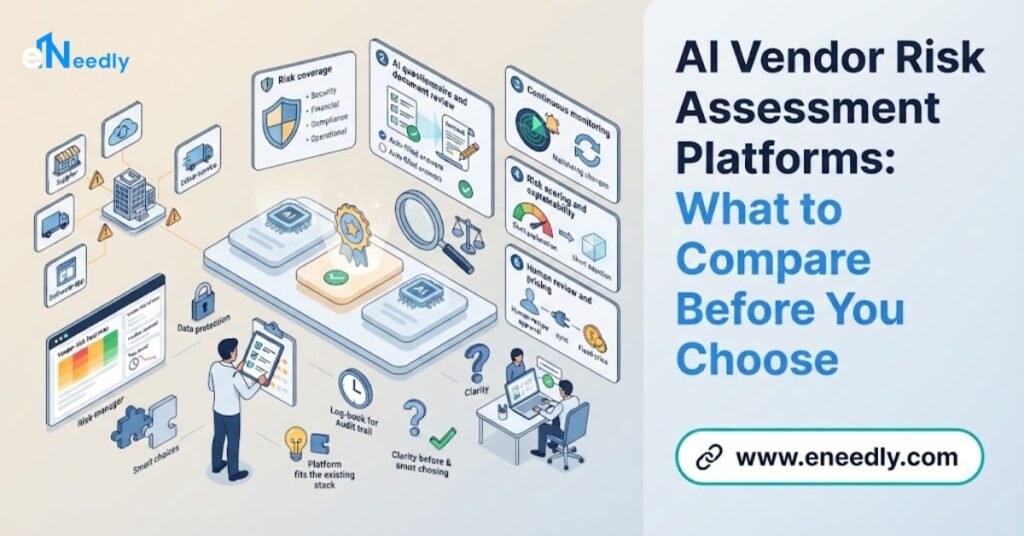
When comparing AI vendor risk assessment platforms, look at six things: how well they collect and read vendor information, how clearly they score and explain risk.
They monitor vendors over time, how easily they fit your existing systems, how securely they handle data, and how much control you keep over the process.
The right platform is the one that matches your vendors, your policies, and your team. eNeedly helps businesses compare their options honestly and build vendor risk solutions tailored to their needs.
Every business depends on outside vendors, from software providers and payment partners to suppliers and service firms. Each one gets access to something valuable: your data, your systems, your customers, or your supply chain. When a vendor fails or is breached, the damage lands on you.
That is why vendor risk assessment matters, and why so many teams are now looking at AI vendor risk assessment platforms.
But the choices can be confusing, and many tools sound alike. This guide explains what these platforms do, what to compare, and how eNeedly can help you choose or build the right solution.
What Are AI Vendor Risk Assessment Platforms?
An AI vendor risk assessment platform is a system that helps you judge how risky each vendor is, and keeps that judgment up to date. It collects information about vendors, reviews it, scores the level of risk, and tells your team where to focus.
Traditional vendor reviews rely on long questionnaires, emailed documents, and spreadsheets. AI adds the ability to read documents quickly, spot patterns, compare answers, and watch for changes without someone doing it all by hand.
A good platform can:
- Gather vendor information through questionnaires, documents, and connected sources.
- Read and check responses to find gaps, conflicts, and warning signs.
- Score and rank vendors by the level of risk they pose to your business.
- Monitor vendors over time instead of only at the start.
- Guide your team with tasks, reminders, and clear next steps.
- Keep records that show what you checked and why you made each decision.
The aim is to support your team’s judgment, not to replace it.
Why Is Vendor Risk So Hard to Manage by Hand?
Most companies begin with spreadsheets and email. That works for a handful of vendors. As the list grows, the process starts to crack.
Here are the most common problems:
- Long questionnaires: Vendors receive huge forms, and your team must read every answer.
- Slow responses: Chasing vendors for answers and documents eats up days.
- Inconsistent reviews: Different reviewers judge similar vendors in different ways.
- Point-in-time checks: A vendor reviewed once a year can change a lot between reviews.
- Hidden risks: Important details are buried in contracts, reports, and long answers.
- Too many vendors: Teams cannot review everyone in depth, so low-risk and high-risk vendors get the same treatment.
- Weak evidence: It is hard to prove later what was checked and why a vendor was approved.
The result is wasted effort on low-risk vendors and too little attention on the ones that matter most. Good platforms fix this by focusing your time where the risk is highest.
How Do AI Vendor Risk Assessment Platforms Work?
While each platform has its own style, most follow a similar flow.
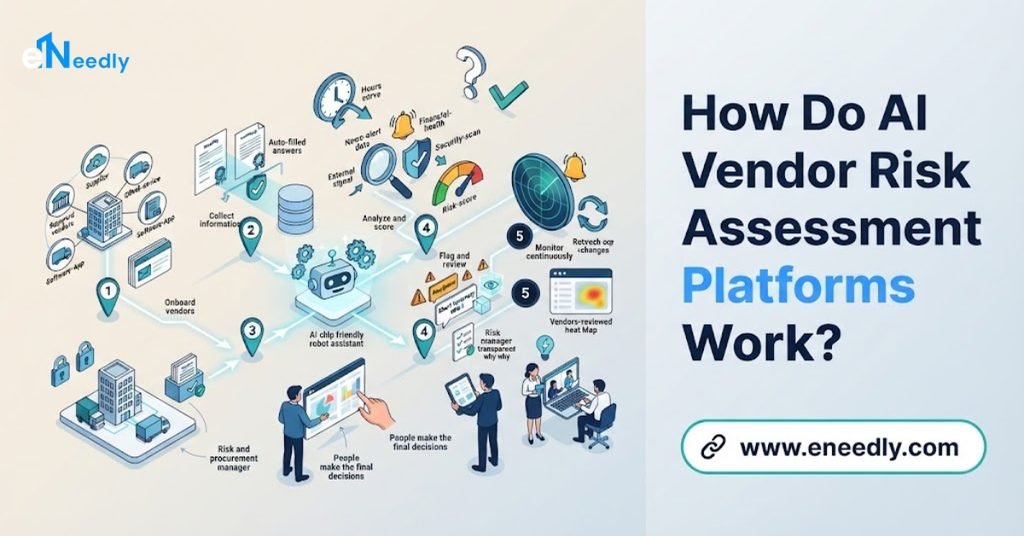
Vendor intake: You add a new vendor, and the platform records what the vendor does, what data it will touch, and how important it is to your business.
Risk tiering: The platform sorts the vendor into a risk level, so high-risk vendors get deeper checks.
Information gathering: The vendor receives a questionnaire and is asked for supporting documents.
AI review: The platform reads answers and documents, compares them with your requirements, and flags missing or concerning items.
Scoring: A risk score or rating is produced, with the main reasons shown.
Human decision: Your team reviews the findings, asks follow-up questions, and approves, rejects, or sets conditions.
Ongoing monitoring: The platform keeps watching for changes and alerts you when something needs attention.
Records and reports: Every step is stored, so you can show your work at any time.
The important point is that people stay in charge of the final decision. The platform does the reading, sorting, and watching.
What Should You Compare in AI Vendor Risk Assessment Platforms?
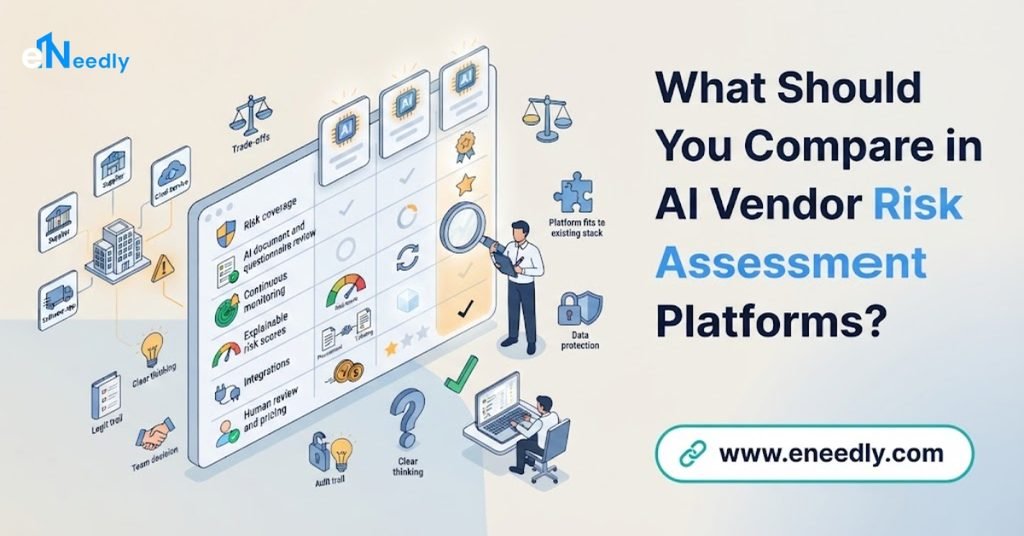
This is the question that matters most. Many platforms look similar in a demo. The differences show up in the details. Use the areas below to compare any option fairly, without relying on marketing claims.
Data Collection and Questionnaires
How does the platform gather information from vendors? Look for flexible questionnaires that you can tailor to each vendor type, easy ways for vendors to respond, and the ability to reuse earlier answers so vendors do not repeat themselves.
Document Review
Can the platform actually read the files vendors send, such as policies, reports, and certificates? Check how well it handles different layouts and scanned files, and whether it points to the exact place where it found each piece of information.
Risk Scoring and Explanation
A score without a reason is hard to trust. Compare how clearly each platform explains why a vendor received a certain rating, and whether you can adjust the scoring to match your own policies and risk appetite.
Continuous Monitoring
A vendor can change after you approve it. Ask how the platform watches for changes, what kinds of signals it tracks, and how it alerts your team without flooding them with false alarms.
Workflow and Reminders
Good platforms manage the process, not just the data. Look for task assignments, approvals, deadlines, and automatic reminders, so reviews do not stall.
Integrations
Your vendor process touches contracts, procurement, finance, and security tools. Check how easily the platform connects to the systems you already use, and what is needed to set up each connection.
Reporting and Audit Trail
Can you quickly show who reviewed which vendor, what was found, and what was decided? Strong platforms make reports easy and keep a complete history of every action.
Security and Data Handling
A vendor risk platform holds sensitive information about your vendors and your own business. Compare how access is controlled, how data is stored, and how the provider handles its own security.
Control and Flexibility
Can you decide what the AI does on its own and what needs approval? The best platforms let you set your own rules, thresholds, and review steps.
Support and Ongoing Improvement
Your vendors, risks, and policies will change. Compare what help you receive after launch, and how easily the platform can be updated.
How Do You Compare Cost and Value?
Price is only part of the picture. A platform that looks cheap can become expensive if it needs a lot of manual work, or if it cannot grow with you.
When comparing cost, think about:
- Setup effort: How much time and money does it take to get started?
- Pricing structure: Is the cost based on number of vendors, users, assessments, or features? Check how this changes as you grow.
- Hidden extras: Ask what is included and what costs more, such as integrations, support, or extra reports.
- Time saved: Estimate how many hours the platform will save your team each month.
- Risk reduced: Consider the cost of a missed warning sign or a failed audit.
- Flexibility: Think about whether you can change or expand the solution without starting over.
The best value comes from a solution that fits your process closely, so your team does less manual work around it.
Should You Buy a Ready-Made Platform or Build Your Own?
This is one of the most important decisions in the process. Neither answer is right for everyone.
A ready-made platform works best when:
- You have a standard vendor process.
- You need to get started quickly.
- You do not need special workflows or unusual connections.
- Your policies fit common practice.
A custom solution works best when:
- You have your own policies, scoring rules, and approval steps.
- You need the process to connect closely with your existing systems.
- You deal with specialized vendor types or unusual documents.
- You want full control over how data is handled.
- You want a solution that grows and changes with your business.
Many companies find that a tailored setup saves more over time, because it fits their process instead of forcing the process to fit the tool. eNeedly will help you decide, and we will say so honestly if a simple option is enough.
What Questions Should You Ask Before You Commit?
Bring a short list of questions to every conversation. The answers will tell you a lot.
How does the platform explain its scores? You should be able to see the reasons clearly.
How accurate is it with real documents? Ask to test it on your own examples, not only on samples.
How does monitoring work? Find out what is watched, how often, and how alerts are handled.
Can I set my own rules and thresholds? You should not be forced into someone else’s approach.
What happens when the AI is unsure? It should hand the item to a person, not guess.
How is my data protected? Ask who can access it and where it is stored.
What will the setup involve? Understand the time, people, and connections required.
What support is included after launch? Look for clear, ongoing help.
How easily can I leave? You should be able to export your data if you ever change course.
A provider that answers these clearly and honestly is usually a good sign.
What Are the Risks and Limits of AI in Vendor Risk?
AI is a powerful helper, but it is not perfect. Knowing the limits helps you plan well.
- Misreading documents: AI can miss or misunderstand a detail, so important findings need human review.
- Incomplete information: A platform can only judge what it can see. Vendors who hide problems may not be caught by a questionnaire alone.
- False alarms: Poorly tuned monitoring can create too many alerts, and people start to ignore them.
- Over-reliance: A score should support your judgment, not replace it.
- Data protection: The platform itself holds sensitive information and must be protected carefully.
- A false sense of safety: A neat dashboard does not mean the risk is gone. Regular review still matters.
A well-designed solution includes human review points, clear limits, careful tuning, and a full audit trail. These protections matter as much as any feature.
How Do You Roll Out a Platform Step by Step?
You do not need to move every vendor at once. Follow these steps.
List your vendors. Gather who they are, what they do, and what data or systems they touch.
Rank them by importance and risk. Start with those who matter most.
Define your requirements. Write down the policies, questions, and thresholds your platform must support. This is the heart of your due diligence process.
Compare options using the areas above. Test each on your own real examples.
Pilot with a small group. Choose a handful of vendors and run the full process.
Gather feedback. Ask your team and your vendors what worked and what did not.
Expand in stages. Add more vendors and features as the process proves itself.
This approach keeps risk low and shows results early.
Why Choose eNeedly for Vendor Risk Automation
eNeedly is a digital solutions agency. We do not push a one-size-fits-all product. We study how your business manages vendors today and build a solution around your policies, your systems, and your goals.
Here is what you can expect when you work with us:
- Plain language: We explain every option clearly, even if you are not technical.
- Business-first thinking: We start with your goals, such as faster reviews and better visibility, and work backward.
- Tailored solutions: Your system is built around your process, not a generic template.
- Honest advice: If a simple option is enough, we will tell you.
- Security and control: Your team stays in charge of decisions, and your data is handled with great care.
- Long-term partnership: We stay with you after launch to improve and expand what we build.
Our aim is simple: help you understand your vendor risk clearly, without drowning your team in paperwork.
Our Vendor Risk Assessment Services
eNeedly offers services that cover the full vendor risk journey, so you can start where it makes the most sense.
- Vendor intake and tiering: We build simple flows that record each vendor and sort it by risk level.
- Questionnaire automation: We create tailored questionnaires and handle sending, reminders, and tracking.
- Document reading: We build systems that read vendor documents and pull out the details that matter.
- Risk scoring support: We design scoring around your own policies, with clear reasons for every result.
- Review workflows: We set up tasks, approvals, and deadlines so reviews keep moving.
- Ongoing monitoring and alerts: We help you watch for changes and be told when action is needed.
- Audit-ready reporting: We create records and reports that show what was reviewed and decided.
- System connections: We link the solution to your procurement, contract, and finance tools.
- Platform selection advice: We help you compare your options honestly against your real needs.
- Custom solutions: If your process is unique, we design something that fits it exactly.
Each service is built to solve a specific problem, and we only recommend what fits your business.
Our Step-by-Step Implementation Process
Our process is simple, transparent, and built to keep you informed.
Discovery call: We learn about your business, your vendors, and how reviews are done today.
Opportunity map: We list the tasks that can be automated and rank them by impact and effort.
Plan and quote: You receive a clear plan, timeline, and price before any work begins.
Build: We create your solution and connect it to the tools you already use.
Testing: We test it on real vendor examples and set review points for your team.
Launch and training: We go live and show your team how everything works.
Support and improvement: We monitor results, fix issues, and suggest new ways to save time.
You are involved at every stage, and nothing goes live without your approval.
Results You Can Expect From eNeedly
Every business is different, but the goals of vendor risk automation are consistent. When we work with you, we aim for results like these:
- Time saved: Hours of reading, chasing, and sorting returned to your team every week.
- Faster vendor onboarding: Quicker decisions on new vendors without cutting corners.
- Better focus: More attention on high-risk vendors and less on routine ones.
- Fewer surprises: Earlier warning when a vendor changes or a problem appears.
- Consistent reviews: The same standards applied to every vendor.
- Clear records: A full trail of what was checked, who decided, and why.
We agree on clear goals at the start, so you know exactly how to measure success.
Get Started With eNeedly Today
Starting is easier than most people think. You do not need technical knowledge, a long brief, or a perfect plan. You only need to tell us how you manage vendor risk today and where it slows you down.
In a free consultation, we will listen to how your team works, point out where automation can help most, and explain what a first project could look like. There is no pressure and no obligation.
Ready to bring clarity to your vendor risk process? Book your free consultation with eNeedly today and find the right approach for your business.
Frequently Asked Questions
What are AI vendor risk assessment platforms?
They are systems that use AI to collect vendor information, read documents and questionnaire answers, score the level of risk, and monitor vendors over time. They help your team focus on the vendors that matter most and keep a clear record of every decision.
What features should I compare when choosing a platform?
Compare how it collects information, reads documents, explains risk scores, monitors vendors, manages workflows, connects to your systems, reports to auditors, protects data, and lets you control the rules. Also check what support you receive after launch.
How accurate is AI in assessing vendor risk?
AI can be fast and consistent, but it is not perfect. It can misread a document or miss something a vendor did not disclose. That is why a good platform shows its reasons, flags uncertain items for a person, and keeps humans responsible for the final decision.
Can AI replace my vendor risk team?
No. AI takes over reading, sorting, and watching, but your team still makes the decisions, talks to vendors, and understands the wider business context. Most teams find that automation gives them more time for the work that needs real judgment.
How much do AI vendor risk assessment platforms cost?
Costs vary with the number of vendors, the features you need, the connections required, and the support you want. Compare setup effort and long-term value, not only the headline price. eNeedly provides a clear plan and quote after your free consultation.
Is it better to buy a ready-made platform or build a custom solution?
It depends on your needs. A ready-made platform suits standard processes and quick starts. A custom solution suits special policies, unusual vendors, and close connections to your own systems. eNeedly can help you weigh both options honestly.
How long does it take to set up a vendor risk platform?
A focused first project, such as automating questionnaires and document review for your most important vendors, can often be ready in a matter of weeks. Larger projects with monitoring and many connections are best delivered in phases, so you see benefits early and keep gaining more.