
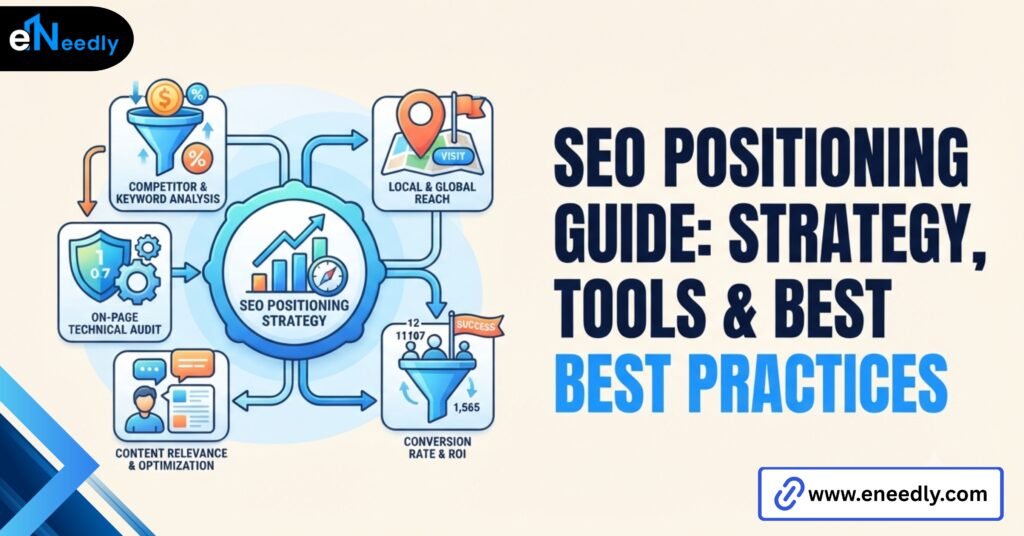
What Is SEO Positioning and How Do You Improve It?
Quick Answer: SEO positioning is where your website actually lands in search results for the terms your customers use not just “page one,” but the specific slot, snippet, or map pack spot you occupy.
You improve it by fixing technical issues that block crawling, matching content to real search intent, and building relevance signals (links, reviews, structured data) faster than your competitors do. It’s an ongoing process, not a one-time fix.
Most business owners think SEO positioning means “showing up on Google. “It doesn’t. It means showing up in the right spot, for the right search, in front of the right person and staying there while three competitors try to knock you off.
We’ve watched clients rank #1 for a keyword nobody searches for and celebrate it. This post breaks down what positioning really means, the tools worth your money, and the moves that actually shift rankings.
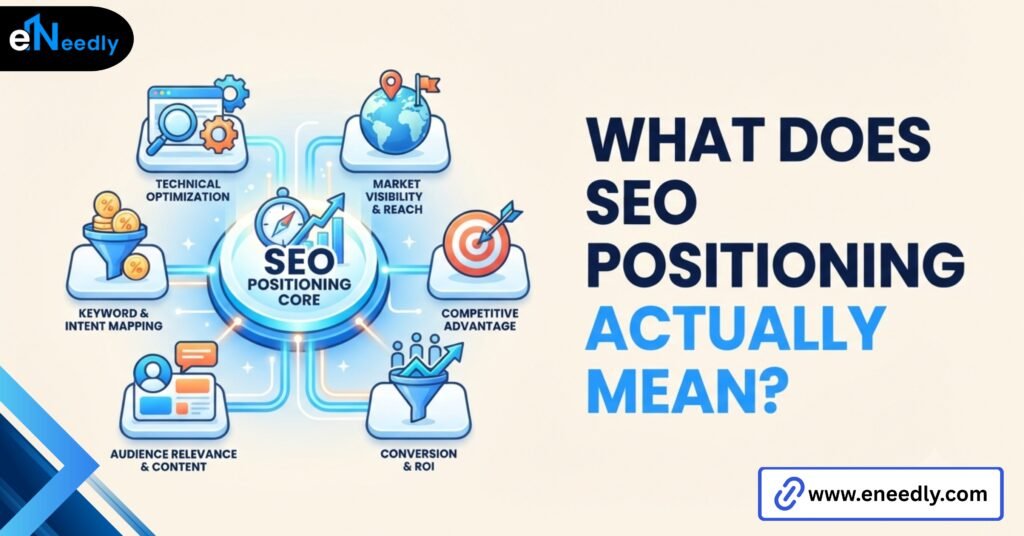
What Does SEO Positioning Actually Mean?
SEO positioning is the practice of claiming a specific, defensible spot in search results and doing it for terms that actually bring in business. Ranking #3 for “best plumber Denver” beats ranking #1 for “plumbing services industry overview.” One gets you calls. The other gets you nothing.
This is where a lot of agencies (and a lot of DIY attempts) go wrong. They chase rankings as a vanity number instead of asking what position actually earns clicks, calls, or purchases.
Google’s own SERP features complicate this further a featured snippet, a map pack, a “People Also Ask” box, and a paid ad can all sit above your organic #1 result. Real positioning strategy accounts for all of that real estate, not just the blue links.
We tell clients to think of positioning in three layers:
- Rank position where you sit on the page for a given query
- SERP feature ownership, whether you’re in the map pack, snippet, or knowledge panel
- Intent match: whether the page ranking is actually the page that should rank
Miss any one of those and you can have “good rankings” that don’t produce a single lead.
Why Does Your SEO Positioning Strategy Keep Falling Flat?
Usually it’s not one big thing. It’s three or four small things stacked on top of each other.
The most common culprit we see:
content built for keywords instead of people. A page stuffed with “SEO positioning strategy” fourteen times reads like it was written for a robot, because it was.
Google’s helpful content systems have gotten good at spotting that, and even if they miss it, your actual visitors will bounce.
The second culprit is technical debt nobody’s looked at in years. Slow load times, broken internal links, orphaned pages with no path to them, and duplicate title tags across dozens of URLs these don’t tank a site overnight, but they add friction everywhere, and friction compounds.
We’ve audited sites where the homepage took six seconds to load on mobile and the owner had no idea. Fixing that alone moved several pages up two to three positions within a month.
Third, and this one’s less technical, more strategic businesses target keywords with zero commercial fit. Ranking for a broad, high-volume term feels good on a report. It rarely converts. A term with a tenth of the search volume but obvious buying intent almost always outperforms it.
Which SEO Positioning Tools Are Actually Worth Paying For?
There’s no shortage of software promising to “unlock your rankings.” Most of it does the same handful of things with different dashboards. Here’s what we actually use day to day and why.
Google Search Console is free and non-negotiable. It’s the only tool that shows you exactly what Google thinks about your site impressions, clicks, average position, and indexing errors straight from the source. If a client isn’t using this, it’s the first thing we set up.
Ahrefs or Semrush for competitive research and backlink analysis. We lean on these to see what’s actually ranking for a target term, who links to those pages, and where the content gaps are. Pick one; you don’t need both unless you’re managing a large portfolio of sites.
Screaming Frog for technical crawls. It’ll surface broken links, missing meta descriptions, redirect chains, and duplicate content issues faster than manually clicking through a site. Free up to 500 URLs, which covers most small business sites entirely.
PageSpeed Insights / Core Web Vitals report for site speed, since speed is both a ranking factor and a conversion factor.
A quick note on all of this: tools surface data; they don’t make decisions. We’ve seen agencies hand clients a 40-page Semrush export and call it a strategy. It isn’t. The judgment on what to prioritize and what to ignore matters more than which SEO positioning tools sit in your stack.
What SEO Best Practices Actually Move Rankings Fastest?
Everyone wants the shortcut. There isn’t one, but some SEO best practices move the needle faster than others, and it’s worth knowing which.
Fixing indexing and crawlability issues tends to produce the fastest visible change, because you’re removing a barrier rather than building new equity. If Google can’t crawl a page, no amount of good content on it matters. Check your Search Console coverage report before you do anything else.
After that, on-page relevance moves fast matching your title tag, H1, and first paragraph to the actual query intent. This sounds basic. It’s shockingly rare in practice.
We regularly find pages targeting “SEO positioning strategy” where the H1 says something like “Our Digital Marketing Services” with no mention of the term anywhere near the top of the page.
Internal linking is underrated and cheap. Pointing relevant pages at your priority pages, with descriptive anchor text, passes authority around your own site without any outside effort. It’s one of the few levers you fully control.
Backlinks still matter a lot, but they’re the slowest lever to pull and the easiest to get wrong. Buying links or dropping your site in low-quality directories is a shortcut that tends to boomerang.
Earning links through legitimate outreach, partnerships, or genuinely useful content takes longer but doesn’t put your site at risk.
One thing we’d add that doesn’t get talked about enough: review velocity and Google Business Profile activity. For any business with a physical location or service area, this often moves local positioning faster than blog content does.
An optimized profile with a steady trickle of real reviews regularly outperforms a stack of articles for “near me” searches.
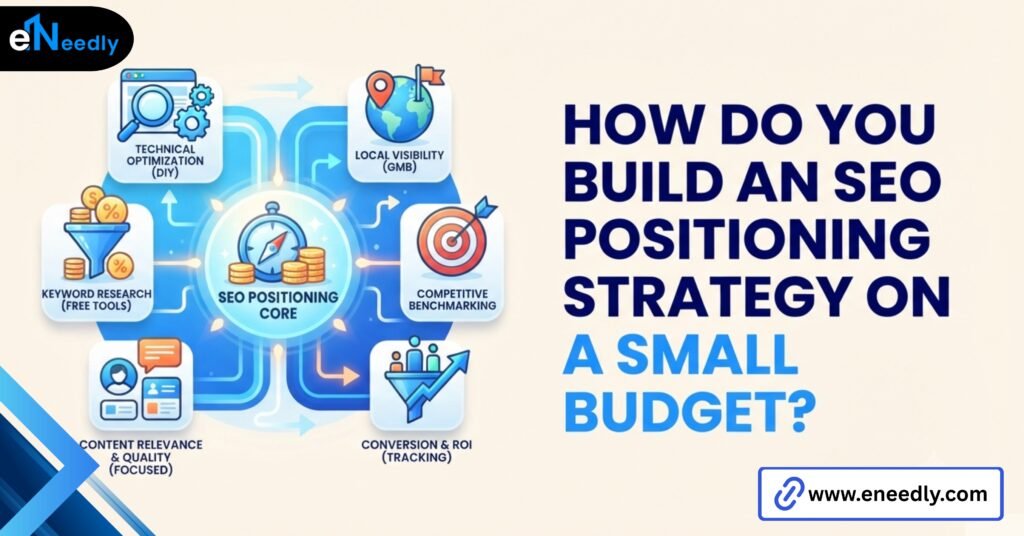
How Do You Build an SEO Positioning Strategy on a Small Budget?
You don’t need six figures. You need sequencing.
Start with a technical audit. This costs time, not money, if you’re willing to run Screaming Frog and Search Console yourself. Fix the crawl errors, the broken redirects, and the slow-loading images. This is unglamorous work, and it’s where most of the early wins live.
Next, pick a short list of five to ten keywords where intent and feasibility overlap. “Feasibility” means “Can a small site realistically compete for this term in the next six months?” A national retailer isn’t going to lose sleep over a hyper-specific, local, long-tail phrase. That’s your opening.
Then build one genuinely good page per keyword instead of five mediocre ones. We’ve had more success with a single, thorough 1,500-word page that actually answers the question than with a content calendar cranking out shallow 400-word posts every week.
Quality compounds: volume without quality just adds noise to the crawl budget.
Finally, get your Google Business Profile fully filled out, categorized correctly, and actively collecting reviews if you’re a local or service-area business. This step gets skipped constantly, and it’s often the highest-leverage thing on the list.
If you want a second set of eyes on where your current setup stands, our team walks through exactly this kind of audit as part of our SEO and web design services, which is worth a look if you’re trying to figure out where to spend limited time and budget first.
How Long Does It Actually Take to See Results?
Longer than most people want to hear, and it depends heavily on where you’re starting from. Technical fixes can show movement in two to four weeks, since you’re removing obstacles rather than building new signals from scratch.
Content and on-page changes typically take six to twelve weeks to reflect in rankings, because Google needs to recrawl, reindex, and re-evaluate relevance against competitors.
Backlink-driven authority gains are the slowest; three to six months is a realistic range for a new or smaller site, and that assumes consistent effort the whole time.
Anyone promising page-one rankings in two weeks for a competitive term is either exaggerating or planning to do something Google will eventually penalize. We’d rather set the honest timeline upfront than have a client feel misled at month two.
There’s also a compounding effect worth mentioning. The first three months often feel slow, with small movements and a few new keywords appearing on page two.
Then, if the fundamentals were done right, months four through six tend to show sharper gains because the accumulated relevance signals start reinforcing each other. It’s rarely linear.
What Mistakes Tank SEO Positioning Before It Even Starts?
A few show up over and over.
Redesigning a website without a redirect plan. This is the single most damaging mistake we see, full stop. A client migrates to a new site, all the old URLs change, nobody sets up 301 redirects, and years of accumulated ranking equity disappear in a week.
It’s entirely preventable, and it happens constantly.
Keyword cannibalization is having three or four pages all loosely targeting the same term, splitting relevance signals across all of them instead of concentrating on one. Google can’t decide which page to rank, so it often ranks none of them well.
Ignoring mobile experience. Google’s indexing is mobile-first, meaning it primarily evaluates your mobile site, not your desktop one. A site that looks great on a laptop and takes eight seconds to load on a phone is fighting itself.
Treating SEO as a project with an end date instead of an ongoing function. We’ve had prospective clients ask for “three months of SEO” as if flipping a switch. Positioning is maintained, not achieved once.
Competitors keep publishing, keep building links, and keep updating their sites. A static SEO effort slowly loses ground even if it never got anything “wrong.”
And a smaller but real one: writing content exclusively for search engines instead of the person reading it. It shows in the phrasing, the pacing, the total absence of a real opinion or specific detail. Readers notice. Increasingly, so does Google.
FAQs
What’s the difference between SEO positioning and SEO ranking?
Ranking is the raw number where you sit for a given search. Positioning is broader: it accounts for SERP features like map packs and snippets, intent match, and whether that ranking actually drives clicks or business.
You can rank well and still be poorly positioned if the wrong page ranks or a competitor owns the snippet above you.
How often should I check my SEO positioning?
Monthly is usually enough for most small businesses; weekly if you’re in a competitive market or mid-campaign on a specific push. Checking daily tends to create noise since rankings fluctuate naturally you’re looking for trend direction over four to six weeks, not day-to-day swings.
Do I need to hire an agency, or can I do SEO positioning myself?
You can absolutely do the basics yourself in Search Console, Google Business Profile, and basic on-page fixes. Where it gets harder is technical audits at scale, competitive link analysis, and knowing which of a dozen possible fixes to prioritize first. Many owners start solo and bring in help once the site’s complex enough to need it.
Does site speed really affect SEO positioning?
Yes, in two ways. It’s a direct (if modest) ranking factor through Core Web Vitals, and it’s a much bigger indirect factor: slow sites lose visitors before Google even gets a chance to judge engagement signals like time on page. We treat speed fixes as high priority for both reasons.
Can I improve SEO positioning without creating new content?
Often, yes, at least at first. Technical fixes, internal linking, title tag rewrites, and Google Business Profile optimization can all move the needle without a single new page. New content matters more once those fundamentals are solid and you’re trying to capture additional keyword territory.
How much should a small business budget for SEO positioning work?
It varies widely by market and competition, but most small businesses see reasonable traction with a modest monthly retainer covering technical maintenance, a few pieces of content, and ongoing link and profile work rather than a large one-time project. Consistency matters more than the size of any single month’s spend.