

Quick answer: Web development, SEO, marketing, and graphic design work best as one connected system rather than four separate purchases.
A well built site needs search visibility to be found, marketing to bring the right visitors, and consistent graphic design to make every touchpoint recognizable and trustworthy once they arrive.
Most businesses buy these four services one at a time, usually in whatever order a problem shows up. The website comes first, then someone notices traffic is low, so SEO gets added, then marketing, then a logo refresh somewhere along the way.
That sequence almost always costs more and delivers less than treating the four as one strategy from the start. A fast website with no SEO gets no traffic. Strong SEO pointing to a slow, poorly designed site converts almost nothing. Each piece depends on the others to actually pay off.
Why These Four Services Belong Together
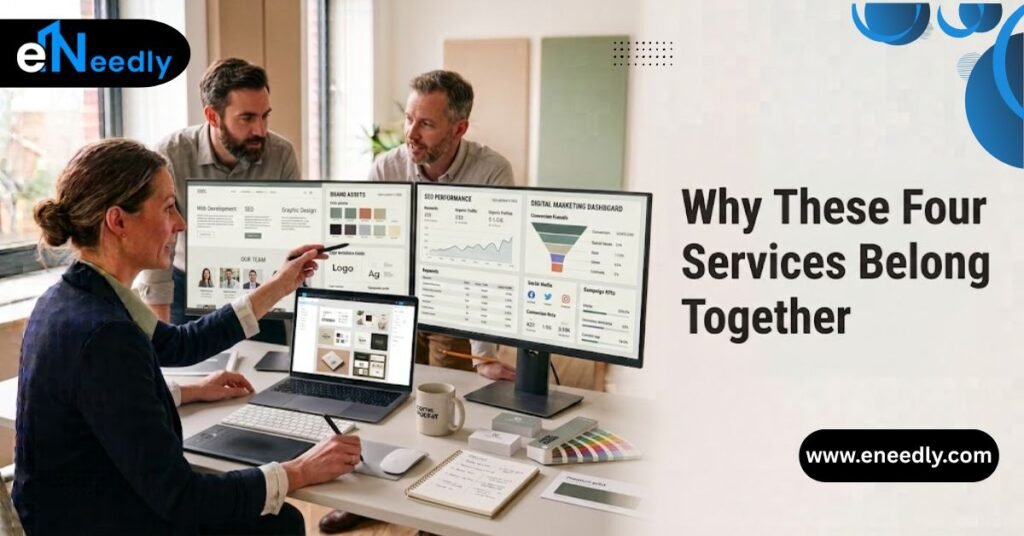
Web development, SEO, marketing, and graphic design solve different parts of the same problem: getting the right person to your business and giving them a reason to trust it once they arrive.
Treating them separately creates gaps. A beautifully designed site with no SEO strategy sits invisible on page five of search results. A strong marketing campaign driving traffic to a slow, unbranded site wastes ad spend on visitors who bounce immediately.
Development Builds the Foundation Everything Else Relies On
Site speed, mobile performance, and clean code all directly affect how well SEO and marketing efforts convert. A campaign can drive traffic, but a poorly built site is what turns that traffic away.
SEO Makes the Foundation Findable
Even the fastest, best designed site earns nothing if it can’t be found. SEO connects development and design work to actual search visibility and organic traffic.
Marketing and Design Bring People In and Keep Them There
Marketing drives the right visitors to the site, and consistent graphic design across every touchpoint, from the homepage to social ads, is what makes a business feel credible enough to convert them.
Key takeaway: Web development, SEO, marketing, and graphic design each solve a different part of the same funnel, and separating them creates gaps that cost real traffic and revenue.
The Business Case for an Integrated Approach

The data behind each of these services on its own is strong, but the real gains show up when they reinforce each other rather than operating in isolation.
SEO alone delivers a median ROI of roughly 748%, meaning businesses earn close to $7.50 for every dollar invested, a figure that consistently outperforms paid advertising over the long run.
Branding consistency adds a separate, compounding layer of return. Companies maintaining strict brand consistency across touchpoints have reported revenue uplifts in the 20 to 23% range, without any increase in ad spend, simply from looking and sounding the same everywhere a customer encounters them.
Development quality determines how much of that traffic and trust actually converts. A one second delay in page load time can measurably reduce conversions, meaning slow site performance quietly erodes the returns that SEO and marketing worked to generate.
Why Isolated Investment Underperforms
Spending heavily on SEO while ignoring site speed, or investing in marketing while brand visuals stay inconsistent, means each dollar works against friction the other services could have removed.
Compounding Returns Across Services
When development, SEO, marketing, and design reinforce the same strategy, gains in one area tend to lift performance in the others, producing returns larger than any single service delivers alone.
Key takeaway: Each service delivers strong returns individually, but the biggest gains come from letting development, SEO, marketing, and design reinforce one another.
What Each Service Actually Delivers
Understanding what each discipline covers makes it easier to see where the real overlap and dependency between them sits.
Web Development
Front end and back end work that turns a design into a fast, secure, functional site, including CMS setup so a business can manage its own content without needing a developer for every update.
Technical SEO, content strategy, and link building that make a site visible in search results, with technical SEO alone delivering roughly 117% ROI within about six months on its own.
Search Engine Optimization
Digital Marketing
Paid campaigns, email, and social strategy that bring qualified traffic to the site, working best when it points to a fast, well designed destination rather than a generic landing page.
Graphic Design
Visual identity, from logo and color palette to marketing collateral and web graphics, that keeps a business recognizable and consistent across every channel a customer might encounter it on.
| Service | Core Job | Depends On |
| Web development | Fast, functional foundation | Design direction, content structure |
| SEO | Search visibility and organic traffic | Site speed, clean technical structure |
| Marketing | Driving qualified visitors | A site strong enough to convert them |
| Graphic design | Consistent, trustworthy identity | Coordination across every channel |
Key takeaway: Each service has a distinct job, but every one of them depends on at least one of the others to fully pay off.
How These Services Reinforce Each Other in Practice
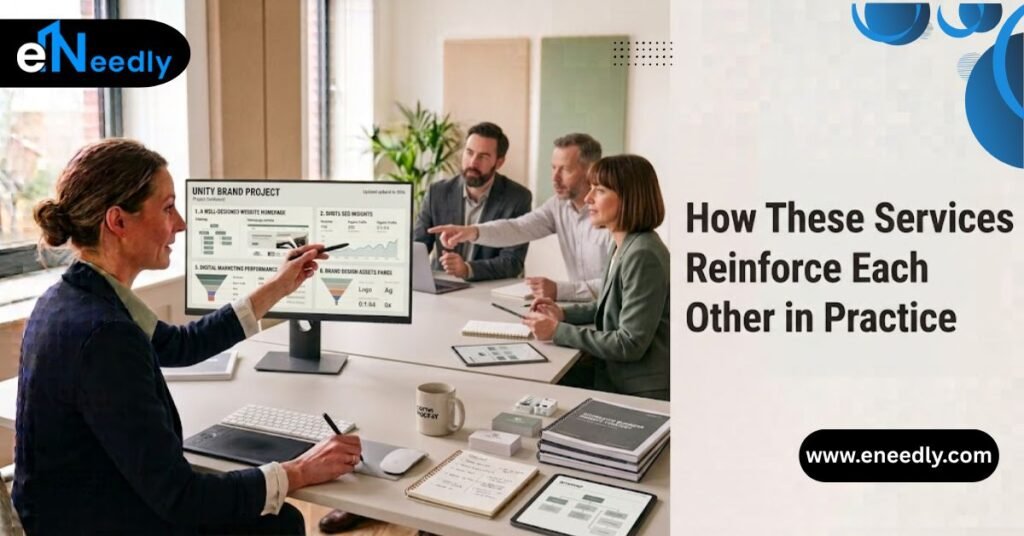
A few common scenarios show exactly where the overlap between these services becomes obvious in real business results.
A Fast Site Makes SEO Work Harder
Since site speed directly affects both search rankings and conversion rates, development quality isn’t separate from SEO performance. It’s one of the biggest levers SEO has to work with.
Consistent Design Makes Marketing Spend Go Further
A marketing campaign driving traffic to a site with mismatched branding creates a subtle credibility gap. Consistent design closes that gap and helps paid traffic convert at a higher rate.
Good Content Feeds Both SEO and Marketing
Content built for SEO, such as blog posts and resource pages, doubles as material for email campaigns and social marketing, stretching the value of a single piece of content across multiple channels.
Key takeaway: The clearest wins happen where two or more of these services reinforce the same goal, not where they operate as separate, unrelated projects.
Common Mistakes When Treating These as Separate Purchases
Businesses that buy these services piecemeal, usually in reaction to a specific problem, tend to run into the same recurring issues.
- Building a site before planning for SEO. Retrofitting SEO onto a site built without it in mind is far more expensive than planning for it from the start.
- Running marketing campaigns with no design consistency. Ads and landing pages that don’t match the site’s branding create friction that quietly lowers conversion rates.
- Treating graphic design as a one time logo project. Visual identity needs to extend consistently across the website, ads, and marketing materials, not stop after the initial branding phase.
- Ignoring site speed while investing in SEO. Ranking well only to lose visitors to a slow site wastes most of the value that SEO investment created.
- Working with separate vendors who don’t coordinate. Four disconnected teams working in isolation often produce inconsistent messaging and duplicated effort.
Key takeaway: Most of the value lost between these four services happens at the seams, where separate vendors or separate timelines fail to coordinate.
How to Approach an Integrated Project
A strong integrated project starts with a shared strategy across all four services, not four separate briefs handed to four separate teams.
- Start with a single strategy document. Define the target audience, brand voice, and business goals once, and use it to guide development, SEO, marketing, and design decisions consistently.
- Sequence the work deliberately. Development and design typically need to establish the foundation before SEO and marketing campaigns can fully perform.
- Keep design consistent across every channel. The website, ads, email templates, and social graphics should all be recognizably the same brand at a glance.
- Plan for ongoing SEO and marketing, not just launch. A site built well still needs continuous SEO and marketing work to keep generating results over time.
- Choose a team that can coordinate across disciplines. Whether that’s one agency or several vendors working closely together, coordination matters more than any single team’s individual skill.
Key takeaway: An integrated project works best when one strategy guides development, SEO, marketing, and design from the start, rather than coordinating four separate efforts after the fact.
Conclusion: Four Services, One Business Goal
Web development, SEO, marketing, and graphic design were never meant to be four separate line items. They’re four parts of the same job: getting the right person to your business and giving them a reason to trust it and take action.
The businesses that get the most from these investments treat them as one connected strategy from day one, not a series of reactive fixes added whenever a new problem shows up.
If your current setup feels like four disconnected pieces rather than one coordinated system, that’s usually a sign these services were never planned together in the first place. At eNeedly, that’s exactly the gap we work to close for clients. Reach out if you’d like a second opinion on what your setup could be doing better.
Frequently Asked Questions
Why should these four services work as one system?
Because each one depends on the others to fully pay off. A fast site needs SEO to be found, and marketing needs consistent design to convert.
How long does it take to see results from SEO efforts?
Most SEO campaigns show meaningful results within six to twelve months, with returns typically compounding as authority and rankings build over time.
Do I need graphic design if I already have a logo?
Yes, usually. A logo alone doesn’t cover consistent visual identity across your website, ads, and marketing materials, which is where most of the value comes from.
What is the difference between web development and web design?
Web design focuses on the visual appearance, layout, and user experience of a website, while web development handles the technical functionality, structure, integrations, and performance that make the site work.
Can SEO be done after a website is already built?
Yes. SEO can be implemented on an existing website, although addressing technical SEO, site structure, content, and performance during development can make optimization easier and reduce the need for costly changes later.
How do SEO and digital marketing work together?
SEO focuses primarily on earning organic search visibility, while digital marketing can include paid advertising, email, social media, and other channels. Combining them can help businesses reach audiences through both organic and paid strategies.