
Quick Answer
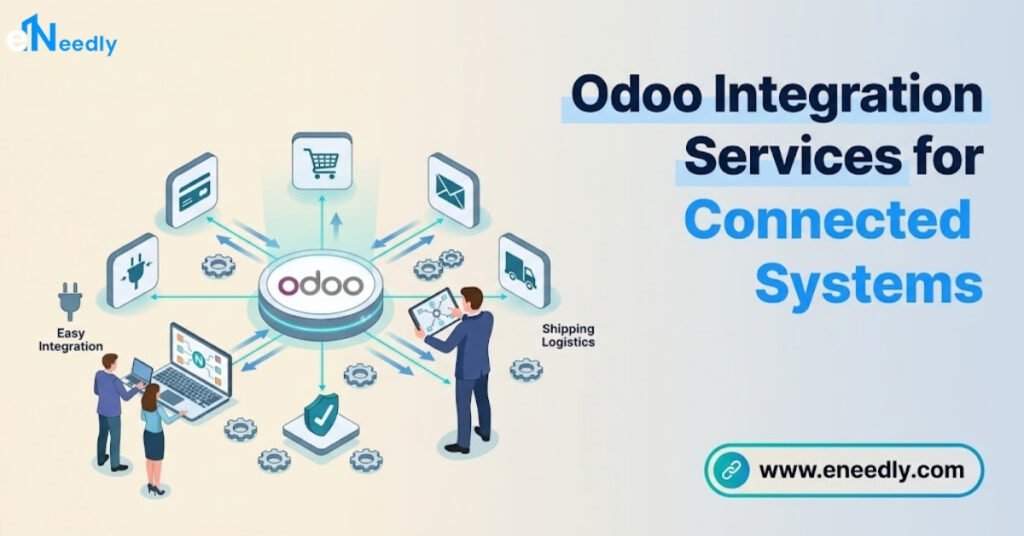
Odoo integration services connect Odoo to third-party platforms, shipping carriers, payment gateways, eCommerce tools, and proprietary internal systems, through API integration, pre-built connectors, or middleware depending on what each system supports.
Most straightforward integrations cost $2,000 to $15,000 and take 1 to 4 weeks, while complex multi-system integrations with custom data sync logic can run $15,000 to $50,000 or more over 6 to 12 weeks. The right approach always starts with checking whether a pre-built connector already exists before committing to custom API development.
Introduction
Most businesses running Odoo alongside other tools don’t have an integration problem, they have a duplicate data entry problem wearing an integration-shaped disguise.
Someone re-keys the same order into two systems because nobody built the connection between them.
Odoo integration services close that gap, connecting Odoo to whatever else a business genuinely needs to keep running, without forcing every tool into one platform.
This guide covers what integration actually involves, how eNeedly approaches these projects, what they cost, and how to choose between a pre-built connector and custom development. It complements the broader picture in eNeedly’s Odoo services overview.
What Do Odoo Integration Services Actually Cover?
Integration means connecting Odoo to an external system so data flows between them automatically, rather than requiring manual re-entry in both places.
This spans a wide range of external systems: shipping carriers, payment gateways, eCommerce platforms, proprietary internal tools, and industry-specific software with no native Odoo connection.
The technical approach varies by what the external system supports. Some integrations use Odoo’s own API integration capabilities directly, others rely on pre-built connectors already available for common platforms, and complex multi-system scenarios sometimes need dedicated middleware to coordinate data flow between several systems at once.
A genuine odoo integration consultant always checks for an existing connector before recommending custom development, since building from scratch costs more and adds more long-term maintenance than using a proven, already-tested connection.
API Integration Versus Pre-Built Connectors
Odoo exposes a comprehensive API that allows external systems to read, write, and update data programmatically. Custom odoo integration services use this API directly when no pre-built connector exists, or when the specific business logic required doesn’t match what an off-the-shelf connector offers.
Pre-built connectors exist for many common platforms, including popular payment gateways, shipping carriers, and eCommerce tools, and installing one is far faster and cheaper than building an equivalent custom integration.
Always verify a connector’s current compatibility with your specific Odoo version before assuming it will work out of the box.
When Middleware Becomes Necessary
Middleware sits between Odoo and multiple external systems, coordinating data flow and business logic that would otherwise require several separate point-to-point integrations.
This approach makes sense when three or more systems need to share data with complex routing rules, rather than each system connecting directly to every other one.
A simpler two-system integration rarely needs middleware, since a direct API connection handles that scenario efficiently. Middleware earns its added complexity only when the number of connected systems and the routing logic between them genuinely justifies it.
Common Integration Scenarios
Shipping and Logistics Integration
Businesses shipping physical products commonly integrate Odoo with carrier platforms to automate rate calculation, label generation, and tracking number sync back into Odoo’s sales orders and deliveries. This eliminates the manual step of visiting a separate carrier portal for every shipment.
Payment Gateway Integration
Payment gateway integration lets customers pay directly through Odoo’s Sales, eCommerce, or Point of Sale apps, with transaction data flowing automatically into Odoo’s accounting records. Many payment gateways offer pre-built connectors, though businesses using a less common or regional gateway may need custom API work.
eCommerce Platform Integration
Businesses running a storefront on a platform other than Odoo’s own eCommerce app, such as Shopify or a custom-built site, often need data sync between that storefront and Odoo’s Inventory and Sales apps to keep stock levels and order data accurate across both systems. This prevents overselling and keeps financial records consistent without manual reconciliation.
CRM and Marketing Tool Integration
Businesses using a specialized marketing automation or CRM tool alongside Odoo sometimes need integration to sync leads, contacts, or campaign data bidirectionally. This is particularly relevant for businesses not yet ready to fully consolidate into Odoo’s own CRM app but still wanting connected data.
Proprietary Internal System Integration
Businesses with a legacy internal tool or an industry-specific system with no existing connector need custom API development to bridge the gap. This is the most technically involved integration category, since it requires building and maintaining a connection to a system Odoo was never built to communicate with directly.
How eNeedly Approaches Integration Projects
Every integration project follows a consistent phase structure, regardless of which external system is involved.
| Phase | What Happens | Typical Duration |
| Requirement Scoping | Confirm what data needs to sync, in which direction, and how often | 2 to 5 days |
| Connector Check | Verify whether a pre-built connector exists and fits the need | 1 to 3 days |
| Development | Build custom API integration or configure the chosen connector | 1 to 6 weeks |
| Testing | Test data flow in both directions against real scenarios | 3 to 10 days |
| Monitoring Setup | Establish error alerts and sync monitoring before go live | 2 to 5 days |
The connector check phase is where many projects save significant budget. A business assuming custom development is necessary sometimes discovers a well-maintained pre-built connector already covers their exact need.
Monitoring setup deserves particular attention, since an integration that silently fails is worse than no integration at all. A business that doesn’t notice a broken sync for weeks discovers the resulting data discrepancy only after it has already caused downstream problems.
What Determines Integration Cost
Cost scales primarily with how many systems are involved, how complex the data mapping is between them, and whether a pre-built connector exists or custom development is required. A single-system integration using an existing connector sits at the lowest end of the cost range, while a multi-system integration with custom middleware sits at the highest.
Light integration, using an existing connector with standard configuration, typically costs $2,000 to $6,000 and completes within one to two weeks.
Moderate integration, involving custom API work for a single external system with straightforward data mapping, generally runs $6,000 to $15,000 over two to four weeks.
Complex integration, involving multiple systems, custom middleware, or intricate business logic governing how data routes between systems, commonly costs $15,000 to $50,000 or more and can take six to twelve weeks.
eNeedly’s Odoo customization services work often overlaps with complex integration projects, since custom business logic frequently touches both categories.
Ongoing Maintenance for Integrations
Every integration carries ongoing maintenance responsibility, since the external system’s own API can change independently of Odoo, breaking a previously working connection without warning.
This is distinct from Odoo’s own version upgrade maintenance, though both should be budgeted as recurring costs rather than one-time expenses.
A monitoring and alert system, established during the initial project, catches integration failures quickly rather than allowing them to go unnoticed.
Businesses that skip this step typically discover integration failures only when a downstream report looks wrong, by which point the underlying data gap has already grown.
Deeper custom integration work, involving new business logic rather than simply connecting two systems, falls under Odoo development services rather than integration alone, and should be scoped accordingly.
Common Mistakes in Odoo Integration Projects
Building custom integration before checking for an existing connector. Many businesses assume every integration needs custom development, when a well-maintained pre-built connector often already exists. Always check the connector landscape before committing budget to custom API work.
Skipping monitoring and error alerting. An integration with no failure notification can break silently, and the resulting data gap often goes unnoticed until it causes a visible downstream problem. Set up monitoring as part of the initial project, not as an afterthought.
Underestimating ongoing maintenance cost. External systems change their APIs independently of Odoo, and an integration built without accounting for this eventually breaks. Budget maintenance as a recurring cost from the start, not a one-time development expense.
Choosing middleware for a simple two-system integration. Middleware adds genuine value for complex, multi-system routing, but it adds unnecessary complexity and cost for a straightforward point-to-point connection. Match the technical approach to the actual number of systems and routing complexity involved.
Not testing both directions of data sync thoroughly. An integration that syncs correctly in one direction can still fail or produce incorrect data going the other way. Test bidirectional data flow against real business scenarios, not just the primary use case.
Who Needs Odoo Integration Services
Businesses running Odoo alongside specialized tools they don’t plan to replace, such as a dedicated shipping platform, a specialized POS system, or an industry-specific proprietary tool, are the clearest candidates for integration services.
This applies whether the business is newly implementing Odoo or has been running it for years alongside these other systems.
Businesses relying on manual re-entry between Odoo and another system, even for a task that feels minor day to day, often benefit more from integration than they initially assume once the cumulative time cost of manual entry is calculated honestly.
This hidden cost is frequently the strongest business case for an integration project.
Integration is a lower priority for a business running Odoo as its sole operational system with no external tools genuinely needed alongside it.
Adding integration complexity where no real external dependency exists adds cost without corresponding benefit.
Frequently Asked Questions
Does Odoo integrate with common shipping carriers?
Yes, pre-built connectors exist for many common shipping carriers, automating rate calculation, label generation, and tracking sync. Less common or regional carriers without an existing connector may require custom API development instead.
How much does an Odoo integration typically cost?
Light integration using an existing connector runs $2,000 to $6,000, moderate custom API work runs $6,000 to $15,000, and complex multi-system integrations can exceed $50,000. Cost scales primarily with system count and data mapping complexity.
What is the difference between an API integration and middleware?
A direct API integration connects two systems point to point, while middleware coordinates data flow and routing logic across three or more systems simultaneously. Middleware only earns its added complexity when multiple systems genuinely need coordinated data sync.
Do integrations require ongoing maintenance?
Yes, external systems can change their own APIs independently of Odoo, which can break a previously working integration without warning. Budget maintenance as a recurring cost and set up monitoring to catch failures quickly.
Should I always check for a pre-built connector first?
Yes, using an existing, well-maintained connector is almost always faster and cheaper than building an equivalent custom integration from scratch. Custom development should be reserved for cases where no suitable connector exists or business logic genuinely exceeds what a standard connector offers.
Can Odoo integrate with a proprietary internal system?
Yes, through custom API development, since a proprietary system by definition has no existing pre-built connector available. This is typically the most technically involved and highest-maintenance integration category.
Key Takeaways
Odoo integration services succeed when they start with checking what already exists before building something new. A pre-built connector, when available, almost always beats custom development on cost, timeline, and long-term maintenance burden.
Cost and complexity scale directly with how many systems are involved and how intricate the data routing between them needs to be, which is why middleware only makes sense for genuinely multi-system scenarios.
Monitoring and maintenance planning, established from the start rather than added after a failure, protect the business from the silent data gaps that make broken integrations worse than no integration at all.
Check whether a pre-built connector already exists for your next integration need before requesting a custom development quote.
Pingback: Custom Odoo Integration Services: API & Third-Party Guide
Pingback: Odoo Custom Development Services That Deliver Results