
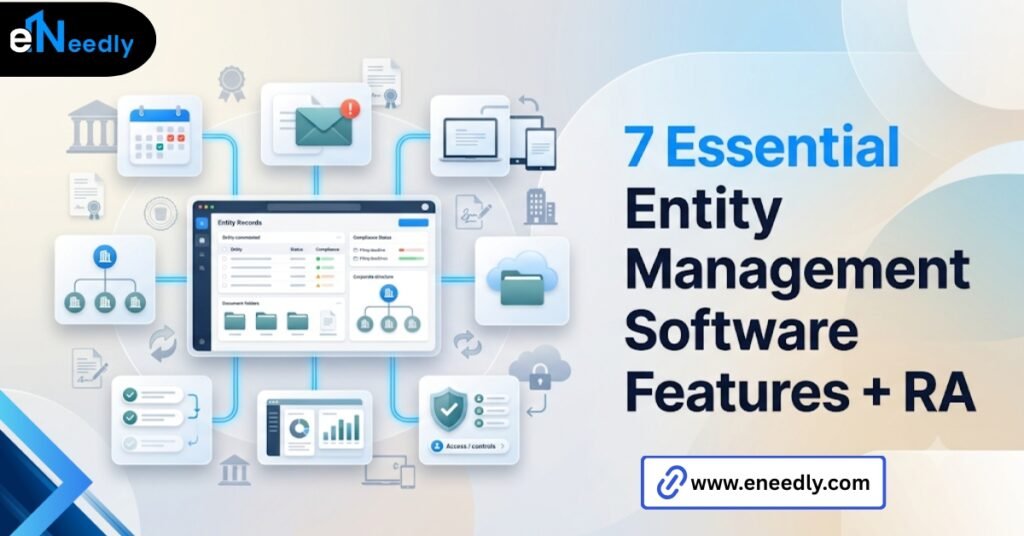
Quick Answer: Entity management software features are a centralized system that tracks corporate entities, registered agent status, compliance deadlines, and filings in one place. It pulls jurisdiction rules and due dates into one calendar that flags problems before a filing goes late.
Businesses use it to avoid administrative dissolution and fines from a lapsed registered agent. Most companies do not go looking for entity management software because a project plan told them to.
They go looking because a registered agent notice arrived late, or an annual report deadline slipped past unnoticed, and someone in legal or finance had to explain why. That is usually the real trigger. By the time a buyer starts researching, the pitch decks all look similar. Clean dashboards. Promises of centralized records.
A screenshot of a compliance calendar with everything green. What separates a platform that actually prevents the next missed filing from one that just adds another login is buried in details vendors do not lead with.
What Entity Management Software Actually Does
Entity management software is a system of record for every legal entity a company operates, along with the people, filings, and deadlines attached to each one. It replaces the spreadsheet and shared drive setup most companies default to once they pass a handful of entities.
The software itself does not file anything with a state or replace legal counsel. It tracks what is due, what has been filed, who owns what, and where the original documents live. Think of it as the operational layer sitting under corporate governance rather than a substitute for it.
Companies with a single entity rarely need this. Companies managing five, fifteen, or a hundred subsidiaries across different states or countries reach a point where a spreadsheet cannot hold the complexity without someone eventually missing something.
The Core Feature Set Buyers Actually Need
Strip away the marketing language and the feature list that matters is short. A central entity database. Document storage tied to each entity. A compliance calendar with automated alerts. Registered agent management.
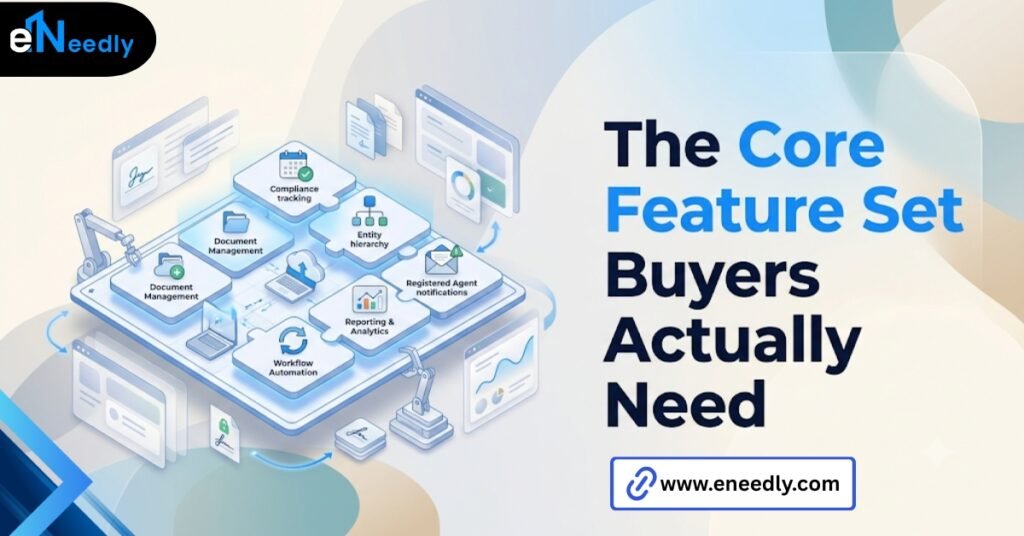
Reporting that can be handed to auditors or the board without rebuilding it from scratch. Everything else org chart visualizations, workflow builders, e-signature add-ons- is useful but secondary.
A platform that nails the five items above and skips the extras will serve a mid sized company better than one with forty features and a shaky compliance calendar.
Central entity database
This is the system of record. Every entity, its jurisdiction, formation date, officers, and ownership structure lives here, searchable and exportable.
Document repository
Formation documents, bylaws, resolutions, and amendments attached directly to the entity they belong to. Not a general file drive with folders that drift out of sync.
Compliance calendar
The single feature this whole category exists to deliver. If this part is weak, the rest of the platform does not matter much.
Registered Agent Integration, and Why Most Platforms Get It Wrong
A registered agent receives legal notices and state correspondence on behalf of a company. When that agent misses something or the information sitting in the software does not match reality, the company finds out only after a deadline has already passed.
This is the detail buyers evaluate on interface and reporting, then discover months later that the registered agent data does not actually sync with the compliance calendar. The two pieces exist on the same screen but were never truly connected on the backend.
Some platforms operate their own registered agent service directly. Others partner with a third party and pull in updates through a feed that may lag by days. That gap sounds small until a notice sits unread during those days.
Almost nobody checks, before signing, whether the registered agent service and the software are run by the same vendor or just loosely stitched together. It is one of the first questions worth asking on a sales call, not a follow up after the contract is signed.
Compliance Tracking and Deadline Alerts
Compliance tracking software works by mapping every entity to the specific filing obligations of its jurisdiction, then generating alerts on a schedule ahead of each due date. Good systems escalate. A first alert thirty days out, another at fourteen, another at three.
Weak systems send one email and consider the job done. If nobody reads that email or it lands in a folder nobody checks, the deadline still slips.
The platforms with the deepest jurisdiction coverage tend to have clunkier interfaces. The ones with the nicest dashboards often thin out on obscure state and international filing rules. That is a real trade-off, not a marketing footnote, and it is worth naming plainly before you decide.
A company operating only in Delaware and California can get away with a lighter tool. A company with entities in eight states and two countries cannot, no matter how good the interface looks in the demo.
Corporate Records and Document Management
Corporate records include formation documents, minute books, stock ledgers, resolutions, and any amendment filed since the entity was formed. Auditors, lenders, and acquirers ask for these constantly, often with short notice.
The value of digitizing them is not storage. It is retrieval speed. A well-built platform lets someone pull a specific resolution from three years ago in under a minute during due diligence, instead of digging through a filing cabinet or a former employee’s old inbox.
Version history matters here too. When a bylaw gets amended, the platform should keep the prior version accessible, not overwrite it silently.
Search that actually works
A document repository is only as useful as its search function. If finding a 2019 amendment means scrolling through a folder tree entity by entity, the repository has not really solved the original spreadsheet problem. It has just moved that problem somewhere less familiar.
Access permissions by role
Not everyone who touches the platform should see everything. Outside counsel might need read access to formation documents for one entity without visibility into every subsidiary’s financials or officer list. Platforms that treat permissions as an afterthought create their own compliance risk later.
Filings Across Multiple Jurisdictions
Every state, and every country, has its own annual report schedule, its own franchise tax rules, and its own definition of what counts as doing business there. A platform built primarily for domestic use often stumbles the moment a foreign qualification enters the picture.
Filings pile up fastest for companies expanding through acquisition. Each newly acquired entity arrives with its own compliance history, sometimes clean, sometimes years behind on a required report nobody caught before closing.
The software should surface that gap immediately during entity onboarding rather than after the next deadline passes. That single feature, a compliance gap check on import, separates platforms built for scale from ones built for a tidy demo.
Franchise tax is not the same as an annual report
These get lumped together in casual conversation, but they are separate obligations with separate deadlines, separate agencies, and separate penalties.
A platform that tracks one and quietly assumes the other is covered will eventually cost someone a late fee they did not see coming.
Foreign qualification triggers vary by state
What counts as doing business in a state, and therefore triggers a foreign qualification requirement, is not consistent across jurisdictions. A remote employee, a warehouse, or even a single signed contract can trigger it in one state and not another.
Software that flags this ambiguity for a human to review is more useful than software that guesses silently.
Governance Tools: Minutes, Resolutions, Cap Tables
Governance features cover the decisions a company makes about itself. Board minutes, shareholder resolutions, consent forms, and for many private companies, a working cap table.
Not every entity management platform handles cap tables well, and some intentionally leave that to specialized equity management tools instead. That is a reasonable scope decision, not a flaw, as long as the platform integrates cleanly with whatever handles equity separately.
Resolution templates save real time for legal teams who draft the same handful of document types repeatedly across dozens of subsidiaries. A platform without them means starting from a blank page every time.
Annual meeting compliance is easy to forget
Many states require an annual meeting, or at minimum a documented consent instead of one, to keep an entity in good standing. This obligation gets far less attention than tax filings because nobody sends an aggressive penalty notice for skipping it right away.
The risk shows up later, usually during due diligence, when a buyer’s legal team notices three years of missing minutes and treats it as a red flag on corporate formalities.
A platform that reminds a company of this obligation every year, not just once at formation, closes a gap that otherwise stays invisible until it matters most.
Officer and director changes need a paper trail
Every time an officer resigns, a director is appointed, or signing authority shifts, that change needs a resolution and, in most states, an updated filing.
Companies that skip the paperwork because the change felt informal often discover the gap when a bank or investor asks for current officer certification, and the records on file are two years stale.
Legal Entity Management for Multi-Entity Structures
Legal entity management gets genuinely difficult once ownership structures stack. A holding company owns three subsidiaries, one of which owns a joint venture, and somewhere in there an entity changed its name two years ago, and nobody updated every record.
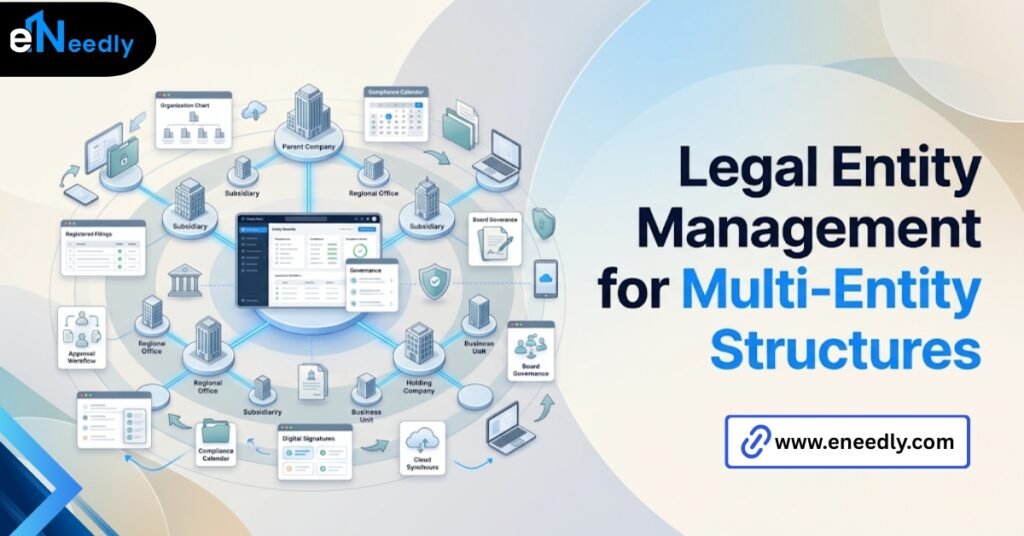
Visualizing that structure clearly, and keeping it accurate as entities merge, dissolve, or get renamed, is one of the harder problems in this category. Org chart tools that look good with five entities often become unreadable at fifty.
This is where the difference between a tool built for small business compliance and one built for complex corporate structures shows up fastest. Ask to see the org chart feature with a large sample dataset, not the vendor’s clean three-entity demo.
What Separates Serious Platforms From the Rest
The feature that gets marketed hardest, the dashboard, is rarely what saves a company from a missed filing. The calendar and alert logic sitting underneath does that work, quietly, without a screenshot to sell.
| What gets marketed | What actually matters |
| Clean visual dashboard | Alert escalation logic and lead time |
| Number of integrations listed | Whether registered agent data syncs in real time |
| AI-powered features | Accuracy of jurisdiction-specific deadline data |
| Modern interface | Depth of coverage across less common jurisdictions |
| Free trial length | Data export options if you ever switch vendors |
Buyers who ask for a live walkthrough of the alert escalation sequence, rather than a tour of the dashboard, tend to make better decisions. That single request filters out platforms that look strong and function thin.
Vendor Red Flags Worth Checking Before You Sign
Most of the entity management software features registered agent compliance tracking depends on are invisible in a sales demo. A few direct checks catch most problems before a contract is signed rather than after.
Ask whether the registered agent service is owned by the vendor or outsourced through a partner feed. Ask how often that feed updates. Ask to see the jurisdiction list, not a marketing claim of nationwide coverage.
Request a sample compliance report the platform generates automatically. If producing one requires a support ticket, that is a sign the reporting feature exists on paper more than in practice.
Check data portability. A platform that makes it easy to import records but difficult to export them later is optimizing for lock-in, not for the customer.
One more question worth asking directly: what happens to alert history and audit logs if you cancel? Some vendors delete everything on termination, which matters if a regulator or auditor asks for that history after you have switched systems.
How eNeedly Helps Businesses Choose and Implement This Software
eNeedly has spent 8+ years helping businesses evaluate software before they commit to it, not after the invoice arrives. Entity management platforms are a category where the gap between the sales demo and daily reality shows up fast, and it is expensive to discover that gap alone.
The work usually starts with mapping a company’s actual entity structure and jurisdiction footprint, then matching that against what each vendor genuinely covers rather than what their website claims.
Where an off-the-shelf platform cannot handle a company’s structure cleanly, eNeedly also builds custom solutions instead of forcing a bad fit.
eNeedly is not a registered agent provider or a seller of entity management software. The role here is evaluation and implementation, choosing the right system, setting it up correctly, and making sure the compliance calendar reflects reality on day one instead of month six.
If your entity structure has outgrown a spreadsheet and the last vendor demo left more questions than answers, a short conversation with eNeedly is a reasonable next step before signing anything.
Frequently Asked Questions
What is entity management software used for?
It centralizes records, deadlines, and registered agent information for every legal entity a company operates. Companies use it to prevent missed filings, administrative dissolution, and compliance gaps that spreadsheets tend to hide.
Does entity management software replace a registered agent?
No. It tracks registered agent status and deadlines, but the registered agent itself remains a separate legal service that receives official state and legal correspondence.
How is compliance tracking software different from a calendar reminder?
Compliance tracking software maps jurisdiction-specific deadlines automatically and escalates alerts as a due date approaches. A generic calendar reminder requires someone to research and enter every deadline manually.
Can small businesses use entity management software, or is it only for large companies?
Small businesses with one or two entities often manage fine without it. Once a company operates several entities across different states, the software starts paying for itself in avoided penalties.
What happens if a registered agent notice is missed?
Missing a registered agent notice can lead to default judgments, fines, or loss of good standing. If the issue isn’t resolved within the state’s deadline, the business may also face administrative dissolution.
Should entity management software also handle cap tables?
Some platforms do; others intentionally leave equity management to specialized tools and integrate with them instead. Neither approach is wrong, but buyers should confirm which model a vendor follows before assuming.
How long does it take to migrate records into a new entity management platform?
Most entity management software migrations take a few days to several weeks, depending on the number of entities, data quality, and system complexity. Many providers also offer migration support to make the transition faster and more accurate.
Why is registered agent tracking important?
It ensures legal and government documents reach the correct contact, helping prevent missed deadlines, penalties, and loss of good standing.