
Quick Answer
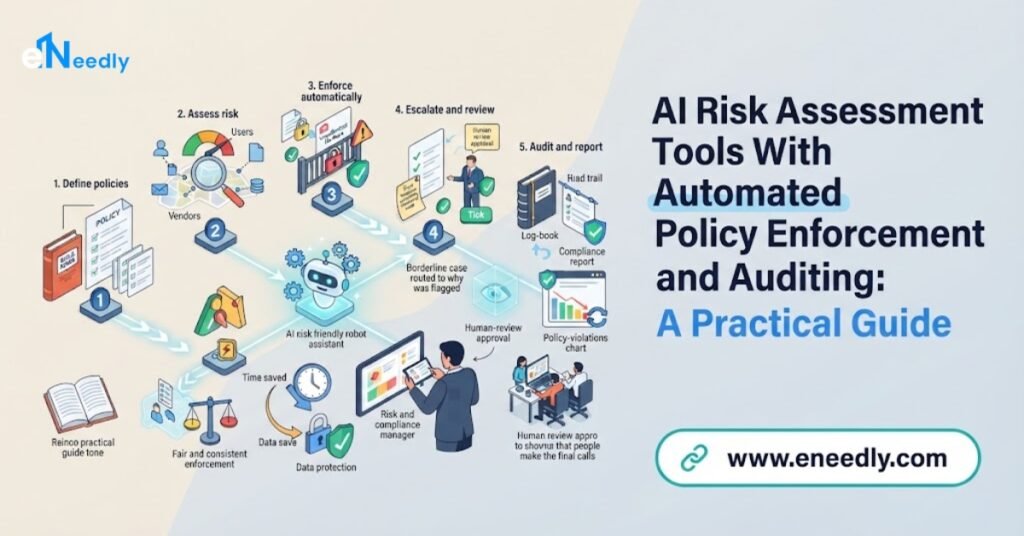
AI risk assessment tools with automated policy enforcement and auditing find and score risks, check everyday actions against your company rules, act when a rule is broken, and record every step automatically.
This replaces scattered spreadsheets and last-minute evidence gathering with one connected, audit-ready process. eNeedly designs and build these solutions around your own policies and systems, with your people always in control of the important decisions.
Most businesses already have risk policies. They have rules about who can approve spending, who can see sensitive data, how vendors are checked, and how new tools are used. The problem is not usually the rules. It is making sure they are followed every day, and being able to prove it.
That is why many teams are now looking at AI risk assessment tools with automated policy enforcement and auditing.
Instead of hoping people follow the rules and then checking months later, the system checks as work happens and keeps the evidence for you. In this guide, we explain how these tools work, what to look for, and how eNeedly can help you build the right solution.
What Are AI Risk Assessment Tools?
AI risk assessment tools are systems that help you find, measure, and track the risks your business faces. They look at information from your systems and processes, spot patterns that point to trouble, and rank risks so you know where to focus.
A manual risk review depends on people reading reports, filling in spreadsheets, and meeting a few times a year.
AI makes this faster and more consistent. It can read large amounts of information quickly, notice unusual activity, and keep the picture up to date instead of showing only a snapshot in time.
A good tool can:
- Collect information from your systems, documents, and teams.
- Spot risks such as unusual transactions, risky access, or missing approvals.
- Score and rank each risk by how likely and how serious it is.
- Explain the reasons behind each score in plain language.
- Track changes so you see whether risk is rising or falling.
The goal is not to remove people from risk management. It is to give them a clear, current view of what needs attention.
What Does Automated Policy Enforcement Mean?
A policy is a written rule, such as no payment above a certain amount without a second approval. Enforcement means making sure that rule is actually followed.
In many companies, enforcement is manual. Someone reads the policy, trusts that staff will follow it, and checks a sample later. Mistakes and shortcuts are often found only after the damage is done.
Automated policy enforcement builds the rules into the work itself. When someone takes an action, the system checks it against the policy right away and responds. Depending on the rule and the risk, it can:
- Allow the action because it follows the rules.
- Flag the action so a person can look at it.
- Route the action for approval before it goes ahead.
- Block the action when it clearly breaks a rule.
- Record the decision and the reason.
This turns policies from documents that sit in a folder into rules that work every day.
How Does Automated Auditing Work?
An audit asks a simple question: can you prove that you did what you said you would do? Most of the pain in audits comes from gathering that proof by hand, long after events happened.
Automated auditing solves this by recording evidence as work happens. Every check, approval, exception, and decision is saved with details such as who did it, when, and why. This creates an audit trail that is complete, organized, and ready to show.
With automated auditing you can:
- See a full history of any action or decision at any time.
- Show proof that a rule was checked and followed.
- Find exceptions and see how they were handled.
- Produce reports for auditors, managers, and regulators in minutes.
- Spot patterns in repeated problems.
Instead of a stressful scramble before each audit, the evidence is already there.
Why Do Businesses Need Risk Assessment, Policy Enforcement, and Auditing Together?
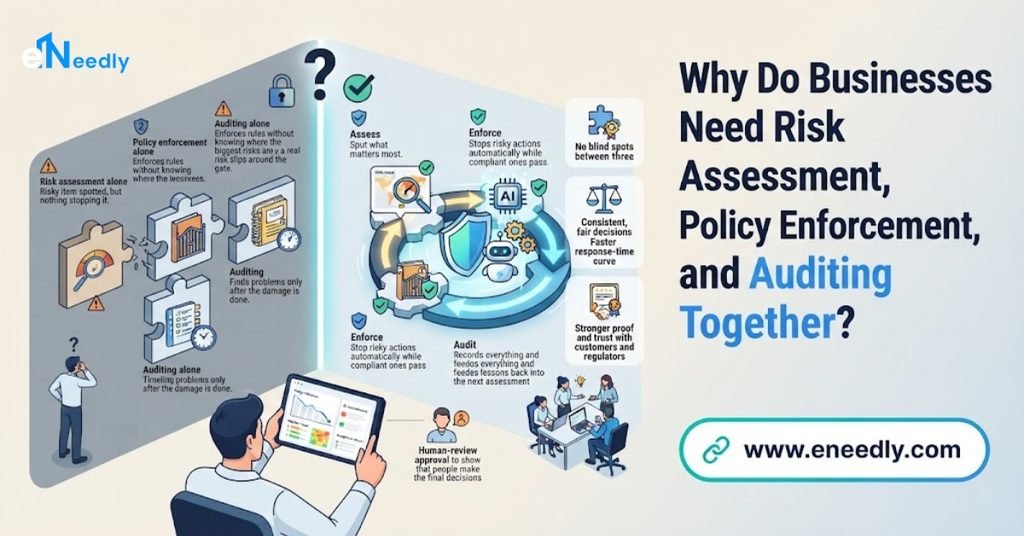
These three activities are often handled in separate places, by separate teams, with separate tools. This creates gaps. Risks are found but not turned into rules. Rules are written but not enforced. Enforcement happens but is not recorded.
When they work together, they form a loop:
Assess: The system finds and scores risks.
Set rules: The biggest risks lead to clear policies.
Enforce: The rules are checked automatically as work happens.
Audit: Every check and decision is recorded.
Improve: The records show where rules work, where they fail, and where new risks are appearing.
This loop keeps your risk picture current and your rules effective. It also saves time, because the same information supports all three tasks instead of being collected again and again.
How Do AI Risk Assessment Tools With Automated Policy Enforcement Work?
A strong solution follows a clear flow from data to proof.
Connect your data. The tool links to the systems where risky activity happens, such as finance, access, vendor, and document systems.
Define your policies. Your rules are turned into clear, checkable conditions, such as limits, required approvals, and allowed uses.
Assess risk. AI scores activities, users, and items by risk, using your own criteria and patterns it finds in the data.
Check against policy. As actions happen, the system compares them with your rules.
Take action. It allows, flags, routes, or blocks each action, depending on how you set the rules.
Involve people. Flagged items go to the right reviewer with the reasons clearly shown.
Log everything. Every step, decision, and exception is stored.
Report and improve. Dashboards and reports show results and highlight where rules need to change.
The important point is that people stay in charge of decisions that need judgment. The system handles the checking, routing, and record keeping.
Which Risks and Policies Can Be Automated?
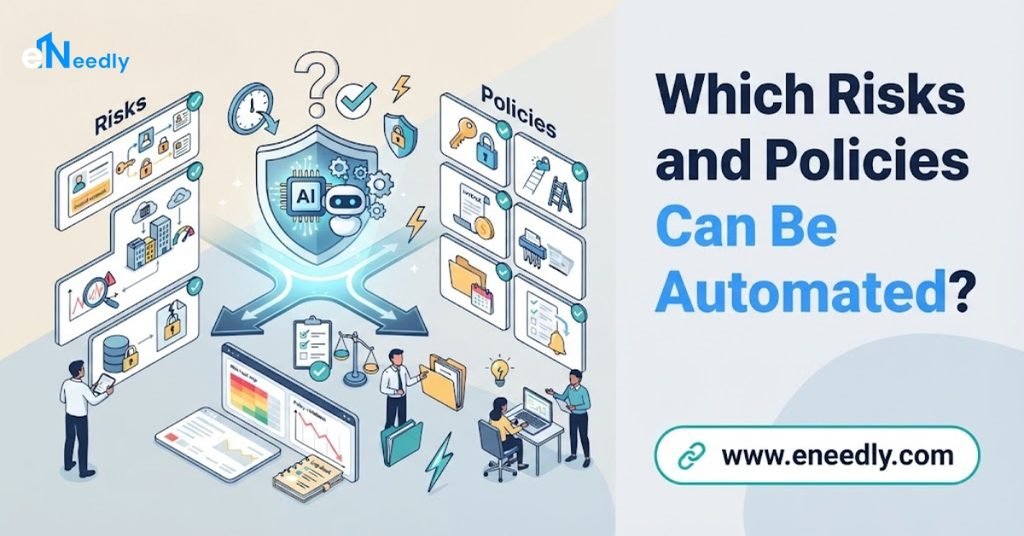
More than most teams expect. If a rule can be described clearly, the system can usually help check it. Common examples include:
- Access rights: Making sure people only have the access they need, and that it is removed when roles change.
- Approval limits: Requiring the right approval for spending, discounts, or contracts above set amounts.
- Data handling: Checking that sensitive information is shared and stored only in approved ways.
- Vendor checks: Confirming that vendors are reviewed and approved before they are used.
- Expense and spending controls: Flagging unusual claims, duplicate payments, or missing receipts.
- Separation of duties: Preventing one person from both creating and approving the same transaction.
- AI and tool usage rules: Checking that staff use only approved tools and follow your guidelines.
- Document and record rules: Making sure required documents are present, complete, and kept for the right time.
- Deadlines and reviews: Tracking that reviews and tasks happen on schedule.
At eNeedly, we start with the policies that carry the highest risk or cause the most manual checking, then expand from there.
What Should You Look for in These Tools?
There is no single best tool for every business. The right choice is the one that fits your policies, systems, and team. Use this checklist to judge any solution.
- Clear, flexible rules: You should be able to write and change policies in your own terms, without needing a developer for every change.
- Explainable risk scores: Every score should come with reasons that people can understand.
- Different enforcement levels: You should be able to choose whether a rule allows, flags, routes, or blocks.
- Complete audit logs: Every action and decision should be recorded in a way that cannot be quietly changed.
- Easy reporting: You should be able to show the full history to an auditor quickly.
- Fit with your systems: It should connect to the tools you already use.
- Easy review screens: Reviewers should be able to see what happened and decide in a few clicks.
- Security: The tool holds sensitive information, so access control and data protection must be strong.
- Room to grow: You should be able to add new rules, systems, and teams over time.
- Ongoing support: Rules and risks change, so help should not end at launch.
If a solution cannot meet most of these points, keep looking.
How Do You Keep Humans in Control?
Automation should support your people, not replace their judgment. The best setups make it easy for humans to stay in charge where it counts.
Here is how:
- Match enforcement to risk. Low-risk rules can be fully automatic. High-risk rules should route to a person for approval.
- Create clear exception paths. Real life is messy, so people need a simple, recorded way to approve a justified exception.
- Name owners. Every policy and every risk area should have a responsible person.
- Show the reasons. Reviewers should always see why something was flagged.
- Allow overrides with a record. A person can override a decision, but the override and the reason are logged.
- Review the rules regularly. People should check that rules still make sense and update them.
This balance keeps the process fast without making it blind.
How Does Automation Make You Audit-Ready?
Being audit-ready is not about a big push before the audit. It is about working in a way that creates proof every day. Automation makes that natural.
- Continuous records: Evidence is saved as work happens, so nothing needs to be reconstructed.
- Proof of enforcement: You can show not only that you have a policy, but that it was checked and applied.
- Clear handling of exceptions: Every exception has an owner, a reason, and a decision.
- Quick reports: Auditors can see what they need without weeks of preparation.
- Fewer gaps: Automatic checks catch problems early, before they become audit findings.
- Less stress: Your team spends less time gathering evidence and more time improving the business.
When an auditor asks for proof, you can show an organized, complete trail instead of searching through emails and spreadsheets.
What Are the Risks and Limits of Automated Enforcement?
Automation is powerful, but it is not perfect. Knowing the limits helps you plan well.
- Wrong flags: AI may flag normal activity or miss something unusual. Good tuning reduces this over time.
- Rules that are too strict: If rules block legitimate work, people will look for ways around them.
- Rules that are too loose: If rules are vague, risky actions can slip through.
- Poor or missing data: The system can only check what it can see. Gaps in data lead to gaps in protection.
- Over-reliance: A dashboard that looks calm does not mean all risk is gone. Regular review still matters.
- Change fatigue: Teams need clear communication and simple screens, or they will resist the new process.
- Security of the tool itself: A system that holds so much sensitive information must be protected carefully.
A well-designed solution begins with a small set of important rules, tests them carefully, keeps humans in the loop for high-risk decisions, and reviews the rules on a regular schedule. eNeedly builds all of these in from the start.
Should You Buy Off-the-Shelf or Build a Custom Solution?
This is a key decision. Ready-made options can be a good starting point for simple needs. But as your business grows, they often show their limits.
A ready-made option works best when:
- Your policies are common and standard.
- You use a small number of common systems.
- You do not need special approval flows or reports.
A custom solution works best when:
- You have your own policies, thresholds, and approval steps.
- You need rules to work across many different or in-house systems.
- You need reports that match your auditors’ exact needs.
- You want enforcement to happen inside the tools your team already uses.
- You want one connected process instead of several separate tools.
Many businesses find that a tailored setup saves more time in the long run, because it fits their process instead of forcing the process to fit the tool. eNeedly can help you decide which path makes sense, and we will tell you honestly if a simple option is enough.
Why Choose eNeedly for Risk and Policy Automation
eNeedly is a digital solutions agency. We do not push a one-size-fits-all product. We study how your business manages risk today and build a solution around your policies, your systems, and your goals.
Here is what you can expect when you work with us:
- Plain language: We explain everything clearly, even if you are not technical.
- Business-first thinking: We start with your goals, such as fewer surprises and easier audits, and work backward.
- Tailored solutions: Your system is built around your rules and your process, not a generic template.
- Honest advice: If a rule is not worth automating, we will tell you.
- Security and control: Your people stay in charge of important decisions, and your data is handled with great care.
- Long-term partnership: We stay with you after launch to improve and expand what we build.
Our aim is simple: make your policies work every day, and make proving it easy.
Our Risk Assessment, Enforcement, and Auditing Services
eNeedly offers services that cover the full journey from risk to proof, so you can start where it makes the most sense.
- Risk assessment setup: We build checks that find and score the risks that matter most to your business.
- Policy rule design: We turn your written policies into clear, checkable rules.
- Automated enforcement: We set up the system to allow, flag, route, or block actions according to your rules.
- Approval workflows: We create simple review and approval steps for high-risk items and exceptions.
- Audit logging: We record every check, decision, and exception in a complete, organized trail.
- Dashboards: We give you a clear view of risks, rule results, and open items.
- Audit-ready reporting: We create reports that show exactly what was checked and decided.
- System connections: We link the solution to the tools and data your team already uses.
- Training and support: We help your team use and improve the system over time.
- Custom solutions: If your process is unique, we design something that fits it exactly.
Each service is built to solve a specific problem, and we only recommend what fits your business.
Our Step-by-Step Implementation Process
Our process is simple, transparent, and built to keep you informed.
Discovery call: We learn about your business, your policies, and how risk and audits are handled today.
Opportunity map: We list the rules and checks that can be automated and rank them by impact and effort.
Plan and quote: You receive a clear plan, timeline, and price before any work begins.
Build: We create your solution and connect it to your systems.
Testing: We test it on real examples and set review points for your team.
Launch and training: We go live and show your team how everything works.
Support and improvement: We monitor results, tune the rules, and suggest new ways to reduce risk and save time.
You are involved at every stage, and nothing goes live without your approval.
Get Started With eNeedly Today
Starting is easier than most people think. You do not need technical knowledge, a long brief, or a perfect plan. You only need to tell us which policies are hardest to enforce and which audits cause the most stress.
In a free consultation, we will listen to how your team works, point out where automation can help most, and explain what a first project could look like. There is no pressure and no obligation.
Ready to make your policies work every day and your audits easy? Book your free consultation with eNeedly today and see what AI risk assessment with automated policy enforcement and auditing can do for your business.
Frequently Asked Questions
What are AI risk assessment tools?
AI risk assessment tools are systems that use AI to find, score, and track risks in your business. They read information from your systems, spot unusual patterns, rank risks by importance, and explain their reasons, so your team knows where to focus.
What is automated policy enforcement?
Automated policy enforcement means building your company rules into daily work, so the system checks actions against policy as they happen. Depending on the rule, it can allow the action, flag it, send it for approval, or block it, and it records what happened.
How does automated auditing help with compliance?
It records every check, approval, exception, and decision as work happens, so you have a complete trail ready at any time. This makes it far easier to show auditors and regulators exactly what was done, and it reduces the effort of gathering evidence by hand.
Can AI enforce policies without human approval?
It can form clear, low-risk rules, such as checking that a required field is complete. For high-risk or unusual cases, it is wise to route the decision to a person. eNeedly helps you set the right level of automation for each rule.
How accurate are AI risk assessments?
They can be fast and consistent, but no system is perfect. Accuracy depends on data quality, careful setup, and regular tuning. That is why a good solution explains its scores, flags uncertain items for review, and keeps people responsible for important decisions.
How much do these tools cost?
The cost depends on the number of policies, the systems to be connected, the level of reporting you need, and how much ongoing support you want. Starting with a few high-impact rules keeps the investment manageable. eNeedly provides a clear plan and quote after your free consultation.
Can the solution connect to my existing systems?
In most cases, yes. A well-built solution is designed to connect with the tools you already use, so your team does not have to learn an entirely new environment. We review your current setup during discovery and plan the connections before any work begins.
How long does it take to set up automated policy enforcement and auditing?
A focused first project covering a few key policies can often be ready in a matter of weeks. Larger projects with many rules and systems are best delivered in phases, so you see benefits early and keep gaining more as each part goes live.