
Quick Answer
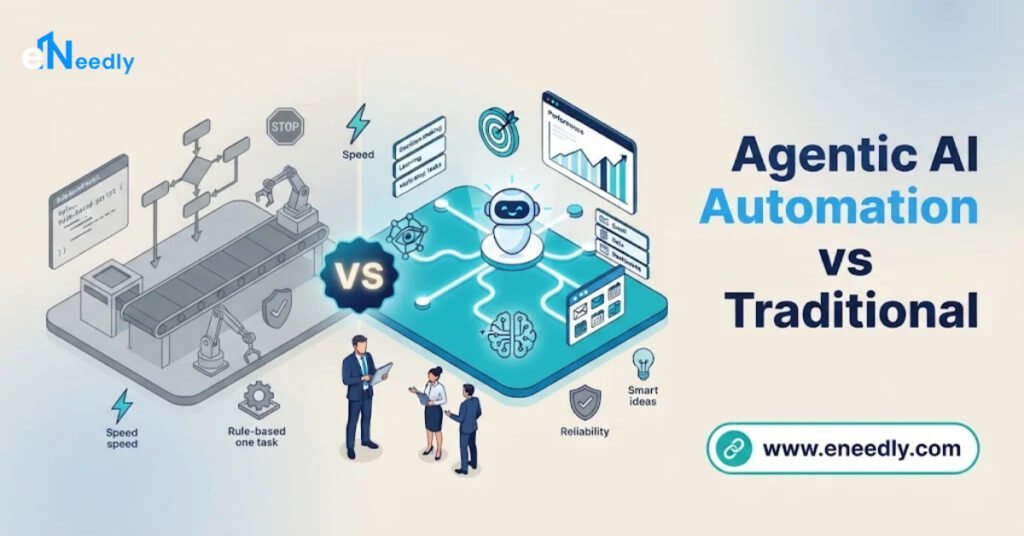
Agentic AI automation works differently from traditional automation, which follows fixed rules that you set in advance, so it repeats the same steps every time. Agentic AI is given a goal and decides for itself which steps to take, adapting when things change.
eNeedly helps businesses use both, so you get the reliability of rules where you need it and the flexibility of AI where it pays off.
Many business owners hear the terms agentic AI automation and traditional automation used as if they mean the same thing.
They do not. Choosing the wrong one can waste money, create frustration, and leave your team doing work that a smarter system could handle.
So, how does agentic AI automation differ from traditional automation? In short, one follows instructions and the other pursues a goal. In this guide, we explain both approaches in plain language, show where each one works best, and explain how eNeedly can help you pick and build the right solution.
What Is Traditional Automation?
Traditional automation is a system that completes tasks by following rules you write in advance. Think of it as a very reliable checklist that runs by itself.
A simple example: when a customer fills in a contact form, the system sends a confirmation email, adds the customer to a list, and alerts your sales team. Every step is planned. Every condition is defined. If the input looks the way you expected, the result is perfect.
Traditional automation has clear strengths:
- Speed: Tasks finish in seconds.
- Consistency: The same input always produces the same output.
- Low running cost: Once built, it runs with little effort.
- Easy to audit: You can see exactly which rule caused which action.
Its weakness is that it only knows what you taught it. If something unexpected happens, it usually stops, skips a step, or makes a mistake.
What Is Agentic AI Automation?
Agentic AI is a type of artificial intelligence that works toward a goal instead of following a fixed script. You tell it what you want to achieve, and it plans the steps, chooses what to do next, and adjusts based on what it finds.
For example, instead of programming every step of lead handling, you might say: qualify this inquiry and book a call if the person is a good fit. The AI can then read the message, gather helpful context, write a personal reply, respond to the person’s answer, and suggest a meeting time.
An agentic system usually has four abilities:
- Understanding: It can read messy, free-form information such as emails and documents.
- Planning: It breaks a goal into smaller steps.
- Acting: It uses the tools and systems you give it access to.
- Adjusting: It checks results and changes course if something does not work.
This makes it far more flexible than a rule-based workflow, especially for work that is not neat and predictable.
How Does Agentic AI Automation Differ From Traditional Automation?
The core difference is how decisions are made. Traditional automation follows your instructions. Agentic AI follows your goal. Here is a side-by-side view of what that means in practice.
- Decision-making: Traditional automation applies predefined if-this-then-that rules. Agentic AI decides which action fits the situation, within limits you set.
- Flexibility: Traditional automation handles only the cases you planned for. Agentic AI can deal with new or unusual cases.
- Type of input: Traditional automation works best with structured data, such as form fields and numbers. Agentic AI can also work with natural language, long documents, and mixed information.
- Handling errors: Traditional automation often stops or fails when a step breaks. Agentic AI can retry, try another route, or ask a person for help.
- Predictability: Traditional automation behaves the same way every time. Agentic AI is more adaptable, but its path can vary, so it needs clear boundaries.
- Setup effort: Traditional automation requires every step to be mapped out. Agentic AI requires clear goals, rules about what it may and may not do, and good access to the right information.
- Best fit: Traditional automation suits stable, repetitive work. Agentic AI suits work that needs judgment and changes from case to case.
A simple way to remember it: traditional automation is like a train on a track, and agentic AI is like a skilled driver with a destination. The train is fast and reliable on its route. The driver can handle detours.

How Does Each Approach Handle Change?
Businesses change all the time. Prices shift, customers ask new questions, and processes get updated. How a system copes with change is one of the biggest practical differences.
With traditional automation, every change means a person must update the rules. If a customer writes something the workflow did not expect, it may fail quietly. Over time, rule-based systems can grow complicated and hard to maintain.
Agentic AI is better at absorbing small changes by itself. If an email is worded differently, or a document has an unusual layout, it can still understand the meaning and respond sensibly. It does not need a new rule for every variation.
That said, large changes still need human direction. If your business model, policies, or goals shift, the agent needs updated instructions and limits. At eNeedly, we build both types of systems so that updates are simple and clearly documented.
When Is Traditional Automation the Better Choice?
Agentic AI is exciting, but it is not always the right tool. Traditional automation remains the best option when you need exact, repeatable results.
Choose rule-based automation for tasks like these:
- Invoicing and payment reminders: The steps are fixed, and mistakes are costly.
- Data syncing between systems: The same fields must move the same way every time.
- Scheduled reports: The format and timing never change.
- Order confirmations and notifications: The message and trigger are clear.
- Compliance steps: You need a clear record of exactly what happened and why.
In these cases, predictability is more valuable than flexibility. Using a more complex tool would add cost and risk without adding value.
When Should You Choose Agentic AI Automation?
Agentic AI is the better fit when the work involves judgment, varied information, or several steps that depend on what happens along the way.
Good examples include:
- Customer support: Questions come in many forms, and answers often need context.
- Lead qualification: Each enquiry is different and needs a personal, informed response.
- Research and summaries: The system gathers information, compares it, and reports back.
- Document handling: Contracts, forms, and messages arrive in different layouts and need to be understood.
- Multi-step requests: Tasks that involve checking several sources before deciding what to do next.
If your team spends hours reading, sorting, and deciding before the real work even begins, agentic AI can take a large share of that load.
Can Agentic AI and Traditional Automation Work Together?
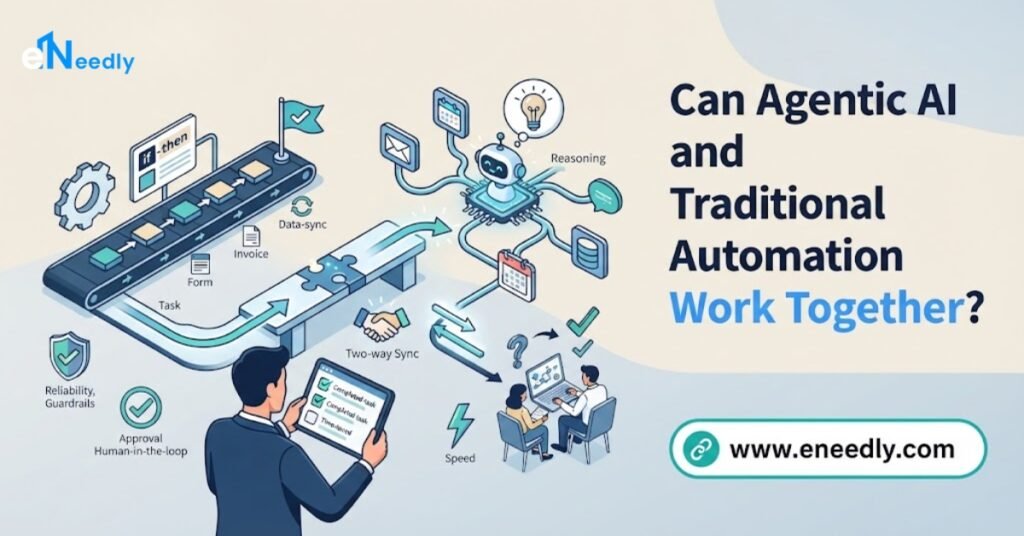
Yes, and this is often the smartest approach. The two are partners, not rivals.
A strong setup uses each one for what it does best:
- Rules for the predictable parts: Fixed steps like sending notifications, updating records, and creating invoices.
- AI for the flexible parts: Reading messages, making sense of documents, and deciding the next step.
- People for the important decisions: Approvals, exceptions, and anything with high stakes.
For example, an agent can read a customer request and work out what the customer needs. A rule-based workflow then handles the exact steps of creating the order and sending confirmation. A person approves anything unusual. The result is fast, reliable, and safe.
What Are the Risks of Agentic AI?
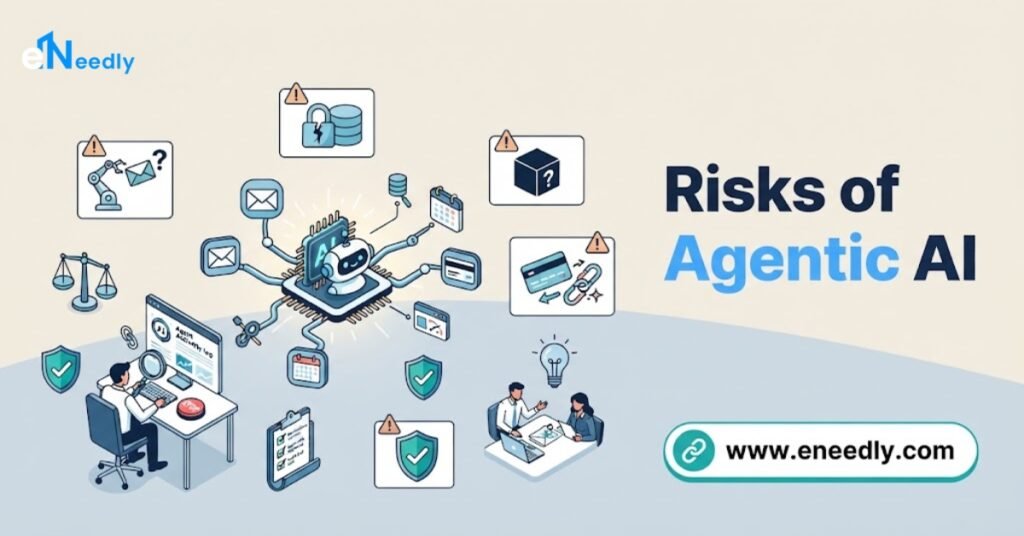
Because agentic AI makes its own choices, it needs more care than a simple rule-based workflow. The main risks are easy to manage when you plan for them.
- Unexpected actions: An agent might take a step you did not intend if its limits are unclear.
- Mistakes in understanding: AI can misread a message or document, so important outputs should be checked.
- Data exposure: The agent should only access the information it truly needs.
- Lack of oversight: Without monitoring, small problems can go unnoticed.
The solution is good design. Set clear limits on what the agent can do, keep a person in the loop for sensitive actions, record what the system does, and review results regularly. eNeedly builds these safeguards in from the start.
How Do You Choose the Right Approach for Your Business
You do not need to be technical to decide. Ask yourself a few simple questions about each task:
Is the task the same every time? If yes, traditional automation is usually enough.
Does it involve reading or understanding messy information? If yes, consider agentic AI.
How costly is a mistake? The higher the cost, the more you should rely on fixed rules and human approval.
How often does the task change? Frequent change favors the flexibility of agentic AI.
Do you need a full record of every step? If so, rules and clear logs are essential.
If you are unsure, that is normal. Most businesses have a mix of both kinds of tasks. A short conversation with a specialist can save you months of trial and error.
Why Choose eNeedly for Agentic AI and Automation
eNeedly is a digital solutions agency. We do not push one tool or one trend. We look at your business, your goals, and your daily tasks, and then we recommend what actually makes sense.
Here is what you can expect when you work with us:
- Plain language: We explain every option clearly, even if you are not technical.
- Honest advice: If a simple rule-based workflow is enough, we will say so. You will not be sold more than you need.
- Tailored solutions: Your systems are built around your process, not copied from a template.
- Safety first: We set clear limits, keep people in control, and protect your data.
- Long-term partnership: We stay with you after launch to improve and extend what we build.
Our aim is simple: make your work easier and your growth smoother.
Our Agentic AI Automation Services
eNeedly offers services that cover both approaches, so you always have the right tool for the job.
- Workflow automation: We connect your tools so that routine tasks move forward on their own.
- AI agents for customer replies: We build agents that understand questions, find answers, and pass complex cases to your team.
- Lead capture and qualification: We make sure every enquiry gets a fast, relevant response and a clear next step.
- Document and data processing: We reduce manual work by reading, sorting, and storing information automatically.
- Automated reporting: We deliver clear, up-to-date numbers without the weekly scramble.
- Custom solutions: If your need is unique, we design something that fits it exactly.
Each service is built to solve a specific problem, and we only recommend what fits your situation.
Our Step-by-Step Process
Our process is simple, transparent, and built to keep you informed.
Discovery call: We learn about your business, your team, and the tasks that slow you down.
Opportunity map: We list the tasks that can be improved and decide which need rules, which need AI, and which need both.
Plan and quote: You receive a clear plan, timeline, and price before any work begins.
Build: We create your systems and connect them to your existing tools.
Testing: We test every workflow and agent with real scenarios and set safety limits.
Launch and training: We go live and show your team how everything works.
Support and improvement: We monitor results, fix issues, and suggest new ways to save time.
You are involved at every stage, and nothing goes live without your approval.
Results You Can Expect From eNeedly
Every business is different, but the goals are consistent. When we work with you, we aim for results like these:
- Time saved: Hours of repetitive work returned to your team every week.
- Fewer errors: Consistent processes that do not forget steps or mistype data.
- Faster responses: Customers and leads hear from you in moments, not days.
- Better use of your team: People focus on work that needs human skill and care.
- Easier growth: Systems that handle more volume without extra effort.
- Lower operating costs: More output from the same team.
We agree on clear goals at the start, so you know exactly how to measure success.
Get Started With eNeedly Today
Starting is easier than most people think. You do not need technical knowledge, a long brief, or a perfect plan. You only need to tell us what is taking up too much of your time.
In a free consultation, we will listen to how your business works, show you where traditional automation, agentic AI, or a mix of both can help most, and explain what a first project could look like. There is no pressure and no obligation.
Not sure which approach fits your business? Book your free consultation with eNeedly today and get a clear, honest answer.
Frequently Asked Questions
What is the main difference between agentic AI and traditional automation?
Traditional automation follows fixed rules you define in advance and repeats the same steps every time. Agentic AI is given a goal and decides which steps to take, adapting to new situations as they appear. One follows instructions, and the other pursues an outcome.
Is agentic AI better than traditional automation?
Not always. Traditional automation is better for stable, repetitive tasks where exact results matter, such as invoicing and data syncing. Agentic AI is better for tasks that involve judgment and varied information. Many businesses get the best results by using both together.
Is agentic AI more expensive than traditional automation?
It can cost more to design and monitor, because it needs clear limits and ongoing review. However, it can also take on work that rule-based systems cannot, which may save more time. eNeedly gives you a clear quote after a free consultation, so you can compare cost and value before you decide.
Can agentic AI replace my employees?
No. Agentic AI takes over repetitive and time-consuming tasks, but people are still needed for decisions, relationships, creativity, and oversight. Most businesses find that their team becomes more productive and spends more time on valuable work.
Is agentic AI safe to use in my business?
It can be, when it is designed with care. Safe setups limit what the agent can access and do, keep people involved in important decisions, and record every action. eNeedly builds these safeguards into every project and explain them clearly.
Do I need technical knowledge to use agentic AI or automation?
No. You only need to describe your daily tasks and your goals. We handle the technical side, explain everything in plain language, and train your team so they feel confident using the new systems.
How do I know which type of automation my business needs?
Start by looking at the task. If it is the same every time, rules are usually enough. If it involves reading messy information or making judgment calls, agentic AI may help. A free consultation with eNeedly can quickly show you the best fit for each task.